

Fighting cancer in a space lab
A new experimental laboratory developed by the Israeli company SpacePharma launched last weekend to the International Space Station aboard a SpaceX Dragon cargo spacecraft, carrying biological experiments from European research groups.
The experiments are being conducted in miniaturized labs developed by the company, which are designed for a wide range of biological and chemical studies under microgravity conditions. The labs operate autonomously, and when needed, company scientists can control the processes from the ground once the shoebox-sized lab is connected to the power and communications infrastructure on the space station or another spacecraft.
Gallery
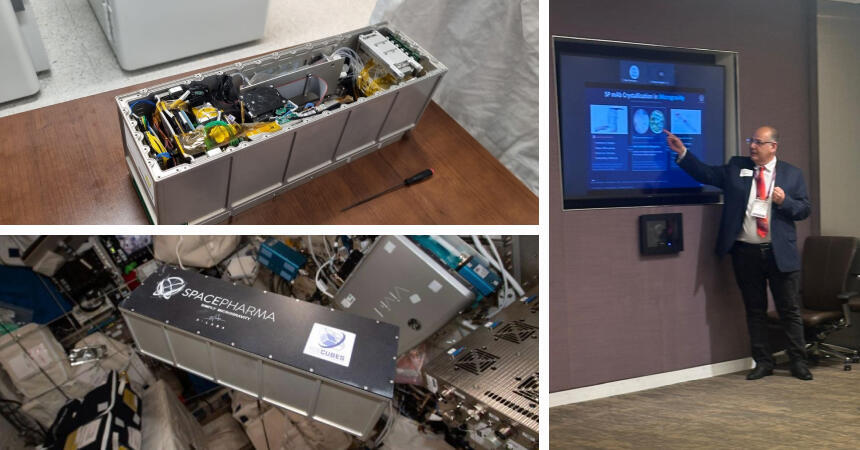
For the first time, SpacePharma has two active laboratories on the space station. Shown here: the lab that launched last weekend, the lab already operating on the station, and Yossi Yamin speaking at an NIH conference
(Photo: Courtesy of SpacePharma)
One experiment uses chips containing brain-tissue organoids: tiny tissue structures that mimic many of the features and functions of a full organ. In this case, the organoids were created from tissue samples taken from patients with brain cancer. Researchers hope that growing them in microgravity will help expose biomarkers for these cancers — proteins produced only by the cancer cells.Under microgravity conditions, those proteins may move more easily to the outer layers of the organoid, where they can be detected using a biological staining method developed by researchers at a hospital in Grenoble, France. The Grenoble team is leading the experiment with funding from the European Space Agency, ESA.
“Developing this method could improve the diagnosis of these types of cancer. The researchers are creating a kind of biomarker atlas, which could make it possible to identify the type of tumor already during the biopsy procedure and deliver the appropriate treatment directly to the brain, without the need for another operation,” Yossi Yamin, founder and CEO of SpacePharma Israel, told the Davidson Institute website.
A second SpacePharma experiment is also focused on cancer treatment. Researchers led by scientists from Roche Pharmaceuticals and Harvard University are working to grow lung-cell tissue equipped with sensors for lung cancer, as well as the ability to release anti-cancer substances in a controlled way. Growing the tissue in microgravity allows the researchers to create three-dimensional tissue that, they hope, could one day be implanted in patients. This experiment is also funded by the European Space Agency.
SpacePharma’s new lab launched to the International Space Station as part of a SpaceX resupply mission. It has now joined another of the company’s labs, which was launched a month ago on a Northrop Grumman resupply mission. That lab is hosting an experiment led by Prof. Gil Atzmon of the University of Haifa’s School of Medicine, aimed at identifying genes linked to longevity. Certain genes are expressed more strongly under microgravity conditions, and the researchers are growing white blood cells from people over the age of 100 in the lab, hoping to identify the proteins and genes that are especially active in these individuals.
The launch was SpacePharma’s 14th mission to space and its third in the past ten months. It also marks the first time the company has had two active laboratories in space at the same time.
Two weeks ago, Yamin was invited to present SpacePharma’s work to senior officials at the U.S. National Institutes of Health (NIH), alongside other companies developing medical technologies. “I presented our work on producing monoclonal antibodies — identical antibodies — and organoids in space. If all goes well, perhaps the NIH will support us in future clinical trials based on our space-manufacturing technology,” he said.
From the classroom to space
The same SpaceX Dragon spacecraft that carried SpacePharma’s lab to the International Space Station also brought experiments developed by Israeli school students. The students won last year’s Ramon Foundation space-education competition. One experiment, from Dekel-Vilnai School in Ma’ale Adumim, examines how microgravity affects the activity of hyaluronidase, an enzyme that breaks down hyaluronic acid. Another, from Psagot School in Yehud, studies how microgravity affects the antimicrobial activity of the protein S100A7 and its role in food preservation. A third experiment, from Ilan Ramon School in Kfar Saba, looks at how microgravity affects interactions between bacteria.
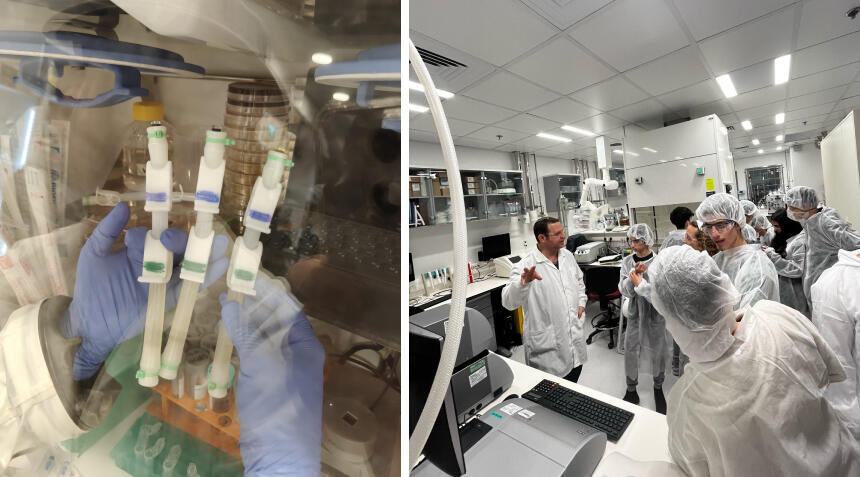
A direct continuation of Ilan Ramon’s legacy. The three test tubes containing the Israeli student experiments (left), and one of the student groups preparing the experiments for delivery ahead of launch
(Photo: Ramon Foundation)
Each experiment is housed in a long test tube-like container with internal partitions. Breaking one partition brings the materials together and activates the experiment; breaking another adds a fixative, preserving the sample so the results can be examined on Earth after the tubes return from space. The Ramon Foundation funds the development of the experiments, their launch, and their operation on the station, with support from Rakia Mission, which works with the company responsible for the launch.
“To me, the launch of the student experiments from the Ramon SpaceLab program captures exactly why we do what we do,” Gil Doron, CEO of the Ramon Foundation, told the Davidson Institute website. “When teenagers realize that an idea of theirs can leave the classroom and reach space, something profound changes in them. Science stops being theoretical and becomes alive, real, and meaningful. They are not just learning about research; they become researchers. They are not just hearing about innovation; they are creating it.”
Last week, the Ramon Foundation announced the winners of this year’s experiment competition. Rimon School in Ra’anana developed an experiment examining how microgravity affects external blood clotting; Ilan Ramon School in Kfar Saba developed an experiment on how microgravity affects the spatial structure and organization of amyloid-beta aggregation; and AMIT Be’er Ami School in Be’er Tuvia developed an experiment examining how microgravity affects the size of casein micelles – tiny clusters of milk proteins – and calcium concentrations in casein proteins. The three experiments are expected to be sent to space in the coming months, in a format similar to those launched last week.
“The power of programs like these lies not only in the experiment itself, but in the confidence they build. A student who develops an experiment for the space station begins to believe they can become a scientist. A student who builds a solution to a real problem begins to see themselves as an engineer, entrepreneur, or leader. That is the real impact of access to space: it broadens horizons and encourages teenagers to dream big, while also showing them that they have the ability to turn those dreams into reality,” Doron added. “We see again and again how encountering the world of space sparks curiosity, creativity, perseverance, and teamwork — some of the most important skills for success. Beyond that, it gives young people a sense of meaning and helps them understand that they can take part in something larger than themselves, make an impact, and contribute. This is also a direct continuation of Ilan Ramon’s legacy: believing in the power of young Israelis to go as far as possible, especially when the sky is not the limit.”
Bringing Israeli space know-how to Africa
The Israeli company Harel Space Agency is working with Israel’s Ministry of Foreign Affairs to establish South Sudan’s first space academy. South Sudan, which gained independence only 15 years ago, is one of the poorest countries in the world.
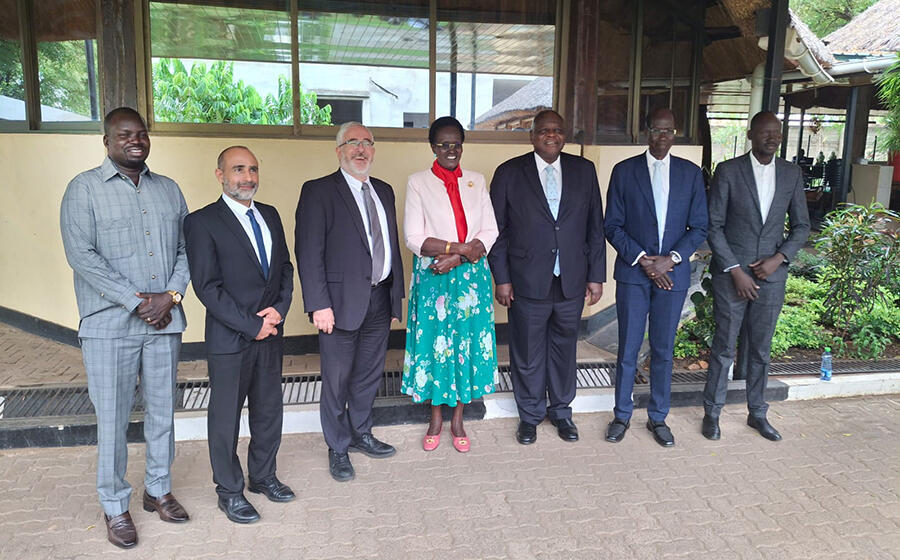
Strengthening Israel’s ties with South Sudan through space science and technology. Ben-Ami (second from left) and Ambassador Kedar (third from left) with South Sudan’s Vice President, Rebecca Nyandeng de Mabior, and other senior South Sudanese officials
(Photo: Courtesy of Harel Space Agency)
“Even in the capital, Juba, there are still mud houses, and some roads are little more than dirt tracks. We are trying to help them develop the ability to use space science for basic needs, such as water management and improving agriculture,” Harel Ben-Ami, the company’s founder and director, told the Davidson Institute.
Ben-Ami is a well-known figure in Israel’s space community. For years, he held several roles in the field, including serving as the Israel Space Agency’s representative to the United Nations. About two years ago, he founded an independent company that provides services “similar to those of a space agency — connecting organizations, encouraging entrepreneurship, and promoting projects such as satellite launches. We work with private organizations, academic institutions, and countries.”
The space academy is being established at the University of Juba, where it will train South Sudan’s first groups of researchers and teachers in space-related fields. “The Ministry of Foreign Affairs and Israel’s ambassador to South Sudan, Gershon Kedar, brought us in to help establish it. We are bringing lecturers from Israel and around the world, have created the first curriculum for training high school teachers in space science, and are trying to teach them how space science can be used to improve life on Earth,” Ben-Ami said. “Our vision is to later establish a nanosatellite laboratory there with Israeli suppliers, and to help South Sudan place its own nanosatellite in space as part of a structured space studies program.”
“Our joint project strengthens ties between Israel and South Sudan through space science and space technologies,” Ben-Ami concluded. “The goal is to promote sustainability, build national resilience, and strengthen local capabilities in agriculture, education, resource management, and scientific innovation in South Sudan. We are already in talks with additional African countries about promoting similar projects.”
A bigger, stronger Starship heads for launch
SpaceX has announced that the 12th test flight of its Starship system is planned for Tuesday, May 19. This will be the first test of the third version of Starship, which includes a slightly larger spacecraft and a slightly larger launch vehicle.
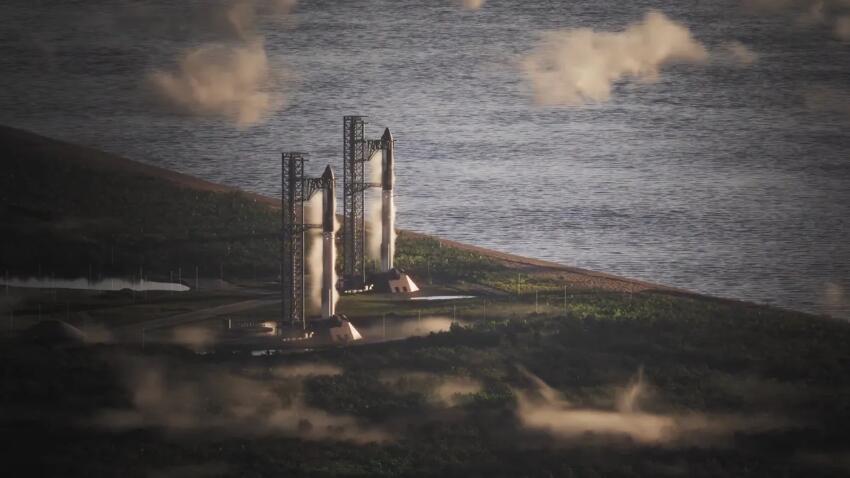
A larger spacecraft, a growing launch network, and plans for a much higher flight rate. Illustration of two Starship systems on launch pads at Cape Canaveral, Florida
(Photo: SpaceX)
The main innovation is new and improved Raptor 3 engines, which are both more powerful and lighter. Additional improvements to the launch vehicle include changes to the structure and placement of the grid fins, changes to the system that feeds fuel to the engines, and improvements to the heat shields. In the spacecraft itself, the propulsion system has been redesigned, the fuel tank has been enlarged, changes have been made to the control system for the steering flaps, and the deployment system intended to place Starlink satellites in space has been improved.
It will be the first test flight of Starship’s third version, which features a slightly larger spacecraft and a slightly larger booster. The most important upgrade is the new Raptor 3 engine, which is both more powerful and lighter than previous models. The booster also includes redesigned grid fins, changes to the engine fuel-feed system, and improved heat shielding. The spacecraft itself has a redesigned propulsion system, a larger fuel tank, updates to the control system for its steering flaps, and an improved deployment system designed to release Starlink satellites into space.
Because this is the first flight of the new model, the mission will largely follow the same profile as previous test flights: a suborbital launch from SpaceX’s Starbase facility in South Texas. After the spacecraft separates from the booster, SpaceX will not attempt to catch the booster with the launch tower. Instead, the booster is expected to perform a landing maneuver over the Gulf of Mexico, not far from the launch site, before falling into the sea. The spacecraft will continue on an arcing trajectory and, if all goes well, reenter the atmosphere over the Indian Ocean. There, it will perform a landing maneuver above the water before splashing down. Before reentry, the spacecraft is also expected to test the deployment of dummy satellites and in-space engine ignitions, while the flight will test all key stages of atmospheric entry.
The planned launch will also mark the debut of SpaceX’s new launch pad at Starbase. The company has completed construction of a second launch pad in Texas, while work continues on three Starship launch pads at Cape Canaveral, Florida. The first Starship launches from Florida could take place as early as this year.
Meanwhile, SpaceX confirmed this week that it is looking into additional Starship launch sites, including locations outside the United States. Responding on X to a rumor that the company planned to buy a large coastal site in Louisiana for a new launch facility, SpaceX wrote: “It’s no secret that we intend to launch Starship a lot, targeting thousands of flights per year. That cadence will require the ability to launch from many different locations, so we are constantly exploring to find viable sites to expand Starship operations in the future, both domestically and internationally.”
China advances on two space fronts
The Chinese company LandSpace successfully launched its fourth Zhuque-2E rocket last Thursday. Like Starship, Zhuque-2E is a two-stage rocket powered by methane and liquid oxygen. It lifted off from the Dongfeng site in northwestern China and, according to the company, successfully placed a 2.8-ton experimental payload into its planned orbit, about 900 kilometers above Earth.
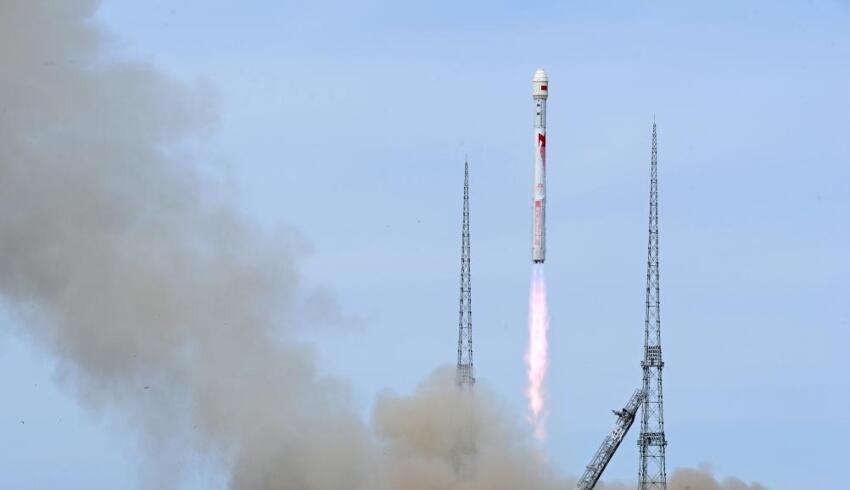
Back on track after a previous failure, and carrying a large payload. The Zhuque-2E rocket launches from Dongfeng this week
(Photo: Wang Jiangbo/Xinhua)
The original Zhuque-2 became the first methane-powered rocket to successfully place a payload in orbit in late 2023. Its upgraded version, Zhuque-2E, entered service in 2024. The rocket’s third launch, in August 2025, ended with a second-stage failure, but last week’s mission put the vehicle back on a successful track.
Earlier last week, China also launched an uncrewed cargo spacecraft to its Tiangong space station. Tianzhou 10 lifted off on a Long March 7 rocket from the Wenchang space launch site and docked with the station about five hours later. It delivered more than six tons of equipment and supplies, including food, water, fuel, scientific experiments, and a new spacesuit for spacewalks. The suit joins two others that were brought to the station on earlier missions. Tianzhou cargo spacecraft are single-use vehicles; after undocking, they are guided back into the atmosphere to burn up.