

More than 80 years after the Trinity test, scientists identify a previously unknown silicon-rich clathrate in red trinitite, the glass formed when the first atomic explosion melted desert sand in New Mexico
At 5:29 a.m. on July 16, 1945, a remote stretch of desert in New Mexico became the site of one of the most consequential moments in human history. American scientists and military officials detonated the world’s first nuclear device in a test code-named Trinity, releasing energy equivalent to about 25,000 tons of TNT.
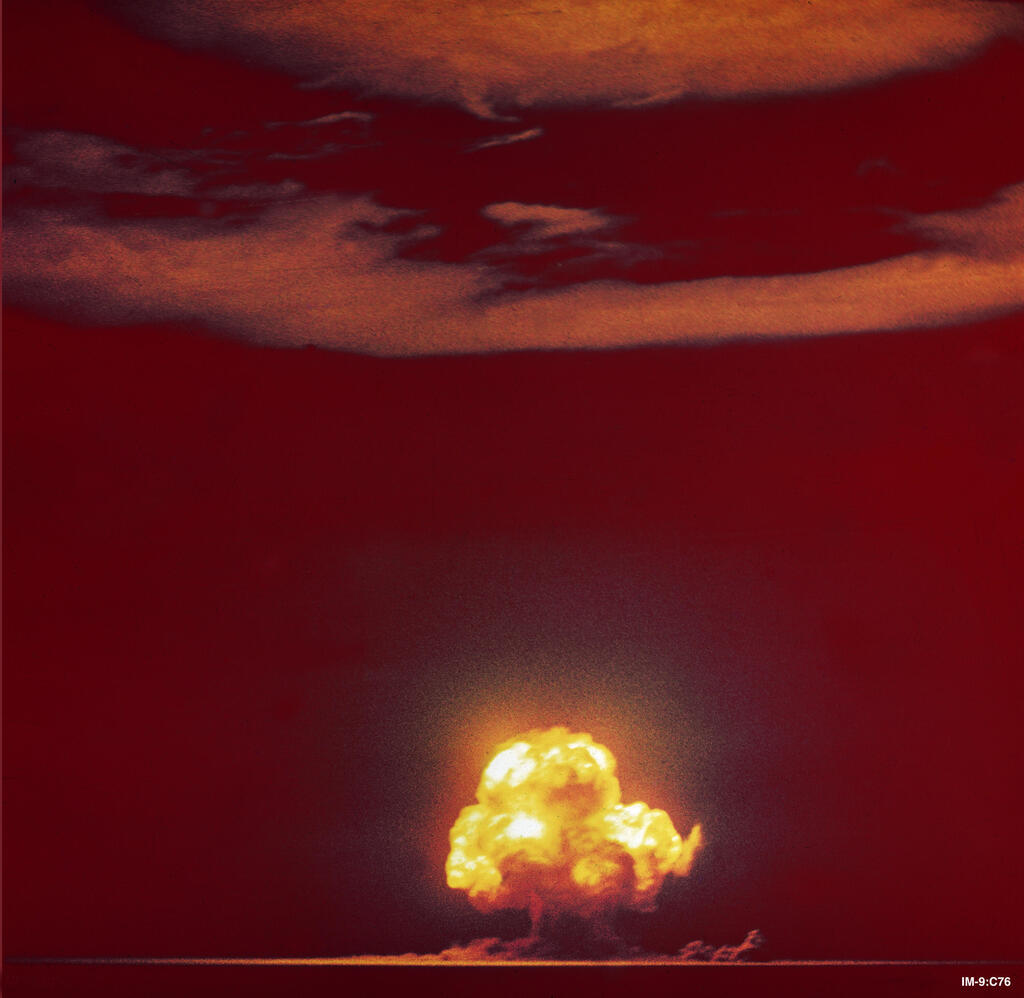
The blast vaporized the steel tower that held the bomb, scorched the surrounding desert and fused sand, metal and other debris into a strange glassy material later known as trinitite. Most of it was a pale green, but some pieces turned red after incorporating copper and other metals from the test tower and nearby equipment.
Now, more than eight decades later, that nuclear glass has revealed another scientific surprise: a previously unknown crystal structure formed under the extreme, fleeting conditions of the atomic blast.
In a study published in the journal Proceedings of the National Academy of Sciences, researchers reported the discovery of a calcium-copper-silicon clathrate inside red trinitite from the Trinity site. It is the first crystallographically confirmed clathrate ever documented among the solid products of a nuclear explosion.
The newly identified phase has the chemical composition (Ca3.3Cu0.4Fe0.3)Σ=4Si23 and was found inside a copper-rich metallic droplet trapped within the red trinitite. Using single-crystal X-ray diffraction and chemical analysis, the researchers determined that it belongs to the type-I clathrate family, a class of cage-like crystal structures in which one framework of atoms encloses others.
Clathrates are unusual because they form atomic “cages.” In this case, silicon atoms created a framework that trapped calcium, copper and a small amount of iron. Such structures are rare in inorganic materials, and this particular calcium-copper-silicon clathrate had never been observed before.
“We wanted to investigate more deeply the products of these extreme formation processes,” said Dr. Luca Bindi, a mineralogist at the University of Florence and one of the study’s authors, in comments to Live Science.
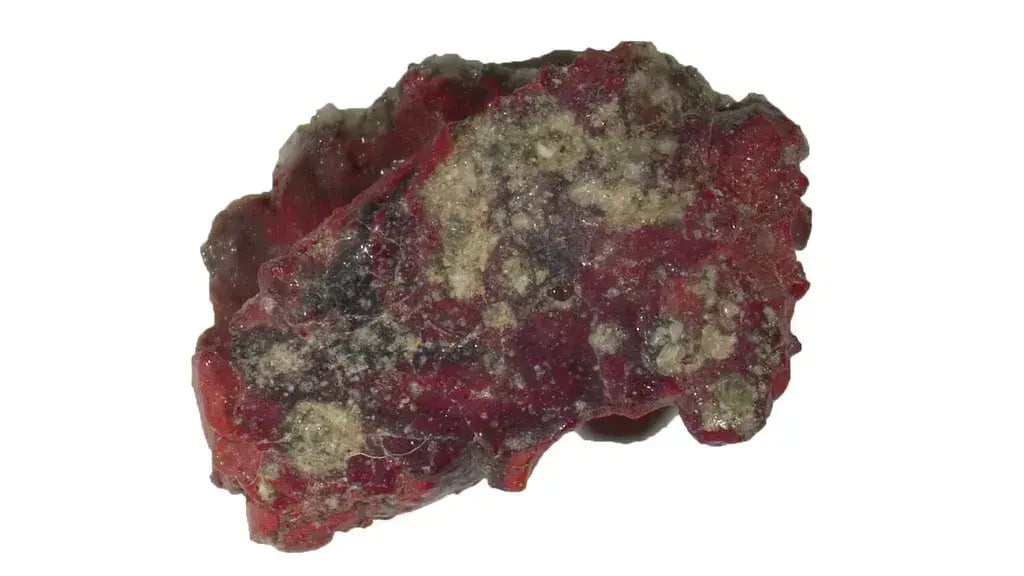
Red trinitite
(Photo: Luca Bindi and Paul J. Steinhardt)
Trinitite itself was created in a matter of seconds. During the Trinity explosion, temperatures soared above 1,500 degrees Celsius, while pressure briefly reached about 8 gigapascals — conditions comparable to those found deep beneath Earth’s crust. These violent, short-lived conditions forced atoms into arrangements that would be difficult, or perhaps impossible, to produce through ordinary geological processes.
The discovery builds on earlier research into red trinitite, including the identification of a silicon-rich icosahedral quasicrystal — another exotic solid formed in the same nuclear detonation. Quasicrystals have ordered atomic structures, but unlike ordinary crystals, their patterns do not repeat periodically.
The newly discovered clathrate is important partly because of its close connection to that earlier quasicrystal. Both phases formed during the Trinity explosion, both occur in similar copper-rich droplets and both share an unusual silicon-rich calcium-copper-silicon chemistry. That raised an intriguing question: could the quasicrystal have developed from a clathrate-like framework?
To test that possibility, the researchers used first-principles calculations, a computational method based on quantum mechanics, to examine clathrate-derived icosahedral models with different amounts of copper. Their results showed that such structures may be mechanically plausible and metastable at low copper concentrations, around 10% to 11%. But as the copper content approached that of the Trinity quasicrystal, the models became unstable.
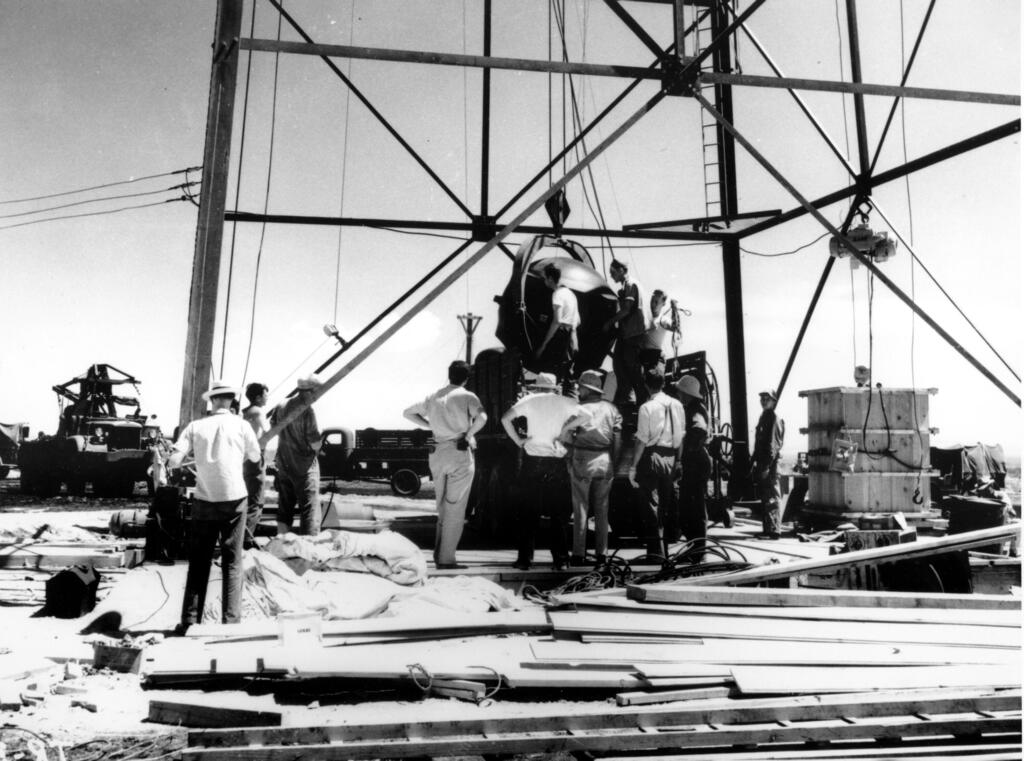
(Photo: AP)
That means the newly discovered clathrate does not provide a simple structural explanation for the quasicrystal. Instead, it helps narrow the range of possible models for how the quasicrystal formed.
Beyond its historical fascination, the finding may have relevance for materials science, condensed-matter physics and nuclear forensics. Materials created in nuclear explosions preserve information about the temperature, pressure and chemistry of the detonation environment. Studying them can help scientists understand how matter behaves far from equilibrium, when atoms are pushed into forms that do not normally appear in nature.
“Extreme events such as nuclear explosions, lightning or impacts from space rocks can create new mineral phases and structures that expand our understanding of how matter organizes under extreme conditions,” Bindi said.
The Trinity test marked the beginning of the nuclear age. But the glass left behind in the New Mexico desert continues to offer scientists a rare laboratory of its own — one formed in an instant, under conditions so extreme that they produced crystals unknown anywhere else on Earth.