

“It was a little sad, but also very joyful. After eight years of constant checkups to see if I was cancer-free, my doctor recently told me, ‘Shani, you don’t need to come anymore—only if you want to.’ I walked out of his office and felt strange. That’s it? Over? Am I really cutting the umbilical cord? Will I not see again the surgeon who operated on me and saved my life?”
At her home in Holon, after another day of reserve duty, 20-year-old Shani Shayo describes how her life suddenly turned upside down.
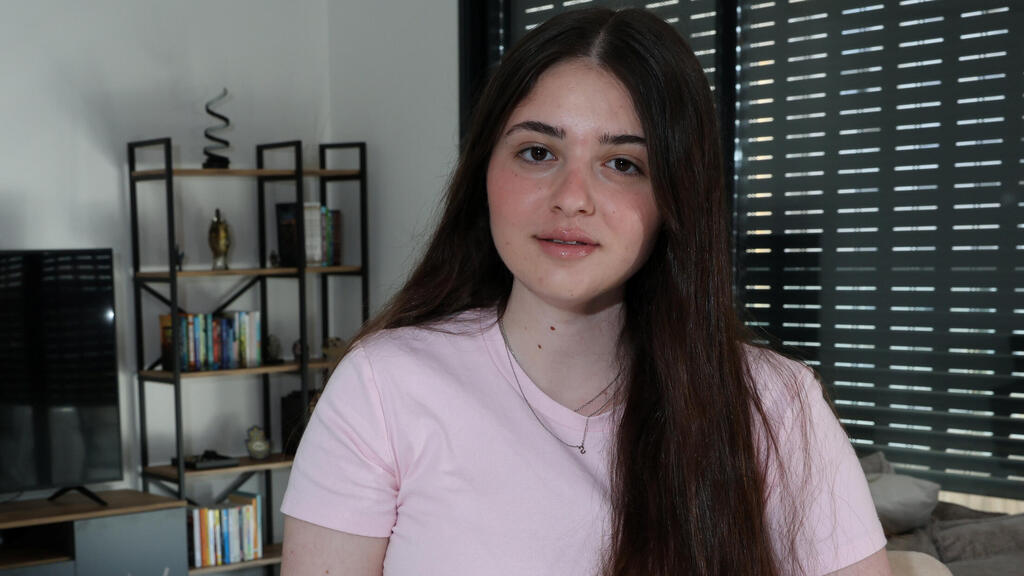
“Just before I turned 12, I started feeling pain in my neck. At first, I didn’t think much of it until it got worse and I couldn’t move my neck properly,” she recalls. Her mother, Sophie—an immensely dominant figure in her life—rushed her to the family pediatrician. “The doctor said my neck was unusually stiff for my age and referred me to an orthopedist.”
The orthopedist also thought something was abnormal and sent her for an X-ray. “I was busy preparing for my bat mitzvah when we got the results. They said one of the vertebrae in my neck might have shifted. As a 12-year-old, that didn’t sound serious to me. I was still in pain, but all I could think about was my party.”
But Shani was the only one still innocent to what would become a life-changing ordeal. The orthopedist suspected more and sent her for an MRI. The results were devastating: Shani had Ewing sarcoma, a rare bone cancer most common in children, teens, and young adults.
“I felt like I was in a nightmare, like the world had gone dark,” Sophie remembers. “For three days, I was on autopilot. Then I snapped out of it and told myself: Sophie, stop. From now on, you take control of this situation—it doesn’t control you.”
Shani underwent a biopsy, and the pain only intensified. “Suddenly, I couldn’t move my hands—they were paralyzed. It was terrifying.” At Dana-Dwek Children’s Hospital, oncologists realized the biopsy had shifted the tumor, irritating a nerve and leaving both arms immobile. The window to prevent permanent paralysis was short. That same day, Shani began chemotherapy.

(Photo: Shaul Golan)
“They didn’t even have time to preserve my fertility before starting very aggressive chemo,” she says. Over the first year after her diagnosis, she endured repeated rounds of chemotherapy and radiation that shrank the tumor but left her body devastated. “I couldn’t put anything in my mouth. I dropped to 27 kilos (59 pounds). I could barely stand.”
Doctors concluded the tumor could be surgically removed. But because of its dangerous location in her cervical spine, some physicians hesitated. The family even considered flying to a specialist in New Jersey.
Then Prof. Zvi Lidar, head of spinal surgery at Sourasky Medical Center in Tel Aviv, agreed to take on the challenge. “It was one of the most difficult procedures described in the medical literature,” he explained. “Only about 40 patients worldwide have undergone this operation. In Israel, I’ve performed four.”
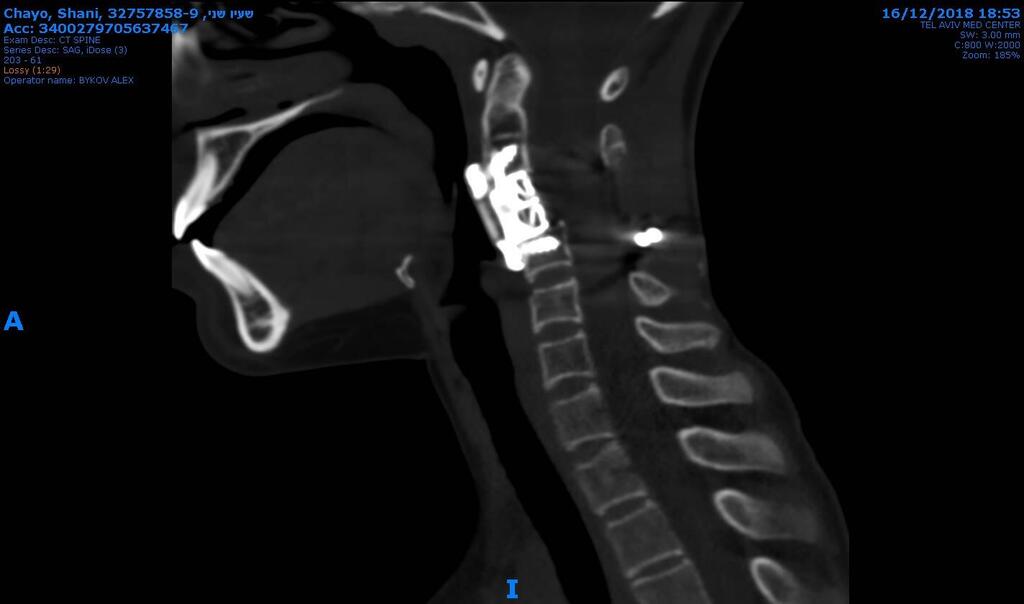
Ewing sarcoma often presents with pain at the tumor site. In Shani’s case, it had developed in the C3 cervical vertebra, close to the skull. “Its position made it uniquely challenging, requiring high technical skill, experience, and patience,” said Lidar.
A 15-hour surgery
The operation lasted 15 hours and involved a large team, including Prof. Gilad Regev, head of minimally invasive spinal surgery, and Dr. Dror Levin, deputy director of pediatric hematology at Dana, who had treated Shani throughout her illness.

In the lengthy surgery, the cancerous vertebra was removed
(Image: Prof. Zvi Lidar)
The surgery was performed in two stages: first with Shani lying on her stomach, then on her back. “With spinal cancer surgery, it’s critical to remove the tumor in one piece. But how can you do that when the spinal cord runs through the middle and even the smallest injury risks paralysis?” Lidar said.
 Prof. Zvi LidarPhoto: Yuval Chen
Preparations alone took three hours. The team began by making an incision at the back of her neck. “I released the affected vertebra, the surrounding bones, and the arteries to the brain. That freed the spinal cord and created a safe surgical space. We stabilized the area, which took seven hours. Then we turned her over,” Lidar explained.
(Image: Prof. Zvi Lidar)
Through an incision in the front of her throat, the team shifted aside her windpipe and esophagus to reach the diseased vertebra. Working carefully above and below it, they fully separated it before removing it whole. In its place, they implanted a custom-made replacement vertebra designed specifically for Shani.
The operation was a success. But her recovery included years of rehabilitation and fertility preservation. She missed two years of school, yet still graduated with a full matriculation diploma and an average grade of over 90.
“I was given an exemption from military service, but there was no way I would accept that,” Shani says. “I fought for the right to serve—even if only as a volunteer. I completed two full years in the army, and now I’m in the reserves. Nothing in life gives you the same sense of health and belonging as serving in the IDF. After the best doctors in the country treated me and saved me, when I turned 18, it was my turn to give back.”
First published: 13:41, 09.09.25