

New technologies developed in Israel may offer a way to detect impending flare‑ups of inflammatory bowel disease before symptoms appear, marking a potential shift in care for millions of patients worldwide.
Inflammatory bowel disease, which includes Crohn’s disease and ulcerative colitis, affects more than 10 million people globally. The chronic conditions are characterized by sudden and unpredictable flare‑ups that can cause severe pain, hospitalization and long‑term intestinal damage. Although treatments have improved significantly, doctors still lack a simple, noninvasive method to continuously monitor disease activity and warn of an imminent flare.
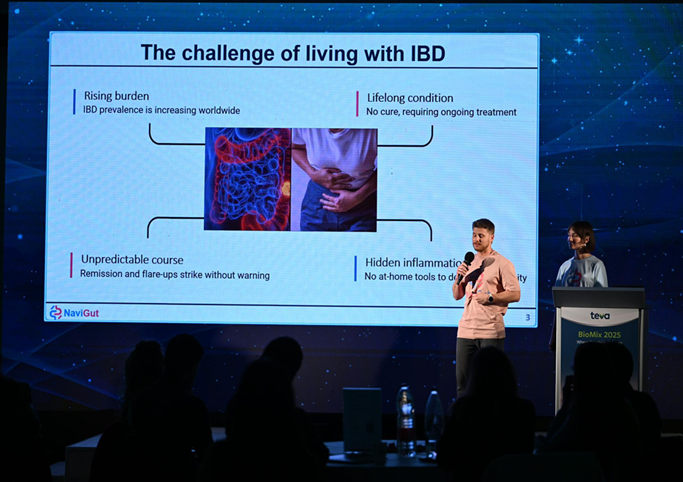
Two pioneering technologies, used together, could help fill that gap by giving patients and clinicians early warning signals, researchers say.
One approach uses genetically engineered bacteria designed to detect inflammatory activity in the gut. When the bacteria sense inflammation, they produce a signal that can be read through a simple urine test, offering the potential to identify inflammation before patients experience symptoms and allowing for earlier intervention.
The second technology targets stress, a well‑established but often overlooked trigger for flare‑ups. Research shows that patients under high stress face a risk of flare‑ups up to 3.6 times higher than those under lower stress, researchers say. A smart, skin‑worn patch continuously monitors physiological markers of stress alongside inflammation‑related signals. The data are analyzed in real time by an artificial intelligence system that alerts patients and doctors to rising risk, effectively acting as an early warning system.
Together, the technologies aim to provide a more complete, real‑time picture of both the inflammatory “fire” and the stress‑related “spark” that can ignite it — information not available in current clinical practice.

Nachi Natan and Bar Ofir
(Photo: Elad Gutman)
One of the projects, led by Ph.D. candidate Nachi Natan at the Weizmann Institute of Science, was recognized at BioMix 2025, an innovation program supported by Israeli drugmaker Teva. Natan’s initiative, called Navigut, uses synthetic biology to address the lack of accurate, continuous and noninvasive monitoring tools for inflammatory bowel disease.
The other project was developed by Ofir Bar, a cancer researcher and Ph.D. candidate, with Wellnitor, a wearable patch designed to monitor stress levels that may predict disease activity. Bar said the approach challenges the traditional reactive model of IBD treatment, which responds to symptoms after they emerge, rather than preventing flares before they start.
Earlier detection of flare‑ups could mean fewer hospitalizations, reduced complications and more tailored treatment decisions, researchers say. For patients, the impact may go beyond clinical measures, offering clarity, control and stability in the face of an often unpredictable disease.
These technologies won’t cure IBD, researchers say, but by making invisible processes visible, they have the potential to fundamentally change how Crohn’s disease is managed: not after the flare but before it starts.

Nachi Natan and Bar Ofir
(Photo: Elad Gutman)
Both projects were part of the Teva BioInnovators Forum, a global, year‑long program that supports early‑stage doctoral and postdoctoral researchers in neuroscience and immunology. BioMix connects academic research with industry to help translate scientific discoveries into real‑world applications.
Dr. Dana Bar‑On, senior director and head of academic and research collaborations at Teva’s Global Innovative Medicines R&D Division, said the initiatives reflect the power of collaboration between academia and industry.
“The young minds of Israeli academia work with the global scientific community and continue to prove that innovation does not stop,” Bar‑On said. “This year, we saw initiatives rooted in a deep understanding of biology, engineering and medicine — driven not only by science but by a genuine desire to make a change, understand deep, unmet medical needs and help as many patients as possible.”
Bar‑On said the projects hold real potential to improve patients’ quality of life and emphasize the importance of sustained investment in collaborative research.