

Between air raid sirens during Israel’s ongoing military operation known as “Operation Roaring Lion,” doctors at Rambam Health Care Campus in Haifa successfully performed a corneal transplant on a man in his 80s who had waited more than a year for the procedure.
The patient, identified only as A., a resident of the Haifa area, had been awaiting a donor cornea that could restore his vision. Late last week, he was informed that a suitable cornea had become available and that his long-awaited surgery could proceed. Shortly afterward, however, the launch of the military operation cast uncertainty over whether the transplant could take place.
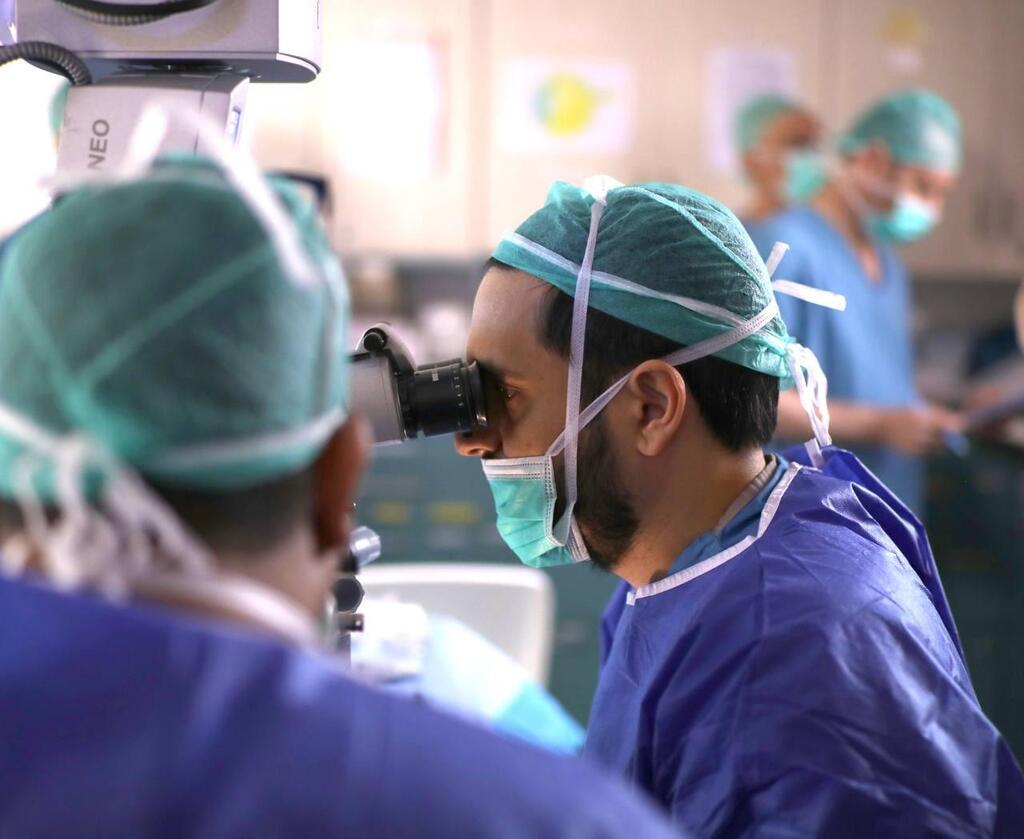
Prof. Michael Mimouni, head of the Cornea Unit at Rambam Health Care Campus, during a corneal transplant surgery
(Photo: Rambam Health Care Campus)
“Despite the complex situation, we decided to carry out the transplant,” said Prof. Michael Mimouni, head of the Cornea Unit at Rambam and chairman of the Israeli Cornea Society, a professional forum for cornea specialists. “Out of respect for the donor and the donor’s family, and in order to provide the patient who had waited so long with this donation. This is an opportunity that is limited in time and must be used.”
The procedure was performed under local anesthesia using an advanced surgical technique, a decision that ultimately proved beneficial under the circumstances.
“Just as we finished preparing for the surgery, a siren sounded,” Mimouni recalled. “We left the operating room together with the patient and went to the protected area.” After the immediate threat passed, the team returned to the operating room and began the surgery, which lasted about an hour.
“Once we completed the transplant, another siren sounded, and again we went with the patient to the protected area,” he said.
The surgery was completed successfully. After a period of monitoring at the hospital, the patient was discharged home.
“Even in times of war, we do everything possible to restore our patients’ vision and to give meaning to the generous donation that was given,” Mimouni said. “It is a privilege to be in a position that allows us to be part of this work.”