

Dr. Inbar Nardi Agmon, a senior cardiologist at Sheba Medical Center, traveled to Toronto for a medical fellowship at the height of Israel's anti-government protests, shortly before October 7. When she landed, she still had a large hematoma on her abdomen, a collection of blood beneath the skin, and her glasses were broken from blows she says she received from police officers at a demonstration the previous week.
"I was very active. I left amid tremendous turmoil and arrived in a land of squirrels and autumn leaves, and that contrast was really difficult," she recalled Sunday morning. "I wished for myself that I would fall in love with Canada and never come back." And she almost did.
Gallery
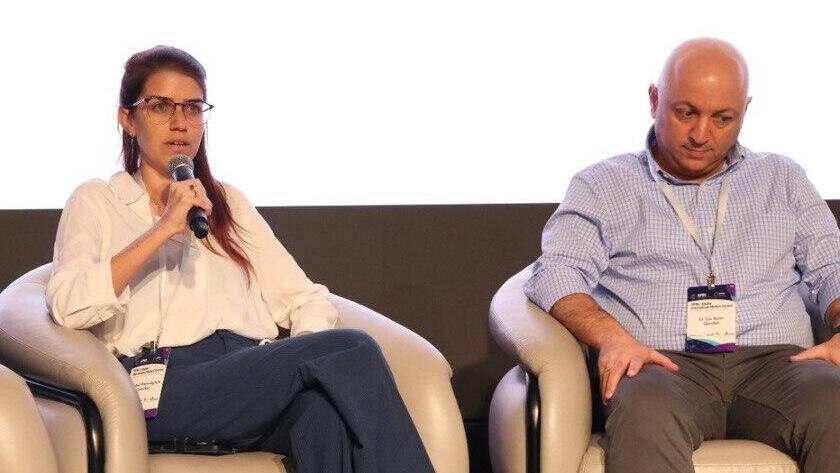
Dr. Guy Rozen and Dr. Inbar Nardi Agmon, senior cardiologist at Sheba
(Photo: Sheba Medical Center)
Nardi Agmon spoke at a conference organized by the Sheba Pandemic Research Institute (SPRI), headed by Prof. Gili Regev-Yochay. The event brought together Israeli physicians working around the world for discussions on critical medical challenges, technological innovation and preparedness for future pandemics. It took place against the backdrop of troubling data on doctors leaving Israel and ahead of the approaching elections.
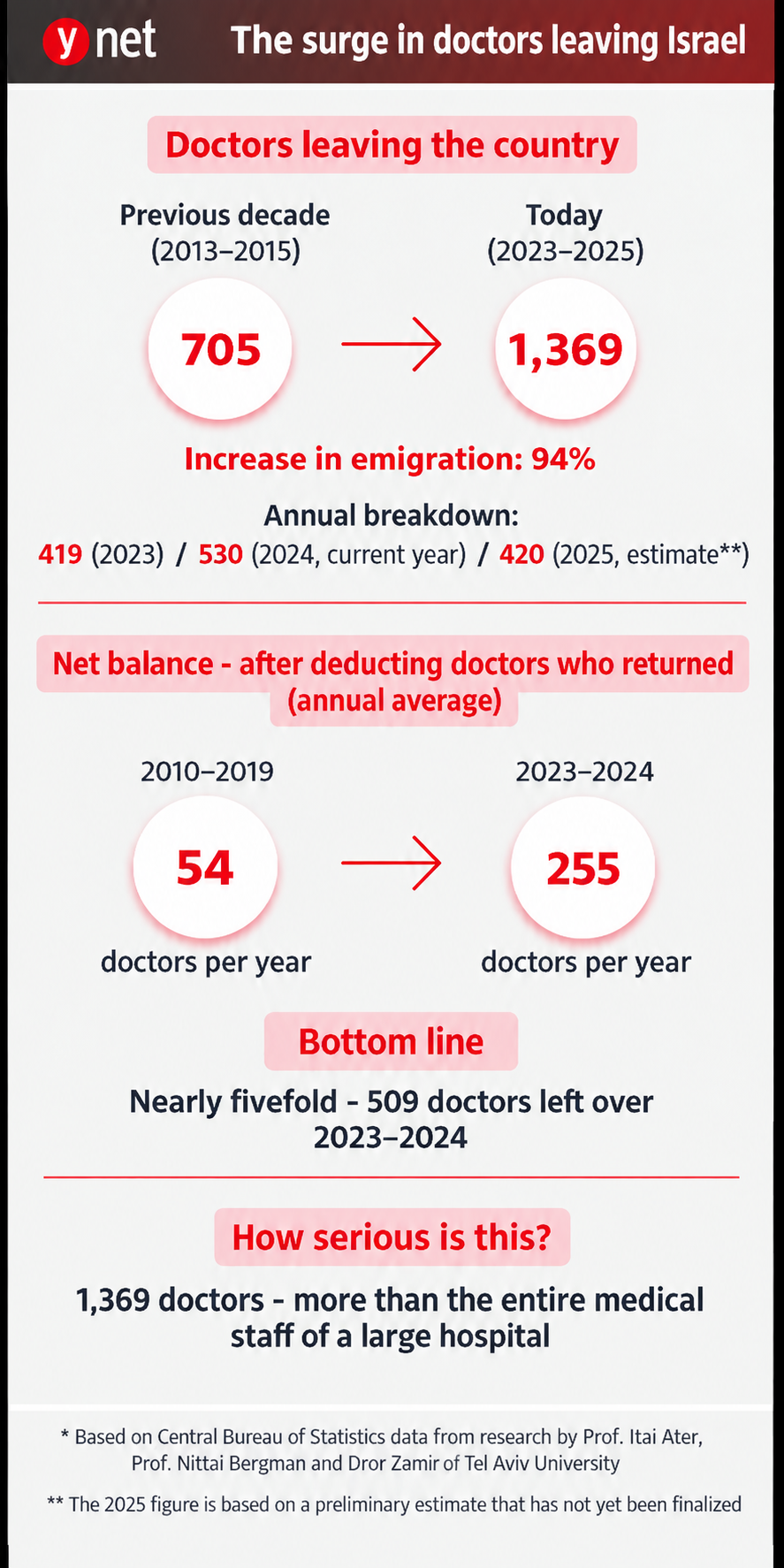
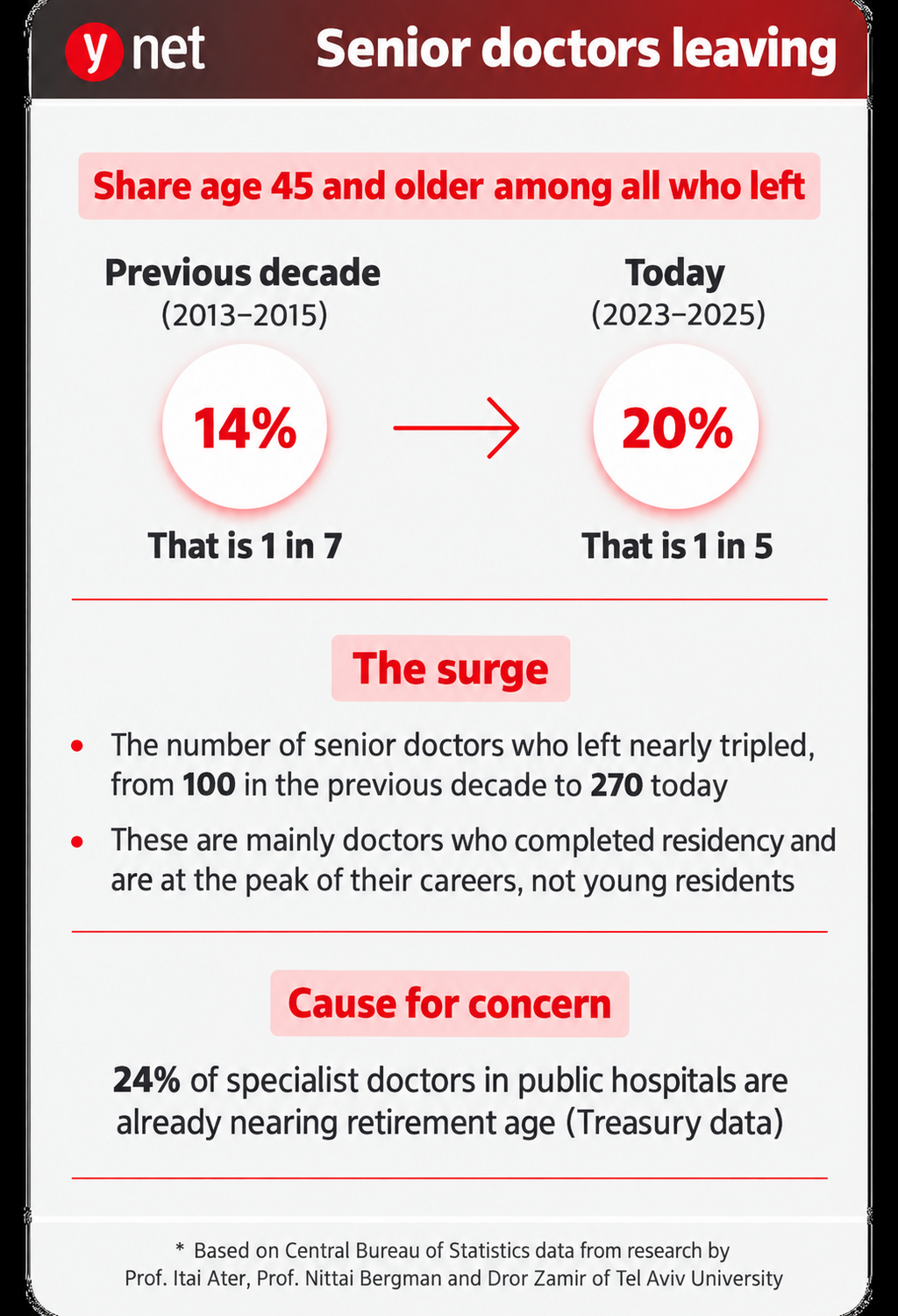
According to a Tel Aviv University study, 1,369 doctors left Israel for at least one year between 2023 and 2025, a 94% increase compared with the same three-year period a decade earlier, when 705 physicians left between 2013 and 2015. In other words, Israel lost more doctors in three years than the entire medical staff of a large hospital, many of them experienced physicians who are particularly difficult to replace.
For Nardi Agmon, the hope of not returning was primarily about her children.
"I have four sons. The oldest is 15, and it was clear to me what would happen in three years," she said. "I always thought that if my flaw in the system was being 'an Israeli who loves her home,' perhaps I should give that up so my children could have a more comfortable life. That's how I went to Canada, knowing I would return but hoping I would convince myself not to."
'Everything I believed collapsed'
According to Nardi Agmon, everything changed after October 7.
"My entire understanding of the situation collapsed. My husband returned to Israel for reserve duty, and I stayed there alone with four children for a while. Everything I had traveled there for, everything I wanted to protect, fell apart."
In January 2024, she visited Israel and joined demonstrations organized by the families of the hostages.
"Unlike the excitement we felt on the Ayalon Highway, that addictive feeling of wanting to change things, the emotion had turned into complete despair," she recalled.
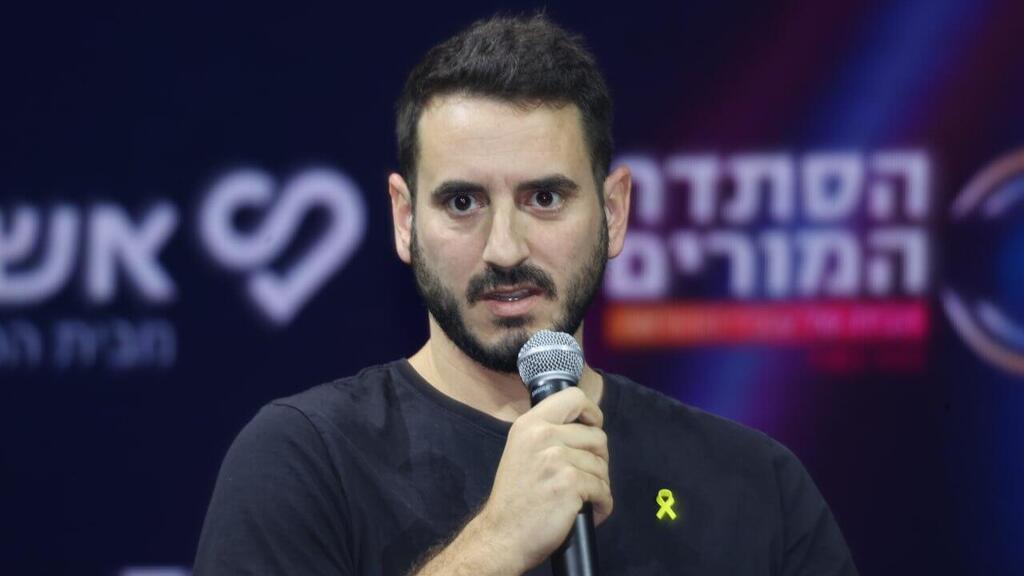
Yonatan Shamriz
(Photo: Yariv Katz)
When she returned to Toronto, her dilemma became even more acute.
"It was a year and a half of virtually no sleep, trying to understand what was happening, and the dilemma was always there. I work in a highly specialized field, I'm good at what I do, and I was offered a position in Toronto, my own laboratory, my own clinic. Everything was possible. I told myself that maybe this was what I needed to do."
Then she came across an interview that changed her mind.
"One day I opened the news and saw an interview with Yonatan Shamriz from the Kumu (rise or awaken) movement, who lost his brother, one of the hostages mistakenly shot by IDF troops. I looked at him, and for the first time I said, 'If they went through the worst imaginable thing and still refuse to give up, getting up every morning to fight for their home, who am I to do anything different?' That was the day I decided I was coming home."
The decision, however, was not immediate.
"I traveled to Israel for a week, three days in the desert and three days in the north, alone with myself, to make the decision wholeheartedly. When I returned to Toronto, I told my boss I was turning down the offer and coming home."
She insists that returning to Israel did not mean sacrificing her children's well-being for her own attachment to the country.
"When I got home after that week, it was minus 10 degrees and snowing in Toronto. The children came home from school at 3 p.m. and sat in the house with only each other for company. I asked myself whether I wished them a life without meaning or a connection to home, and I said no," said Nardi Agmon.
"If there's one thing I've learned from October 7, and from various personal experiences over the past few years, it's that there's little point in planning 10 years ahead. Our lives can be turned upside down in 30 seconds. I choose to make decisions based on what feels right to my heart and my beliefs today," she said. "So I came back wholeheartedly, with enormous love for the people, not for this piece of land. I'm grateful every day that I returned, and I hope I never regret that decision."
He returned to Israel, then left again
Unlike Nardi Agmon, Dr. Guy Rozen returned to Israel after completing a fellowship in Boston between 2014 and 2017, only to decide in 2022 to leave again and move back to the United States. Today, he heads the electrophysiology and cardiac arrhythmia service at Tufts Medicine in Boston.
"When we left in 2014, I had a three-and-a-half-year plan. It was absolutely clear to me that I was returning to Israel, first and foremost because of my connection to the people, the country and my family. I couldn't imagine my children growing up without their grandparents.
"Short of writing 'leave me alone' across my forehead, I wasn't looking for anything. I didn't want to stay. There were offers, but it was obvious we were going back to Israel," he recalled.
After returning, Rozen helped establish the cardiac arrhythmia unit at North Medical Center, formerly Poriya, through a collaboration with Sheba. He later headed the cardiac arrhythmia unit at Hillel Yaffe Medical Center while also running a private clinic.
"So why did we eventually move back to the United States? Many people who do fellowships develop professional relationships and build extensive networks, so they receive offers. When I got those approaches, they didn't interest me. But then the offer from Boston came," he explained.
"When I discussed it with my wife, she said one sentence, and it felt like a knife to the heart. She said we had returned to Israel mainly to be closer to family: 'We became closer to our extended family, but we grew further away from you.'"
According to Rozen, the problem lay in the working conditions of Israeli physicians, particularly the difficulty of maintaining a balance between professional and family life.
"I really enjoy what I do. I never complained when I came home at 10 or 11 at night, and it seemed ridiculous to whine about it when I had a thriving private practice. But ultimately, I wasn't home. I wasn't there for dinner or for various events with the children."
For now, the family remains in Boston. Rozen says they still do not know whether they will eventually return to Israel.
'I came back more for Sheba than for Israel'
Dr. Einat Engel-Haber returned to Israel just two months ago after five years in New Jersey. She is preparing to establish a new neurorestoration unit at Sheba's integrated rehabilitation hospital, focusing on restoring functions impaired by damage to the nervous system.
"We lived in a part of New Jersey that wasn't very Israeli, and it was very difficult for the children at first. But eventually they adapted, and it very quickly became home. Some of the children also developed a strong sense of belonging to the local community," she said.
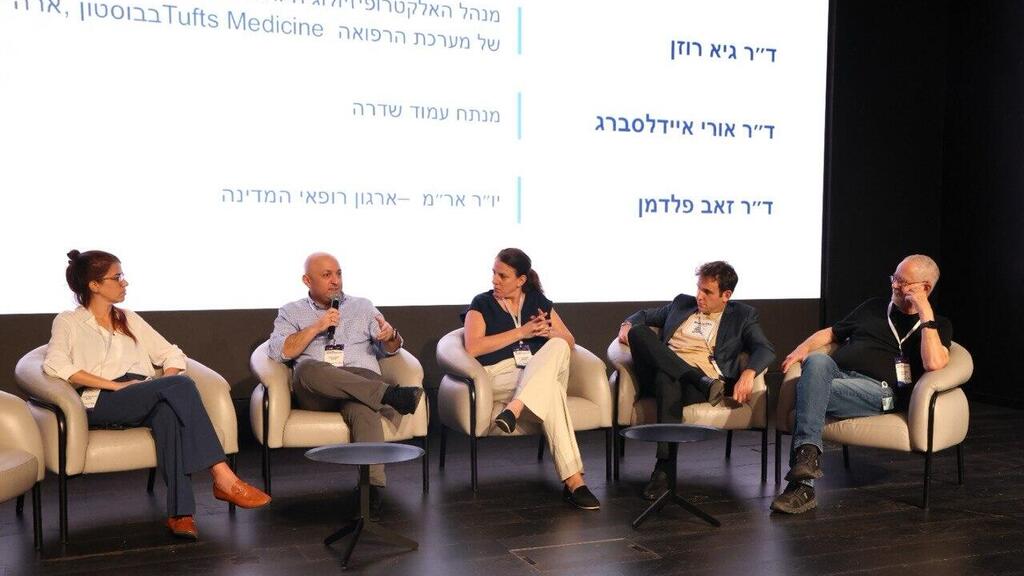
From the left: Dr. Inbar Nardi Agmon, Dr. Guy Rozen, Dr. Einat Engel-Haber, Dr. Uri Hadelsberg and Ze'ev Feldman
(Photo: Sheba Medical Center)
"We struggled with the decision. Life there was very pleasant and comfortable. We had a good life, a large house with a little stream running through the garden and the sea behind the house, and we really loved the weather. I made significant progress professionally and became connected to the research community. It was all very, very tempting.
"But ultimately, what tipped the balance in favor of returning to Israel was that Sheba had always been my home. Sheba stayed in touch with me even while I was in the United States, and before we returned, they had already started discussing the center they hoped I might establish. They gave me a truly exceptional opportunity. I feel that, at the moment, I came back a little more for Sheba than for Israel."
The move was accompanied by considerable anxiety, particularly about the children.
"We made this move with a lot of fears, mainly because of the children, who had spent five years growing up in the United States. One of my daughters said to me, 'Why are you doing this to us?' Another, who used to watch the news, asked, 'You're bringing us back to that?'
"It was very difficult. So far, they're generally happy. I really hope this was a good and correct decision, and only time, and the elections, will tell."
Dr. Uri Hadelsberg, a spine surgeon, also received lucrative offers to remain abroad but ultimately decided to return, partly because of his children.
"There was a seven-figure offer to stay in the United States. There's a great deal of money in my field. Once you have children, it changes a lot of things. The fact that my wife is also a doctor and wasn't working there was another consideration," he said. "The government certainly didn't make me want to come back, and yet I returned, out of Zionism."
'That's an insane proportion'
Like the other physicians, Hadelsberg pointed to the difficulty of balancing work and family life in Israel, as well as the enormous salary gap between Israeli hospitals and the offers he received abroad.
"There's a price to pay. When you return to Israel, go to a hospital and are offered a salary of 6,000 shekels, you realize that it pushes you very strongly into private practice."
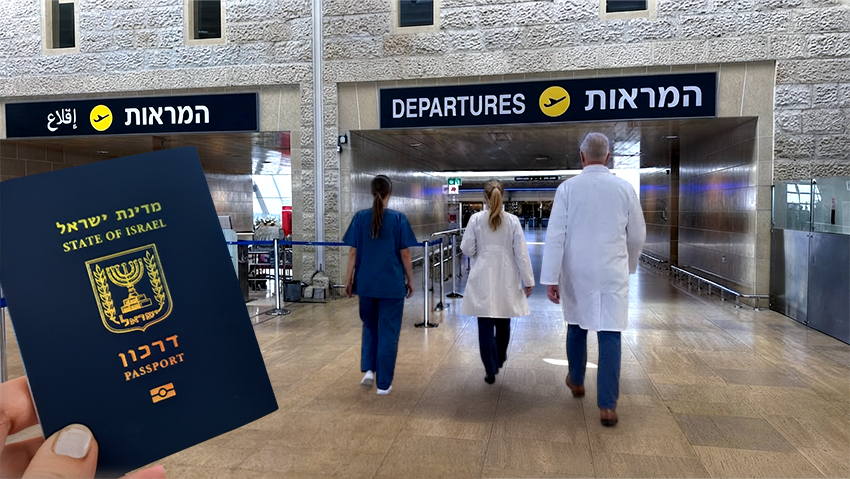
'If the Health Ministry doesn't put its hand in its pocket, people won't stay'
(Illustration: Shutterstock)
He said he knows approximately six neurosurgeons who have remained abroad. "That's a very significant loss for the system because there aren't many of us in Israel. I think we need to examine the issue in depth and fix it."
Dr. Ze'ev Feldman, chairman of the State Physicians' Organization and a neurosurgeon himself, said that approximately 15 of Israel's 60 neurosurgeons have left the country.
"That's an insane proportion, and these are some of our very best. Right now, four people from my department here at Sheba are still up in the air, abroad. I say 'up in the air' because I hope they'll return, but there's no certainty."
Dr. Mayan Gilboa, a senior specialist in Sheba's Infection Prevention and Control Unit who moderated the panel, presented findings from research she conducted with Professor Gadi Segal, Dr. Lior Seluk and Dr. Daniel Weltsch. The study, conducted in early 2024 among approximately 300 physicians, examined the factors influencing Israeli doctors' decisions to return home after completing fellowships abroad.
Of the participants, 156 were still living overseas, and 69% of them reported moderate to low confidence that they would return to Israel.According to the study, the main factors keeping Israeli physicians abroad were higher salaries (62.6%), better work-life balance (45.5%) and Israel's political and social situation (39.1%).
'You ask for a horse and end up with a camel'
The physicians on the panel also outlined what they believe needs to change to encourage doctors to return to Israel.
"The ridiculous salaries in the public health care system are insulting," Nardi Agmon said. "To look at your pay slip at the end of the month after 10 years of training, and know that you have to pay a mortgage and bills that just keep rising, is insulting. It doesn't make you want to come back, and of course it forces you to look for work in the private sector, which prevents you from investing in the public system."
She also argued that Israel does not invest enough in physician-researchers. "If I'm working full time and conducting my research at 11 at night, while the people around me don't receive representation or opportunities to enter the laboratory, work and advance the things that ultimately really change the future of medicine and our place in the world, that's a failure of the health care system.
"The system needs to recognize that research is an inseparable part of medical practice and that it should be financially compensated, rather than coming at the expense of our personal time. We shouldn't have to come in at 11 at night and not see our children.
"I think that's what would have made it much easier for me to return, along with some kind of minimum salary that would be higher than what I pay the babysitter for the hour I'm away from home."
Rozen pointed to problems with the availability of resources in Israel. "At Poriya, I had an anesthesiologist available once a week," he said.
"If the Health Ministry doesn't put its hand in its pocket, people won't stay," Hadelsberg added.
According to Feldman, the Health Ministry is expected to establish a dedicated administrative body to address the issue. "Until 2023, there was a balance between doctors leaving and returning. Since then, there's been a flood of departures by senior physicians, the people leading teaching and research," he said.
"The system finally understands this and is establishing a new administrative body that will first of all know who's leaving. But they don't have the faintest idea where to begin. I'm worried, because every time a government establishes a committee, you ask for a horse and end up with a camel. Let's see what this new body actually accomplishes."