

“Any time you mention the name of a former senior official to colleagues who knew him, you will also hear criticism. But I never heard anyone say a bad word about Aby. He worked with many senior officials and with 10 or 11 science ministers,” Tal Inbar, a strategic consultant and researcher in space affairs, said of his friend Aby Har-Even, who headed the Israel Space Agency, developed Israel’s satellite launcher and was murdered in the Arab riots in Acre five years ago.
“It is hard to believe he is no longer here. To this day, the memory is still vivid for me. He was an extraordinary person, a true mensch, who always supported others and helped them,” added Ariela Alon, who was Har-Even’s secretary at MLM, the Israel Aerospace Industries plant for integrated weapons systems. “He was the last person anyone should have harmed.”
Gallery
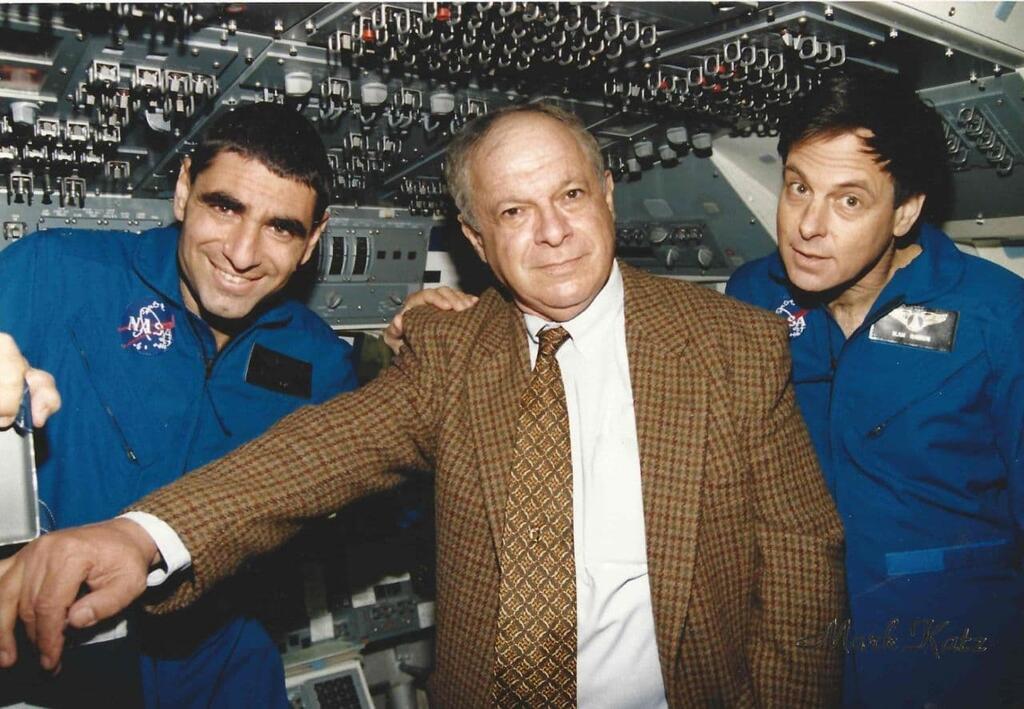
Aby Har-Even with late astronaut Ilan Ramon and Itzhak Mayo
(Photo: Ministry of Science and Technology)
A top student and artillery officer
Aby Har-Even was born Aba Hartstein on March 7, 1937, in Galati in eastern Romania, the only child of parents from Ukraine and Moldova who owned a soap factory. From a young age, he was interested in science and mathematics. At one point, his parents received a certificate allowing them to immigrate to Mandatory Palestine, but it did not work out and the family remained in Romania throughout World War II.
“The Jews of Galati wore yellow badges, and some were taken to labor camps, but they were in less danger than in other places,” his widow, Miriam Har-Even, told the Davidson Institute website. In 1950, the small family immigrated to Israel and settled in Jerusalem.
Aby, who by age should have entered seventh grade, wanted to study at the Hebrew Gymnasium in Rehavia. The principal said there was no room for another child in that grade, but after one of the teachers tested his knowledge of mathematics, it was decided to admit him directly into eighth grade, even though he barely knew Hebrew.
“He spoke only Romanian and Russian, but he overcame the language barrier fairly quickly and became an outstanding student,” Miriam said. “He did not excel only in science. He loved the Talmud, for example, and in high school he got a promise from his history teacher of a perfect grade without even having to take the exam, after answering in class a question about the difference between the Greek conquest and the Roman conquest.”
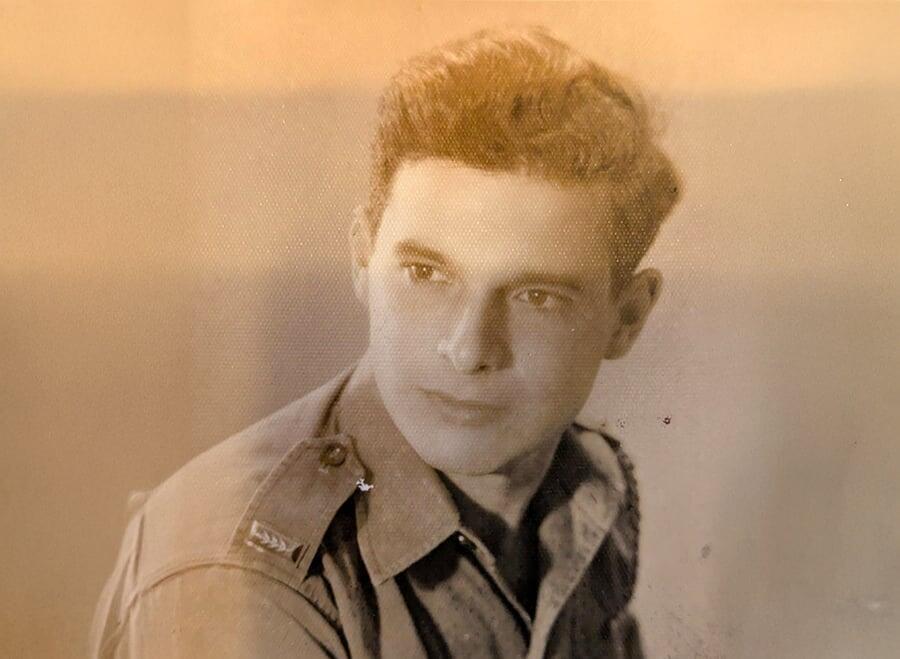
He was an outstanding student and an outstanding officer; Har-Even as a young officer in the Artillery Corps
(Photo: Courtesy of the family)
After finishing high school in 1955, he was accepted into the academic reserve program and began studying mechanical engineering at the Technion.
“That was an old dream he had already formed in his parents’ factory,” his widow said. “But when the Sinai Campaign broke out, nearly all the academic reserve students were drafted.”
He enlisted in the Artillery Corps, completed officers training and served in command roles. During his service, he met Miriam Calderon by chance. She ran the Air Force’s Hebrew school, and the two married in 1959. That same year, he returned to complete the studies his service had interrupted, though his academic interests had shifted somewhat. He studied electrical engineering instead of mechanical engineering, and was supposed to be assigned to a missile unit the Artillery Corps planned to establish.
Israel’s security
“Aby had not planned on a military career, but he had to repay four years of service for every year of study, so he remained in the army for a long period of career service,” Miriam explained.
When he returned to service in 1963, it had been decided that missile operations would belong to the Air Force, not the artillery. He served as a research and development officer at Artillery Corps headquarters and helped integrate advanced systems into the corps. He also helped absorb new anti-aircraft guns, the Bofors L/70, into the Air Force, and later moved to the anti-aircraft array, now the Air Defense Array, where he commanded, among other things, an officers course and a Hawk missile battery that protected the Nuclear Research Center.
In 1965, he was sent to Uganda to establish that country’s air defense system. Before that, he had been sent for training in several European countries, and under the practice common at the time, he Hebraized his surname to Har-Even.
In 1968, he was assigned to the center for weapons development at the IDF General Staff, which later became the Defense Ministry’s Directorate of Defense Research and Development, known as MAFAT. After the Yom Kippur War, he headed a team tasked with drawing lessons from the war and implementing them in the IDF. Har-Even established the Meital unit for cooperation in defense research with friendly countries. Later, he headed the research and development department for special systems. In 1977, he was awarded the Israel Defense Prize for a secret project he led in that field, whose details remain barred from publication to this day.
“In my role as assistant R&D officer in the Artillery Corps, I helped introduce sophisticated equipment into the corps — computers, range-measurement systems and even radiosondes, devices carried aloft by balloon that enable the meteorological service to obtain atmospheric data at heights of tens of kilometers,” he said in a 2004 interview with the HAYADAN website and Galileo magazine. “The Artillery Corps is the most sophisticated corps in the IDF in terms of equipment among the ground combat branches.”
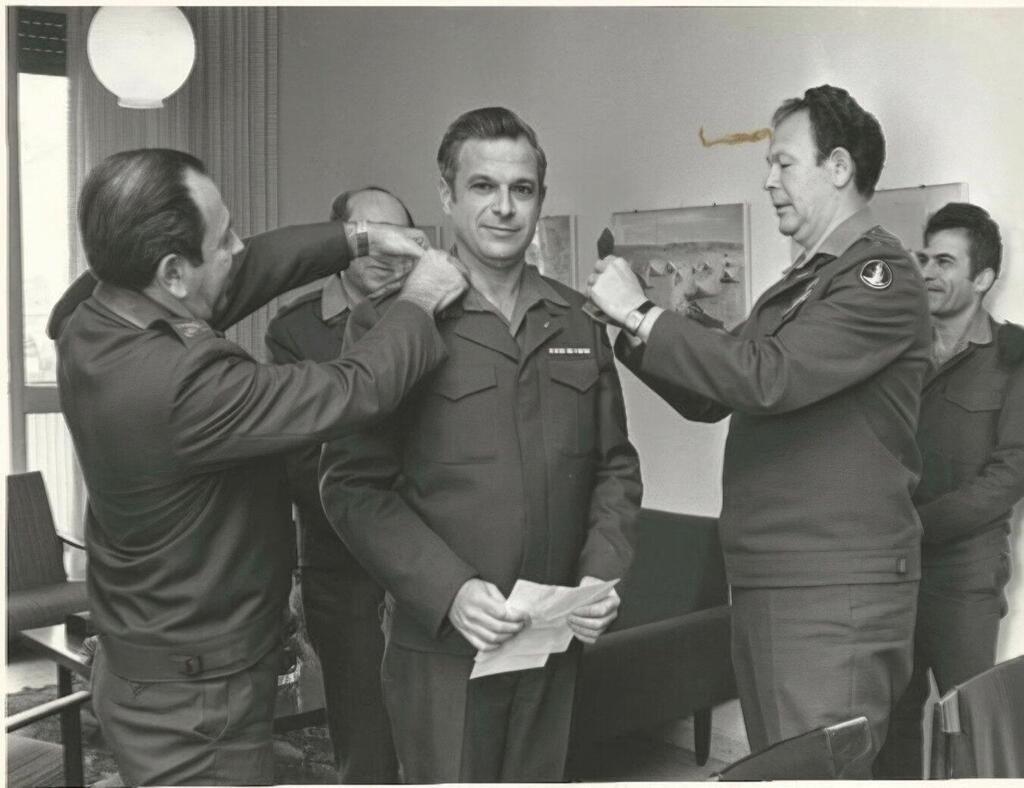
He led technological innovation in the Artillery Corps and throughout the military, and received the Israel Defense Prize for a project whose details remain classified; Har-Even receives the rank of colonel from IDF Chief of Staff Mordechai 'Motta' Gur
(Photo: Courtesy of the family)
During Har-Even’s studies and military service, the couple’s three children were born: Yael, now CEO of Oracle Israel and a senior vice president at Oracle Global; Yoav, who was a major general in the IDF and CEO of Rafael, and is now chairman of Sindiana Technologies, which works in simulators, and a consultant to defense companies; and Oded, a partner at the American law firm Sullivan and managing partner of its Israel office. Miriam, his wife, is a computer professional who for many years held a senior role in Bank Leumi’s computing division.
“Dad was always driving us crazy to study physics. He would explain all sorts of principles to us and the physics behind everyday phenomena,” their son Oded told the Davidson Institute website. “He was obsessed with science education, but in the end none of us became an engineer.”
Har-Even was also handy and did many repairs and improvements around the house.
“When we built the house, the contractor abandoned the job in the middle, and Aby finished it himself. He would come with Yoav on weekends and build with their own hands,” Miriam said.
During his career service, Har-Even himself also diverged from engineering studies and completed a master’s degree in business administration.
“He would sit and study on Saturdays, and I would take the children out so they would not disturb him,” Miriam said.
In 1979, he retired from the IDF with the rank of colonel.
Israel’s satellite launcher
Har-Even’s main hobby was technological innovation.
“There was nothing he did not collect. Cameras, binoculars, transistors. Everything,” his son Oded said. “He did not just collect things. He also studied every specification of what he bought and delved into every detail. In New York, he would spend hours in Radio Shack. When I came to Israel from the United States, I would bring him catalogs from camera and electronics stores. When the first tablets came out, he got up at 5 in the morning to stand in line and buy one.”
His first job after leaving the army brought together his beloved world of gadgets and his business education. He was appointed head of the Israeli branch of Fischer & Porter, a technology company that develops precision measuring and control systems.
Har-Even liked the job, but after three years, he was invited to join Israel Aerospace Industries and lead the project to develop a launch rocket for placing an Israeli satellite in space.
“The decision to launch an Israeli satellite was debated extensively, and in the end it was approved in 1981,” Tal Inbar said. “Israel had certain missile capabilities, and when the decision was made to launch a satellite on our own, he was appointed to manage development of the launcher project.”
In 1982, Har-Even began work at Israel Aerospace Industries, and a year later, he was appointed head of the Launchers and Space Directorate at the MLM plant, where he managed development of the Shavit launch rocket. In 1988, Israel’s first satellite, Ofek 1, was launched into space, and the launcher, whose development Har-Even led, fulfilled the mission with complete success.
The Shavit launcher is still in use. It has, of course, undergone upgrades and improvements in the nearly 40 years since its first launch, but it is still based on the model developed by Har-Even and his colleagues.
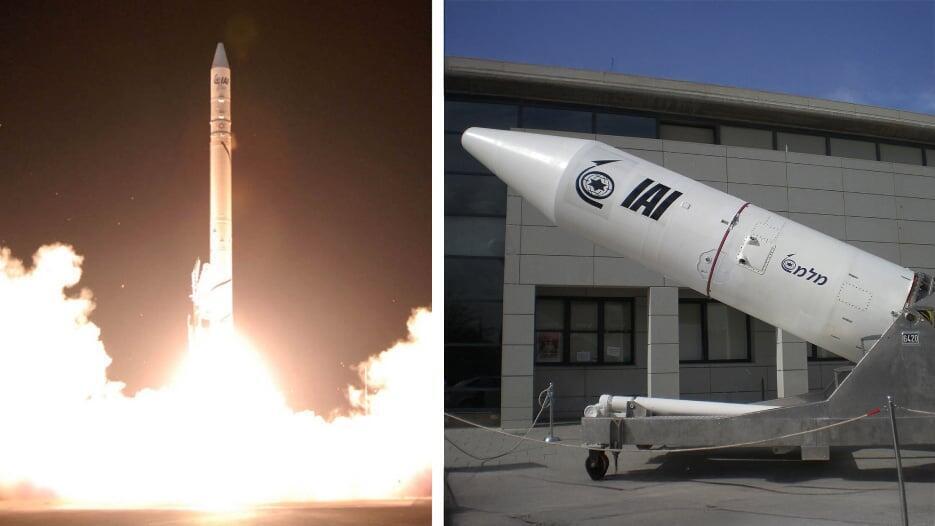
It has been refined and improved, but the rocket Har-Even led the development of is still used by Israel to launch satellites; the launch of Ofek 7 in 2007 aboard a Shavit rocket, and the rocket’s third stage as displayed in an exhibition in 2009
(Photos: Israel Aerospace Industries, Tal Inbar)
Har-Even also led additional projects at Israel Aerospace Industries, including some that remain classified to this day and are related to capabilities widely used today.
“Among other things, Aby led cooperation with South Africa, and the personal connections he created there contributed greatly to advancing and funding those projects,” Inbar said.
“At work, he managed complex classified projects, but what left the deepest impression on me was his leadership style — methodical thinking, modesty and insistence on precise work alongside listening and respect for people. What made him unique in my eyes was the rare combination of brilliant professionalism and genuine human relations — the kind that make people want to work better, not because they have to, but because they believe,” said Ariela Alon, who was his personal secretary for most of his years at MLM. “He managed dozens of people in demanding work with many long days and nights, and he always cared for his employees, including going to human resources to make sure they got the ranks and promotions they deserved. I was very sorry when he decided to leave.”
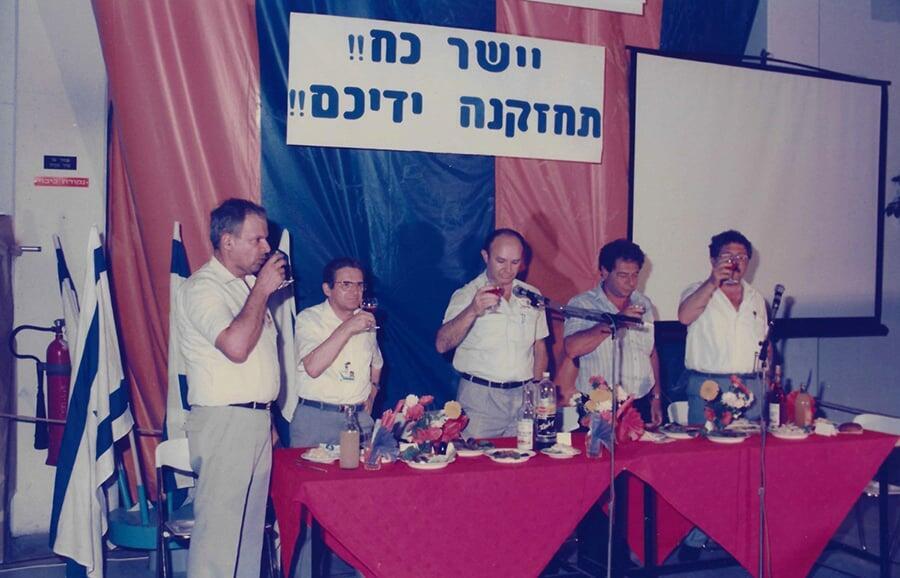
He led development of the launch rocket for Israeli satellites, alongside additional projects; Har-Even, left, at an MLM plant event marking completion of a project that is still barred from publication
(Photo: Scan from Har-Even’s album, courtesy of Tal Inbar)
After about a decade at Israel Aerospace Industries, Har-Even decided to look for a new direction. He left the organization on Dec. 31, 1994, and the next day began his next role: director of the Israel Space Agency.
An Israeli astronaut
The Israel Space Agency was established in 1983.
“To conceal the activity of developing a military satellite and its launcher, Science Minister Yuval Ne’eman created a civilian agency as a cover for the defense activity,” Inbar said. “It was a tiny body with an almost nonexistent budget. Its staff consisted of a director and a secretary. The directors were academics who did the job voluntarily or part-time, and for relatively short periods.”
Har-Even’s appointment to head the space agency fit with the policy of the ministry’s unusual director-general, Zvi Yanai, who supported the creation of a civilian space agency and even managed to secure it annual funding of $5 million.
“When I took office, the position was formalized, but the budgets kept being cut and we never reached the target of $5 million a year,” Har-Even said in an interview with HAYADAN. “Even so, I managed to carry out many activities despite the tiny budget provided, through coordination and explanation to the various bodies. Those were the things I had to explain to colleagues at other space agencies who raised an eyebrow and asked how we had managed to do so much with such a tiny budget.”
As head of the space agency, Har-Even promoted many international collaborations, but what was probably the largest project fell into his lap almost by chance — sending the first Israeli astronaut into space.
“The project of launching an Israeli astronaut was born during a visit by Prime Minister Shimon Peres to U.S. President Bill Clinton after the assassination of Yitzhak Rabin,” Inbar said. “Aby learned about it from the media.”
After the general agreement, Israel was required to sign a formal accord with the United States in order to actually send an Israeli astronaut.
“It had to be done agency to agency, and Aby had to obtain funding and recruit the relevant Israeli bodies,” Inbar added. “In the end, he got half the funding from the Air Force in exchange for a promise that the astronaut would be one of their pilots, and half from MAFAT at the Defense Ministry, and he succeeded in bringing the project to life. He also had to deal with quite a few political matters, such as who would attend the launch and how the prime minister would speak with the astronaut in space.”
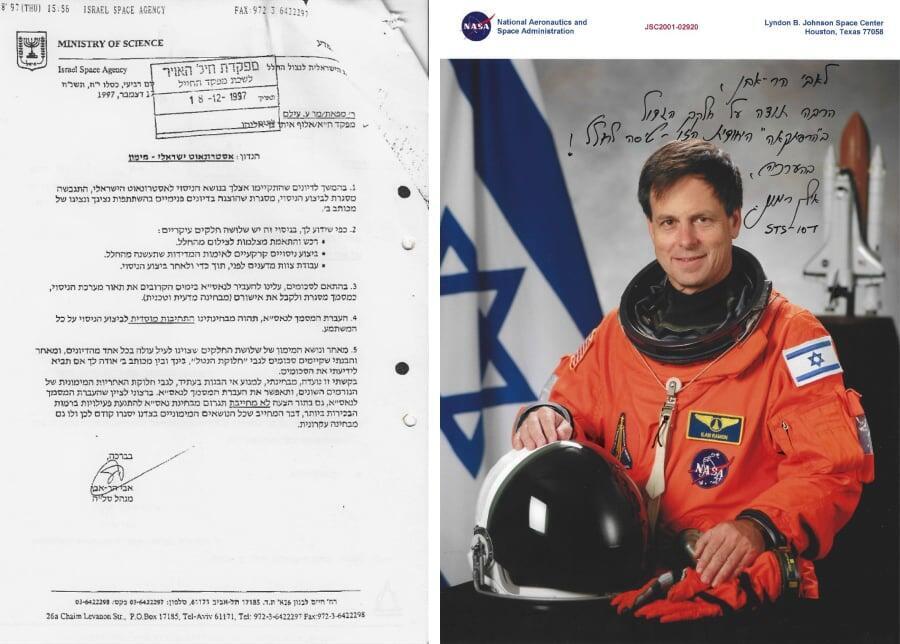
He secured funding for the Israeli astronaut project and overcame the political obstacles; a photo Ilan Ramon dedicated to Har-Even, alongside one of Har-Even’s letters regarding funding for the project
(Photo: Scan from Har-Even’s album and from the Ilan Ramon archive, courtesy of Tal Inbar)
Har-Even was the one who insisted on incorporating student experiments into the astronaut project in order to make the event an educational catalyst and spark interest in science and space among middle school students.
Israeli astronaut Ilan Ramon was launched into space aboard the space shuttle Columbia in January 2003. During the mission, he carried out many experiments, spoke with students and completed all of the mission’s objectives. Tragically, the mission ended in disaster when the shuttle disintegrated upon reentry into the atmosphere, killing all seven crew members.
“Aby loved Ilan Ramon very much. They had a good relationship. Rona and he used to visit us often,” Miriam said. “He took the crash and Ilan’s loss very hard. It was not easy for him.”
A transformation at the agency
Paradoxically, out of that disaster and thanks to Har-Even’s interpersonal skills, a long friendship grew between the Israel Space Agency and NASA.
“He had good ties with NASA chief Dan Goldin at the time, and they led to many space collaborations with the United States and deep ties between the agencies,” Inbar said. “His personal charm led to good relations with many officials, which also produced professional cooperation, such as with the Indian ambassador to Israel and the heads of the French space agency.”
“His personality and broad knowledge helped him promote the foundations of Israel’s space agency, and especially its foreign ties,” Avi Blasberger, who headed the Israel Space Agency from 2016 to 2021, told the Davidson Institute website. “He was pleasant, straight as a ruler, and a pleasure to work with. Thanks to his personality, the industries responded to his call.”
Another central project that grew out of Har-Even’s work at the space agency was the Israeli-French research satellite Venus. The satellite carried an Israeli-made hyperspectral camera that photographed in 12 different wavelengths, making it particularly suited to its mission of monitoring environmental changes.
The satellite originally began as a collaboration with Germany, largely thanks to Har-Even, who connected officials from the German company OHB with those from El-Op, which eventually developed the camera, and who also provided a small amount of seed funding for the project out of the agency’s tiny budget.
“He found 50,000 shekels for it, which was a tiny sum for a technological project even in the 1990s,” said Blasberger, who at the time was a senior executive at El-Op. “He had a vision that maybe something would come of it, and he was right.”
The satellite’s development went through many upheavals and difficulties, mainly because of funding problems, and in the end, it was developed with the French space agency CNES, also within a collaboration Har-Even led. It was launched in 2017 and completed its highly successful mission in the summer of 2024.
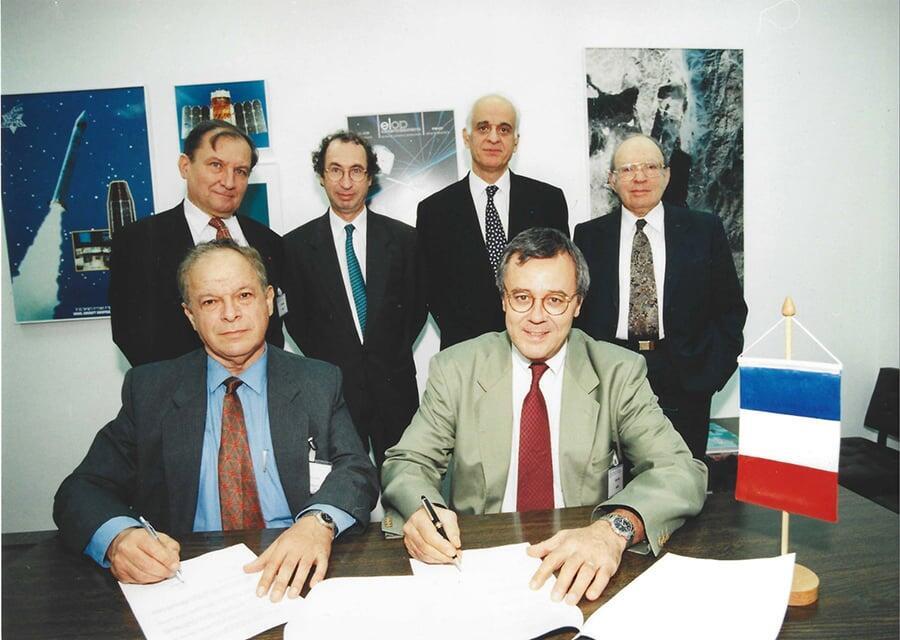
His personal charm helped lead to many international collaborations; Har-Even, seated at left, signs with Alain Bensoussan, head of the French space agency, the agreement that led to the launch of the joint Venus satellite
(Photo: Scan from Har-Even’s album, courtesy of Tal Inbar)
Har-Even led many other projects at the Israel Space Agency, including cooperation with the Netherlands on development of the SloshSat satellite to measure the movement of liquids in space and their effect on satellites; testing of French space components at the Soreq Nuclear Research Center; signing an agreement for Israeli participation in the European Galileo navigation satellite project; development of the Israeli space telescope Tauvex; and signing an agreement with India to launch it on an Indian rocket. In the end, that agreement did not come to fruition because of concerns over the quality of the Indian launch rocket, and the project was shelved, but that happened after Har-Even had already retired from the agency.
Alongside promoting international cooperation, Har-Even also worked to advance Israeli companies and help them enter the civilian space sector. Among other things, he promoted a venture to commercialize the technologies of the Ofek reconnaissance satellites, which led to the establishment of the satellite imaging company ISI. He also promoted cooperation with academia, and during his tenure the space agency began helping fund selected research projects and integrate scientific projects into space missions, such as the Meidex dust-storm study, which was an important component of Ilan Ramon’s mission.
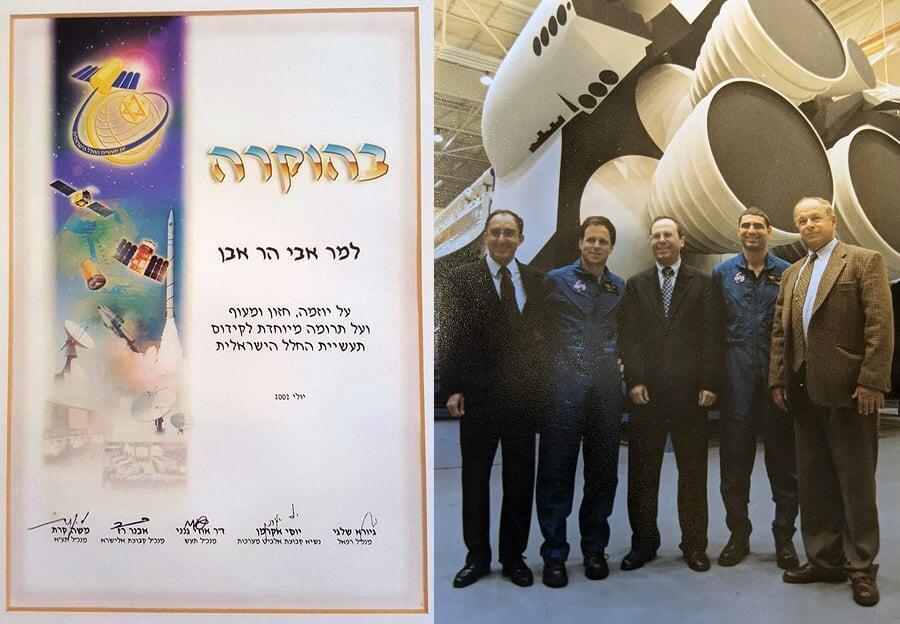
He promoted collaborations and Israeli companies in the space sector; Har-Even, right, with Israeli astronauts Ramon and Mayo and Science Minister Silvan Shalom next to a space shuttle simulator, alongside a certificate of appreciation he received from Israeli industry
(Photo: Mark Katz, Ministry of Innovation, Science and Technology; scan from Har-Even’s album, courtesy of Tal Inbar)
Another field Har-Even consistently promoted throughout his time at the space agency, even though it was not part of its formal mandate, was science education.
“I believe space is the best possible tool, because of its attractiveness, to draw young people in and open a window for them to the sciences through which achievements can be reached. And indeed, such projects are carried out in cooperation with the Education Ministry and also independently,” he said at the end of his tenure in an interview with HAYADAN.
He not only made sure to include students and educational projects in major initiatives, but also personally took part. He was happy and willing to lecture to young people in any setting, no matter what kind.
A lasting legacy
At the end of 2004, after nearly a decade at the Israel Space Agency, Har-Even was forced to step down upon reaching age 67.
“When Aby took the job, the Israel Space Agency was something of an afterthought in the Science Ministry, and no one was eager to work there,” Inbar said in summary. “He brought Israel to a highly impressive position in space and left behind an orderly agency, with staff positions, work plans and even a bit of a budget. It is no wonder that when he retired, more than 10 candidates sought to compete for the job of heading the agency.”
In 2014, when Israel hosted the annual International Astronautical Congress in Jerusalem, Inbar initiated a session at the conference in honor of Har-Even’s work in space, under the title “A One Man Space Agency.”
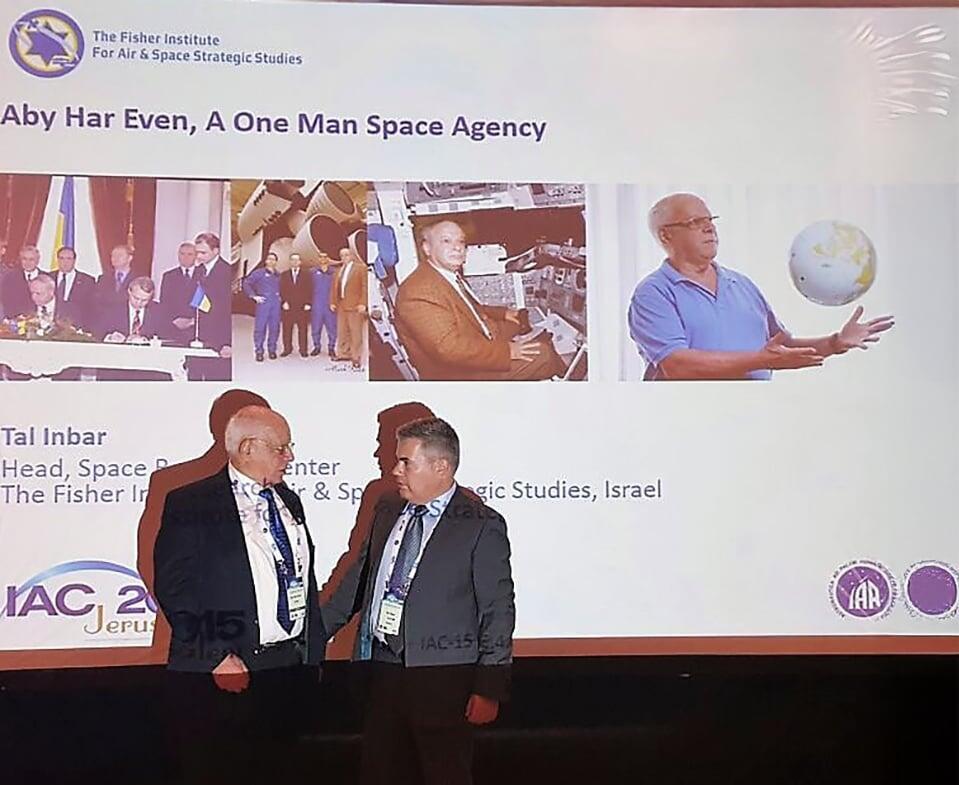
A one-man space agency; Har-Even with Tal Inbar at the close of the session honoring his work at the International Astronautical Congress in Jerusalem, 2015
(Photo: Courtesy of Tal Inbar)
Even after retirement, Har-Even continued to work on space-related matters and to promote Israel’s space sector. He served on a judging committee for projects seeking U.S. funding, lectured and advised various bodies on space issues. In 2008, he was appointed a senior research fellow at the Begin-Sadat Center for Strategic Studies at Bar-Ilan University. In that framework, he published several articles on Israeli space policy, and in 2016, he released a research booklet titled “Wars in Space,” in which he reviewed the future possibilities of using space systems in wars on the ground. He was also ahead of his time in discussing cyberwarfare in space, a field that was then still in its infancy.
Har-Even also greatly enjoyed spending time with his family after retirement, especially with his eight grandchildren, and traveling in Israel and abroad.
“He spent a great deal of time with the grandchildren, and they loved him very much,” his son Oded said. “He was a warm person, and he always wanted to be with the family.”
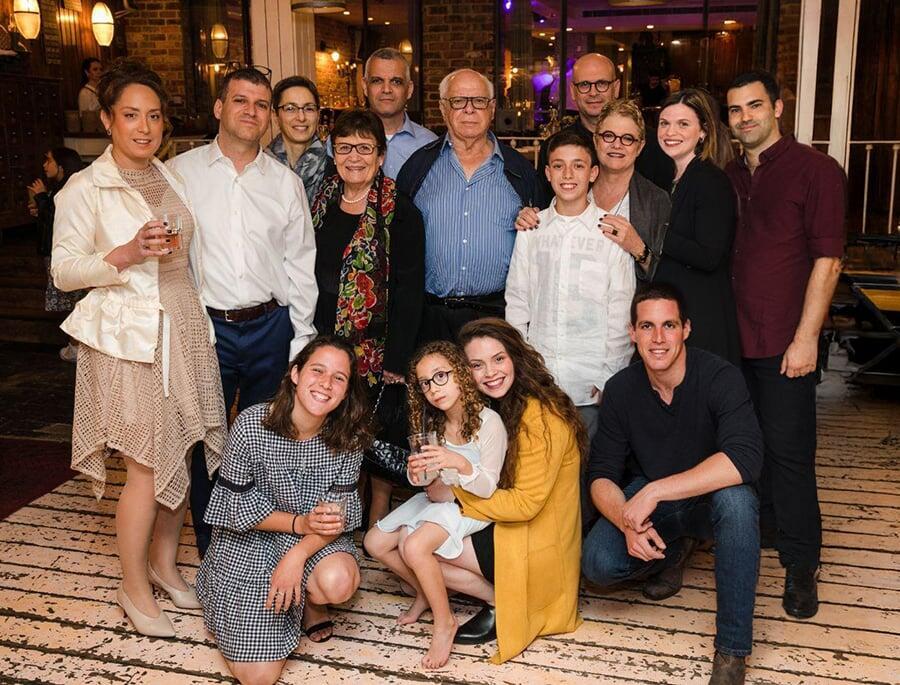
A beloved father and grandfather; Har-Even at the center of the photo with his wife, children and grandchildren at a family event
(Photo: Courtesy of the family)
In addition to caring for his own family, Har-Even also devoted time and energy to helping other children. He was one of the founders of the Safe Future Association, which worked to prevent violence and protect at-risk children, and he served on its executive board. The association ceased operating in 2016.
‘Save yourself’
After Israel’s Independence Day in 2021, Miriam and Aby Har-Even traveled to Acre for a few days’ vacation at the Efendi Hotel. At that time, during the IDF operation in Gaza known as Operation Guardian of the Walls, violent riots broke out in several mixed cities, including Acre. On May 11, the evening before the end of their vacation, Arab rioters set the hotel on fire using Molotov cocktails.
Fire at the hotel where Har-Even was staying and at a nearby restaurant


“After the hotel was set on fire, the guests were evacuated from their rooms and gathered in the lobby. They were then sent to retrieve their personal belongings from the rooms, and while they were on their way back, the hotel was set on fire again,” their son Oded said. “My mother came down in the elevator and survived, but my father, who always followed instructions, knew that during a fire, you do not use an elevator, so he went down the stairs and was trapped in the flames. When a rescuer reached him and found him in the stairwell, my father said to him, ‘You are young — save yourself.’ That was who he was. He always thought of others.”
Har-Even was still conscious, and saw that Miriam had not been hurt, when he was taken to the ambulance. Later, he lost consciousness. He was hospitalized for about three weeks at Rambam Hospital in Haifa, and died of his injuries on June 6.
“He was 84, but active and healthy. He could have enjoyed life for many more years,” his son said.
Eight people involved in setting the hotel on fire were arrested, and some of them were convicted of causing damage and participating in a riot. They received relatively light sentences — several years in prison. Some of the sentences were slightly increased following prosecution appeals to the Supreme Court. Still, no one was convicted of Har-Even’s murder or of causing his death.
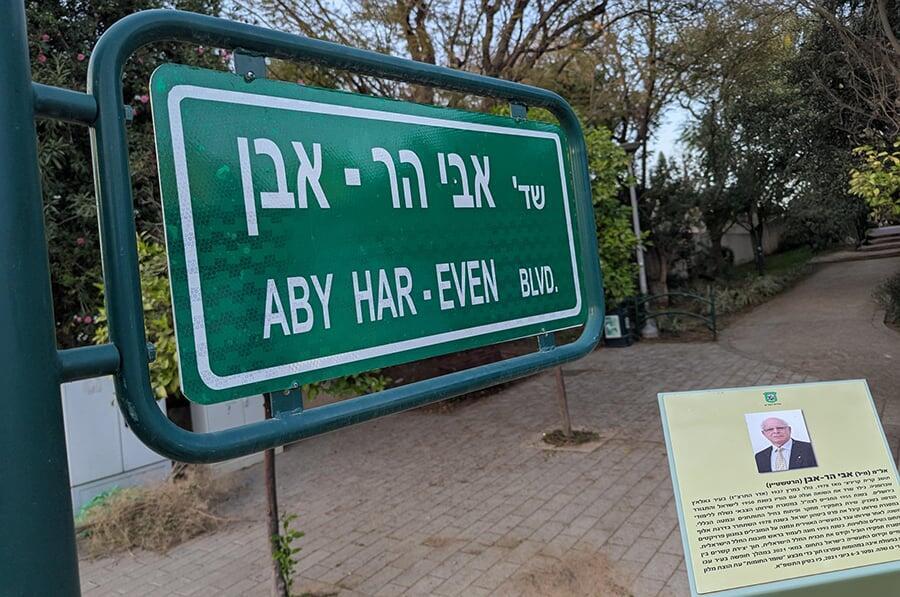
He always thought of others; Aby Har-Even Boulevard in Ramat Gan, not far from his home, and the memorial sign in his honor on the street
(Photo: Ettay Nevo, Davidson Institute of Science Education)
Since 2022, the Israel Space Agency has held the “Aby Har-Even Space Forum,” an annual conference on space, science, technology and security. In 2023, the Ramat Gan municipality named a street after him, not far from the family home.
Last year, the family established a scholarship fund in his memory in partnership with the ISEF Foundation. The scholarships are intended for master’s and doctoral students whose research also deals with space-related fields.
“Last year, there were five scholarship recipients, and this year there are six. They are truly remarkable people, including students who served extended reserve duty,” Oded said. “We thought this was a good way to commemorate someone for whom space and science education were so close to his heart.”
Ettay Nevo, Davidson Institute of Science Education, the educational arm of the Weizmann Institute of Science