

Since the dawn of human history, long before we came to understand the physics behind it, people have looked with wonder at the ceaseless transformations energy undergoes, and have sought ways to harness them by transferring energy from one form to another: from water wheels to dams and turbines; from horses pulling carriages to automobile engines; from batteries large and small to, of course, solar cells that convert the Sun’s energy into electrical energy.
It is unclear whether the question of why the Sun can be harnessed to produce electricity truly preoccupied the discoverer of the photovoltaic effect, the French physicist Edmond Becquerel, when he identified the phenomenon nearly two hundred years ago. What is clear is that almost another seventy years passed before Albert Einstein laid the theoretical foundations for understanding it. The photoelectric effect, for which Einstein was awarded the Nobel Prize, is closely bound up with the photovoltaic effect, despite the subtle difference between the two.
Gallery
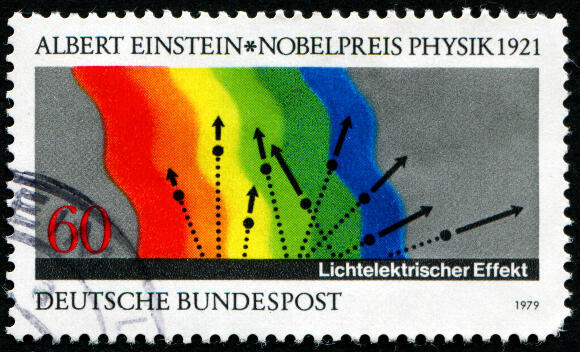
The explanation that solved a long-standing mystery in physics: why do certain waves cause electrons to be emitted from matter? A stamp issued in West Germany in 1979 to commemorate the photoelectric effect
(Photo: Galyamin Sergej, Shutterstock)
Waves of understanding
Long before Becquerel and Einstein, Isaac Newton investigated the mysteries of nature as they were understood in his day: motion, heat, and light. Electricity, of course, lay beyond his knowledge, since electromagnetic theory emerged only toward the end of the 18th century. At the time, the connection between light and other branches of physics was far from self-evident, and optics was regarded as a field of its own. Newton still believed that light consisted of particles, which he called “corpuscles.”
For several centuries, there appeared to be no findings that contradicted Newton’s view. During the 19th century, however, the idea that light was not a particle but a wave gradually gained ground, successfully explaining a wide range of optical phenomena. By the eve of the 20th century, it had become the dominant view of the nature of light. But there was one major phenomenon it could not explain: the photovoltaic effect.
One defining feature of a wave is the maximum height it reaches above its midpoint. This height is known as the wave’s amplitude. The square of this quantity is called the wave’s intensity, and according to wave mechanics, a wave’s energy is built into its intensity. The energy of a high ocean wave, for example, is greater than that of a lower one; similarly, the energy of a child on a swing increases as the highest point it reaches in its motion rises.
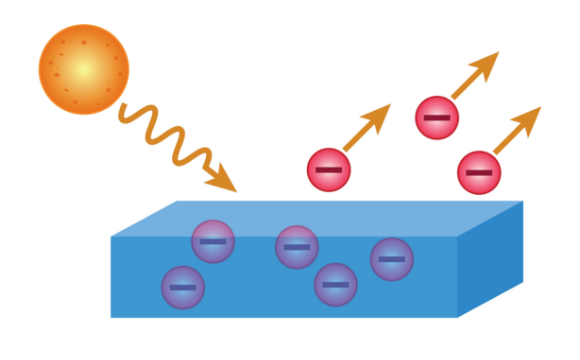
When light carries enough energy, it can free electrons from the atoms of a material — a property with many applications in science and technology
(Illustration: zizou7, Shutterstock)
According to this principle, when a metal is illuminated by light that is strong enough — that is, light of sufficiently high intensity — an electric charge should sooner or later be emitted from it. The causal link between the incident light and the emitted charge was identified by Heinrich Hertz as early as 1887, when he shone ultraviolet light on a metal and detected a negative electric charge near the metal plate. But those experiments showed that the match had to be exact: radiation at certain frequencies would cause charge to detach from the metal, while radiation at other frequencies would not. And here lies the problem: we have just said that a wave’s energy depends on its intensity, yet in this case, intensity alone is not enough to cause charge to be emitted. Does wave mechanics fail?
Back to Einstein
In 1905, Einstein published four foundational papers in three different branches of physics. Each addressed a different subject, and each became a major milestone in its field. One of them, titled On a Heuristic Point of View Concerning the Production and Transformation of Light, focused on the particle nature of light — and here, the pendulum of history swings back toward Newton.
Einstein argued that light comes in discrete packets, and that the energy of each packet depends not on the amplitude of the light wave, but only on its frequency — the property we perceive as color in the range of visible light. The higher the frequency of the light, the greater its energy. Such a packet of light is a single particle of light, which we now call a photon. The principle of discrete packets, or “quanta,” lies at the foundation of quantum theory and gave the theory its name. The intensity of light corresponds to the number of photons emitted by a light source per unit of time.
Einstein arrived at this idea through thermodynamic considerations. He also drew on an earlier paper by Max Planck, who in 1900 formulated a law describing the energy spectrum of a body that emits radiation at all wavelengths — a blackbody. Planck had shown that the radiation was emitted in discrete packets; Einstein’s further step was to identify those packets with the particles of light he had proposed.
The conceptual significance of this phenomenon, which became known as the photoelectric effect, was profound. Physicists came to understand that the crucial factor was the frequency of the incident light. If the electrons are very strongly bound to the metal, an appropriate amount of energy must be supplied to release them into free space — in other words, the metal must be illuminated with light whose frequency is high enough. The energy gap between the state in which the electrons are firmly bound to the metal and the state in which they are free is called the metal’s “work function.”
If the energy of the incident light is lower than the work function, not a single electron will be released. If the energy of the light is greater than the work function, the electrons that are released will move faster, because they carry the excess energy. So where does the intensity of the light come in? High-intensity light means a larger flux of light particles striking the metal. Once the light’s frequency is above the threshold, increasing its intensity will cause more electrons to be released.
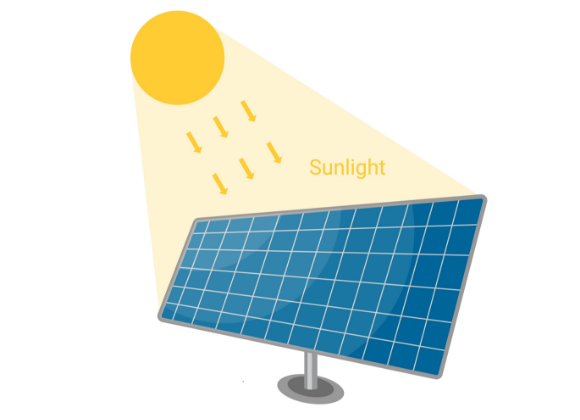
In the photovoltaic effect, electrons are not released from the material but move within it, creating an electric voltage
(Illustration: Kidzkamba, Shutterstock)
In the photovoltaic effect, the situation is similar, but not identical. Photons arriving from the Sun strike solar panels, but instead of releasing the particles that carry electric charge into free space, they leave those particles confined within the material. Without going into detail, the separation of electric charges inside the material — that is, the separation between charge carriers that have been freed and those that have not — creates an electric voltage, and therefore an electric current that can be harnessed as electrical energy. From a theoretical standpoint, the fundamental insight into the particle nature of light is what allows us to understand the photovoltaic effect as well, even though the precise mechanism is different.
The right Nobel, for the wrong reason
Although Einstein achieved many things in his lifetime — above all the development of special and general relativity — and even indirectly helped set the Manhattan Project, which developed the first nuclear bomb, in motion, it was the photoelectric effect that earned him the Nobel Prize. Why was that? After all, there is little doubt that the theory of relativity is broader in scope and far more consequential.
It seems that relativity’s very revolutionary nature worked against it. Several years passed before the groundbreaking theory took hold in the scientific community and its critics came to acknowledge their mistake. Even the experimental evidence supporting it — above all the famous solar eclipse experiment of 1919 — initially met with considerable criticism, and time was needed to answer and dispel those objections. Added to all this was the antisemitism prevalent in the German scientific community, one of the world’s leading scientific communities in the years between the two world wars.
By contrast, the photoelectric effect was much easier to accept, and it solved a long-standing and stubborn scientific mystery. In 1921, pressure grew within the international scientific community to award Einstein the Nobel Prize, and the controversy surrounding the decision ultimately led to no physics prize being awarded that year at all. Only a year later were the members of the Nobel Committee for Physics convinced that the obvious decision could no longer be postponed. Even then, the prize was awarded to him “for his services to Theoretical Physics, and especially for his discovery of the law of the photoelectric effect,” and was granted retroactively for 1921.
Einstein himself was not particularly moved by the honor, which had not been awarded for what he rightly regarded as the pinnacle of his scientific work. When his win was announced in late 1922, he was in Japan, and chose not to change his plans or travel to receive the prize from the King of Sweden. Only in July 1923 did he deliver his Nobel lecture, which pointedly dealt with relativity — a clear act of defiance toward the prize committee. With decidedly non-relativistic bluntness, he made it clear that relativity was his greatest achievement. Later in life, he did not list the Nobel Prize among his accomplishments either.
Since then, 121 years of physics have passed. The many applications of the photoelectric effect and its counterpart, the photovoltaic effect, have made them cornerstones of contemporary science and technology — from television remote controls to night-vision devices. It will be interesting to see whether, just as Einstein taught us to look at light differently, future scientists will one day challenge our current view in turn.
First published: 03:00, 06.26.26