

A routine ultrasound led to an emergency medical operation that saved the life of a newborn from Kibbutz Ashdot Yaakov Ihud in northern Israel.
Stav Burgos underwent a routine late-term pregnancy scan when Dr. Iris Ohel, a specialist in women’s ultrasounds, noticed that the fetus had dilated bowel loops with no movement, a possible sign of an intestinal obstruction.
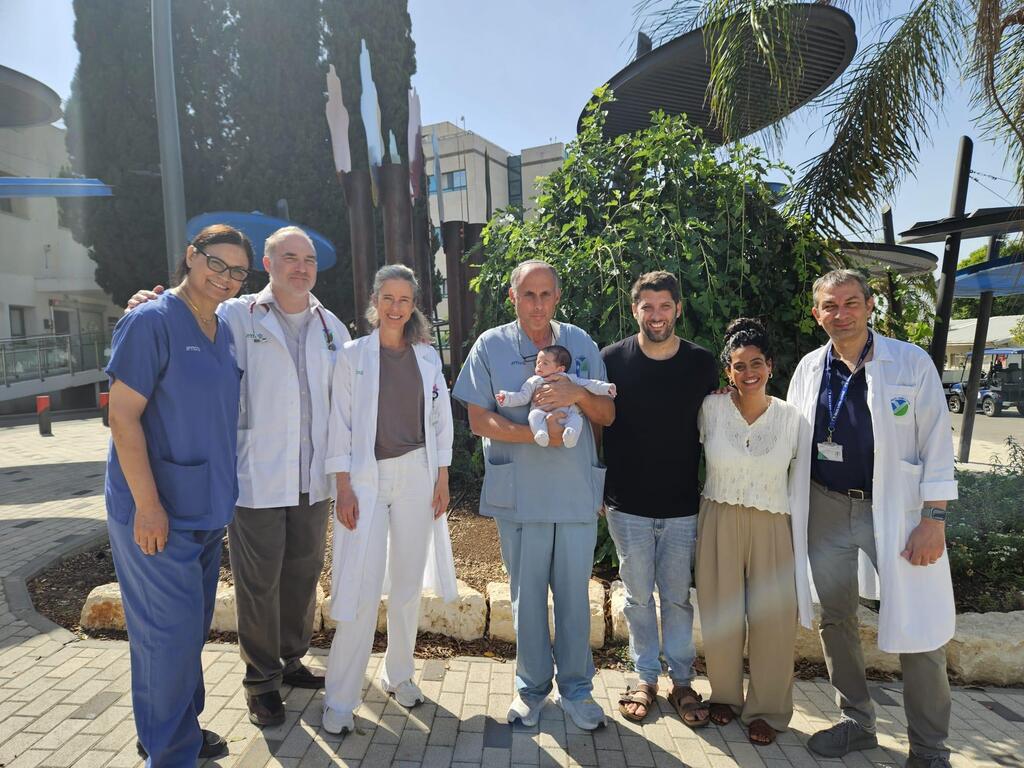
Baby Ari alongside his parents and the doctors who saved his life
(Photo: HaEmek Medical Center)
Dr. Ohel immediately referred her to the ultrasound unit at HaEmek Medical Center in Afula, where Dr. Maya Milbauer confirmed multiple intestinal blockages, a life-threatening condition that requires surgery immediately after birth.
“Intestinal obstruction in a fetus can cause fluid buildup and pressure in the bowel, which can lead to tissue death, perforation, or leakage into the abdominal cavity, any of which could be fatal,” explained Dr. David Danon, head of the hospital’s ultrasound unit.
Following the diagnosis, teams from labor and delivery, neonatal intensive care, and pediatric surgery were mobilized for an emergency birth and immediate operation.
Dr. Marc Arkovitz, head of pediatric surgery at the medical center, performed the operation shortly after the baby was delivered.
“We entered surgery without knowing the exact cause,” Arkovitz said. “It turned out there were five separate obstructions. Each one required removing the affected segment and connecting the healthy ends. These are rare congenital malformations known as atresias.” The surgery took about an hour and a half. Afterward, baby Ari was transferred to the NICU.
Dr. Scott Weiner, head of neonatology at HaEmek Medical Center, said the baby recovered more quickly than expected. “In the first days, he was fed through a central IV line to let his intestines heal, but within a few days we saw steady improvement. He started eating and digesting on his own and was released home in excellent condition less than two weeks later."
Stav, the mother said that all the tests had been normal until then; we had no reason to think anything was wrong."
Stav and her husband Ronen thanked the medical staff. "We went through challenging days, from the second scan until we were discharged home, but from the start, we felt we were in the best hands. We thank everyone, we’re now home with a healthy baby, and we can’t thank them enough."