

American economists Robert E. Hall and Michael Woodford have won the 2026 Nobel Prize in Economics for groundbreaking research into how individual economic decisions affect the wider economy and how governments and central banks can maintain economic stability, the Royal Swedish Academy of Sciences announced Monday.
The prize was awarded to Hall, of Stanford University, and Woodford, of Columbia University, for their contributions to the "microeconomic foundations of macroeconomic stabilisation," according to the academy's announcement.
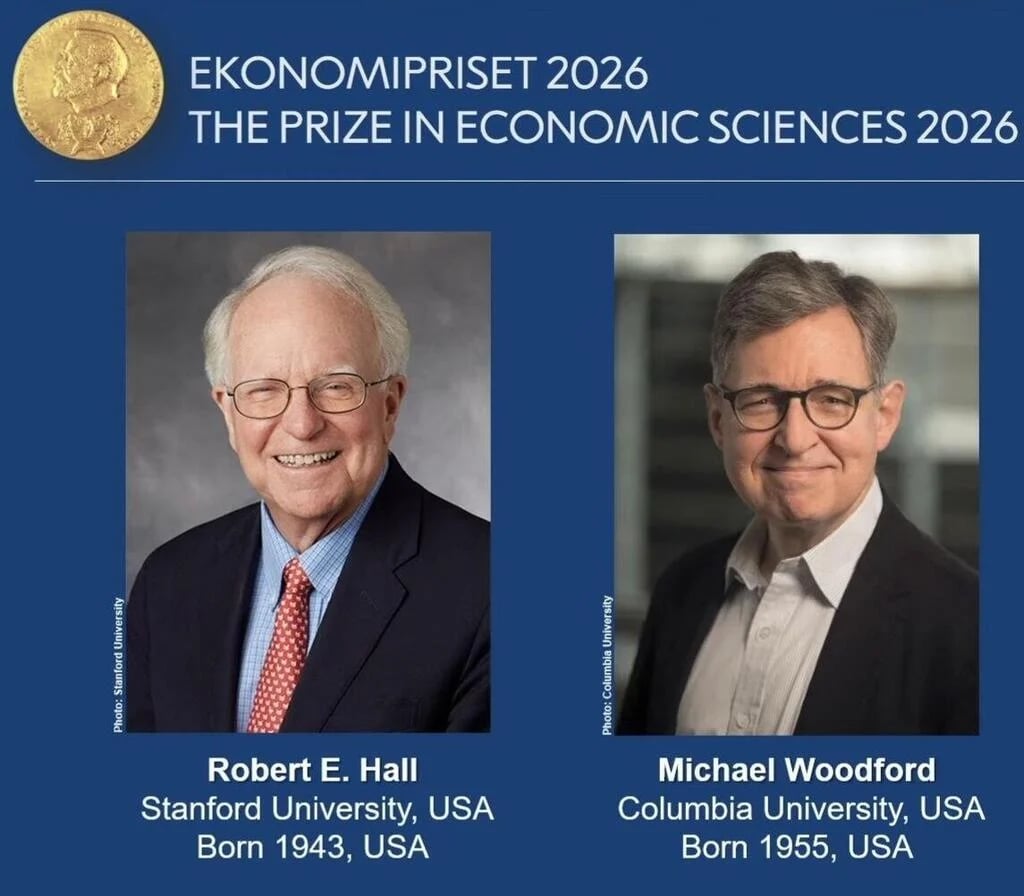
Robert Hall and Michael Woodford win 2026 Nobel Prize in Economics for work on economic stability
Their research has helped explain how the decisions of households, businesses and workers influence inflation, unemployment and economic growth, providing economists with tools to understand how governments and central banks can respond to economic downturns.
At the heart of their work is a fundamental challenge in economics: understanding how millions of individual financial decisions combine to shape the performance of entire economies.
Macroeconomics examines large-scale developments such as inflation, employment, interest rates and economic growth. Microeconomics focuses on how individuals and businesses make decisions about spending, saving, hiring and investment.
By connecting these two fields, economists can develop a more detailed understanding of why economies experience recessions, why prices rise and how monetary policy can limit economic instability.
Hall, born in 1943, is an emeritus professor of economics at Stanford University and a senior fellow at the Hoover Institution. His research has focused on employment, inflation, consumer spending and economic fluctuations.
He has also played an influential role in measuring economic cycles in the United States, serving as chairman of the National Bureau of Economic Research's Business Cycle Dating Committee, which determines the chronology of American recessions and expansions.
Woodford, born in 1955, is a professor of political economy at Columbia University and one of the leading figures in modern monetary economics.
His research has significantly influenced how economists understand the relationship between interest rates, inflation and economic activity.
Woodford is particularly known for his contributions to New Keynesian economics, a framework widely used to analyze monetary policy. His influential 2003 book, Interest and Prices: Foundations of a Theory of Monetary Policy, helped establish a theoretical basis for understanding how central banks can stabilize inflation and economic activity.
One important aspect of Woodford's work concerns expectations and the ability of central banks to influence economic behavior through communication.
For example, when a central bank signals that interest rates will remain low for an extended period, households and businesses may change their spending and investment decisions even before any further policy action is taken.
This approach, known as forward guidance, became an important part of monetary policymaking following the 2008 global financial crisis, when central banks sought ways to stimulate economic activity despite interest rates already being close to zero.
The research recognized by the academy addresses questions that remain central to economic policy: how to contain inflation without unnecessarily increasing unemployment, how to support economic activity during recessions and how to design policies that reduce the severity of financial and economic shocks.
The Sveriges Riksbank Prize in Economic Sciences in Memory of Alfred Nobel, commonly known as the Nobel Prize in Economics, was established in 1968 by Sweden's central bank and first awarded in 1969.
Unlike the original Nobel Prizes, it was not established under Alfred Nobel's will, but is awarded by the Royal Swedish Academy of Sciences and presented alongside the other Nobel honors.
This year's prize carries an award of 12 million Swedish kronor, approximately $1.2 million, to be shared by the two laureates. The award ceremony is scheduled for December 10 in Stockholm.