

The drug known as “dosa” has been grabbing headlines over the past week following the high-profile arrest of singer Osher Cohen. But on the Israeli party scene of 2026, dosa is hardly new. It has long since become the “house drug” among broad segments of the population.
A pink, fragrant powder often marketed as a “pink version of cocaine,” it conceals one of the most troubling realities of the modern drug world behind its glossy branding: uncertainty.
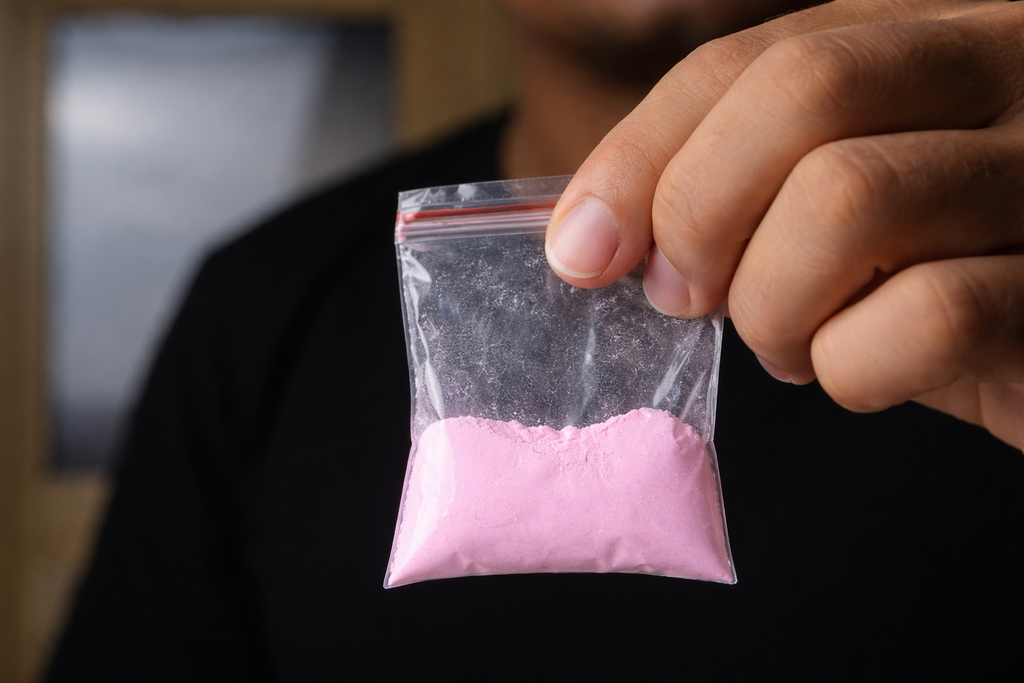
In the past, many mistakenly believed it was the psychedelic drug 2CB, hence the nickname “tusi.” Today, it is clear that the connection between the two is often purely coincidental. 2CB is a synthetic psychedelic and empathogen with properties somewhat similar to MDMA. Dosa, by contrast, is not a single substance but a shifting chemical cocktail. That is precisely what makes the powder so dangerous.
The danger of mixing
The only element that is almost always certain about dosa is its pink color. The real problem lies in the unknown “recipe” behind it. Producers in illicit laboratories mix leftovers of various substances to maximize profits. In most cases, the blends include stimulants combined with psychedelics and dissociative drugs such as ketamine.
Recent lab tests have identified combinations of the following substances in bags sold as dosa:
Ketamine: A highly prevalent drug on the party scene, increasingly found in substitute forms rather than pure ketamine. Originally developed as an anesthetic, it combines psychedelic effects with central nervous system depression.
MDMA: A stimulant and empathogen, a distinct derivative of methamphetamines, that primarily acts on the serotonin system and induces feelings of empathy and euphoria.
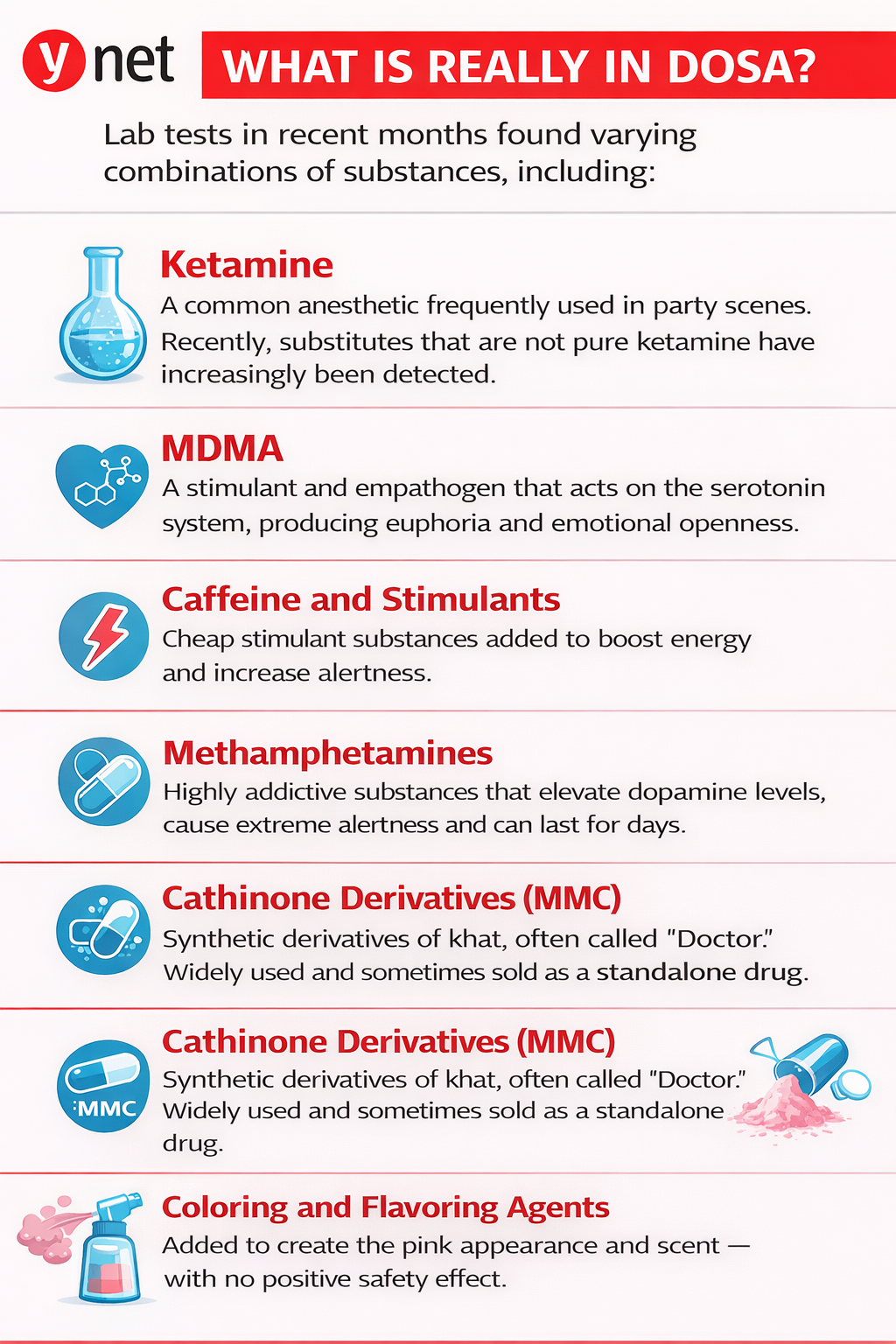
Caffeine and other stimulants: The addition of stimulants such as caffeine creates an extra boost of energy and alertness using cheap and readily available substances.
Methamphetamines: Inexpensive drugs with extremely high addiction potential, which raise levels of the neurotransmitters norepinephrine and dopamine. In Israel, significant use of methamphetamines has been observed as a low-cost substitute for other drugs. They can produce extreme alertness lasting two to three days.
Cathinone derivatives: Synthetic derivatives of khat, often referred to as MMC. Today they are among the most widely used drugs across all segments of the population. Commonly nicknamed “Doctor,” they frequently form part of the cocktail found in dosa, though they are also sold independently.
Coloring and flavoring agents: As with many products, dosa’s distinctive appearance simply results from added dyes.
Using several stimulants simultaneously can cause significant cardiac strain, spikes in blood pressure and activation of the body’s “fight or flight” response. Some users experience euphoria, heightened focus and a sense of omnipotence. Others may develop severe anxiety, panic attacks, a feeling of suffocation and rapid heart rate.
In some cases — particularly among older users (40 and above) or those with a genetic predisposition, whether known or undiagnosed — there is a risk of life-threatening cardiac events such as heart attacks or cardiac arrest, as well as strokes caused by damage to blood vessels.
Don’t rely on luck — there are steps you can take
Within this complex reality, a new company called Party Keepers was recently established with the goal of changing the conversation. The initiative was born from a basic and realistic understanding: the safest and best course of action is to avoid drug use altogether. However, for those who choose to use, safety cannot be left to chance.

(Photo: Shutterstock)
Innovative and accessible testing kits are now available, allowing individuals to determine within minutes what a powder actually contains, with a high level of certainty (testing for 10 substances). The tests are validated by the toxicology laboratory at Tel Hashomer. The initiative to introduce them stemmed both from recent experience, in which many substances sold as one thing turned out to be something entirely different, and from a forward-looking effort to create a kind of “health intelligence” system regarding substances circulating on the market — identifying changes quickly and issuing alerts about emerging trends.
Why is this particularly critical with dosa? Because dosa is a mixture rather than a single drug, the risk of unknown and potentially dangerous substances being present is significantly higher. The testing kit is not a recommendation to use drugs, but a life-saving tool. It transforms the user from a “gambler” into someone making a more informed decision based on data rather than a dealer’s assurances. It is not perfect, but it is a meaningful additional tool for understanding the pink powder.
Harm reduction: tools to prevent the next extreme case
The philosophy of harm reduction is not meant to encourage use, but to prevent deaths and serious injuries. Here are several essential rules every partygoer should know:
Testing comes first: Before touching any substance, find out how it affected others who used that exact batch, and use a testing kit to determine what it contains. This is a critical step before anything enters your body — and there is no turning back afterward.
 Dr. Roy Zucker Photo: Sourasky Medical Center
Start with half a dose: Because dosa is a cocktail, the first dose must be smaller — up to half a regular amount. Wait at least an hour to understand how this specific mixture affects you.
Be cautious with alcohol: Dosa, which may contain substances such as ketamine, can be extremely dangerous when combined with alcohol and may lead to respiratory depression and loss of consciousness. If testing reveals the presence of ketamine or other depressants, do not combine them. It is also important to remember that dosa containing mainly stimulants can mask alcohol consumption and lead to dangerous alcohol poisoning.
Have a friend nearby: Make sure people around you know what you have taken and can call for help if needed. Mutual responsibility and looking out for one another are critical and can sometimes provide a clearer assessment of your condition.
Dosa is the pink illusion of nightlife — a marketing product designed to sell cheap substances at a high price. The best choice is not to use at all. But if you decide otherwise, do not do so blindly. With the right tools and proper testing, it is possible to prevent the next party from ending in tragedy in an emergency room — or, in the worst case, as a “found without signs of life.”
- Dr. Roy Zucker is a specialist in internal medicine, infectious diseases and LGBTQ medicine. In recent years he has led harm reduction efforts in Israel and recently founded Party Keepers, which develops tools aimed at reducing risks associated with substance use.