

Media coverage of the war with Iran often notes that its large missile arsenal includes both solid-fuel and liquid-fuel missiles. The use of these two propulsion methods has accompanied modern rocketry since its earliest days, about a century ago.
This provides a good opportunity to examine how they work, the differences between them, the advantages and disadvantages of each method and their additional applications.
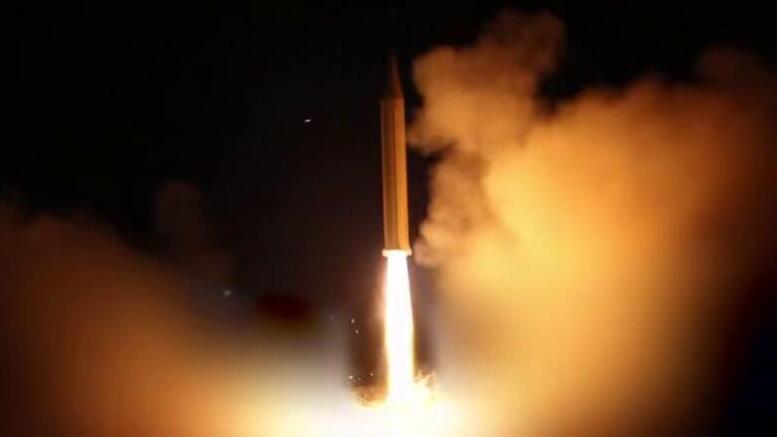
Footage of the launch of the Khorramshahr-4 missile


A matter of pressure
Unlike other types of munitions such as shells, bombs or bullets, missiles and rockets carry their own fuel and continue producing thrust after launch. All missiles currently in operational use rely on chemical propulsion. In other words, they burn fuel and move forward through the expulsion of gases produced during combustion.
Rocket flight through the powerful expulsion of gases is an application of Isaac Newton’s third law of motion: for every action there is an equal and opposite reaction.
In the past, some believed that rocket propulsion would not work in space. The reasoning was that gases must push against something — such as air — and that in the vacuum of space there would be nothing to push against. However, this idea is incorrect: the mere expulsion of gases propels the rocket in the opposite direction, even in a vacuum.
In 1969, while the Apollo 11 spacecraft was on its way to the first crewed landing on the moon, The New York Times published an apology to American rocket pioneer Robert Goddard. In a 1920 article the newspaper had mocked his claim that rockets could operate in space. “The Times regrets the error,” the paper wrote, a quarter century after Goddard’s death.
The chemical reaction responsible for the expulsion of gases is, as noted, combustion of fuel. Combustion is a chemical process in which a fuel reacts with an oxidizing agent. The process releases energy in the form of heat and light, while the combustion products are emitted as gases.
For example, the combustion reaction of propane (C₃H₈), a gas commonly used for cooking, is:
C₃H₈ + 5O₂ → 3CO₂ + 4H₂O
In other words, each propane molecule reacts with five oxygen molecules to produce three carbon dioxide molecules and four water molecules. Because the reaction also generates heat, the water is emitted as vapor — a gas — and the high temperature increases gas pressure, thereby increasing thrust.
Rocket developers today prefer fuels that produce especially large volumes of gas. One key component in such fuels is hydrazine (N₂H₄) or its derivatives. Breaking the bond between nitrogen atoms releases significant energy — similar to the process in explosives — while oxidation of hydrazine produces large amounts of nitrogen gas (N₂) and water vapor, generating strong thrust.
Fuel combustion occurs in most kinds of engines. In an internal combustion engine, such as that in a car, gas pressure moves pistons, and a crankshaft converts that motion into rotation of wheels or propellers. However, whereas in internal combustion engines — and even in jet engines — oxygen for combustion comes from the surrounding air, in rocket propulsion the oxidizer is stored within the rocket itself. It is not always pure oxygen but may be a compound containing oxygen.
Rocket engines also contain very few moving parts. In liquid-fuel rockets, most movement occurs in pumps that deliver fuel and oxidizer to the combustion chamber. The gases are expelled through a relatively narrow tube known as a nozzle, which increases gas flow speed according to Bernoulli’s principle.
To compare the performance of rocket engines and fuels, engineers use a measure called specific impulse, which reflects the change in momentum of the mass — essentially the velocity the engine can impart to the rocket. It is measured in units of velocity, though sometimes the unit is combined with Earth’s gravitational acceleration so that specific impulse is expressed in units of time.
Liquid fuel
Liquid-fuel rockets usually have two tanks — one for the fuel itself and one for oxygen or another oxidizer, such as hydrogen peroxide (H₂O₂). Pumps feed the fuel and oxidizer into the combustion chamber, and an ignition system provides the spark needed to ignite the mixture.
Some fuels are hypergolic, meaning they ignite spontaneously when they come into contact with the oxidizer and do not require an ignition system.

Zolfaghar short-range missiles powered by solid fuel displayed at an Iranian military parade in 2017
(Photo: Tasnim News Agency)
There is a vast range of fuels used in rocket propulsion. Hydrogen (H₂) is an excellent fuel, providing high specific impulse due to its low weight, and its oxidation produces only water vapor. NASA’s SLS rocket, designed to launch astronauts to the moon as part of the Artemis program, uses liquid hydrogen and liquid oxygen.
Condensing gas into liquid allows more fuel to be stored in the tank, but it requires extremely low temperatures and lengthy fueling — conditions that are not suitable for military missiles. Hydrogen is also difficult to handle because its molecules are extremely small, and even NASA struggles with leaks.
Other liquid fuels include methane (CH₄); kerosene, a mixture of hydrocarbon chains typically 12–15 atoms long that is also used as jet fuel; hydrazine and its derivatives such as unsymmetrical dimethylhydrazine (UDMH); nitric acid (HNO₃); nitrogen tetroxide (N₂O₄), which can also serve as an oxidizer; and various mixtures of these substances in different proportions depending on the needs of a particular launch system.
Most liquid fuels cannot be stored inside a missile for long periods. Some are corrosive and can damage the rocket’s metal casing. Others require cooling, and if they warm and expand they may deform the rocket structure. Hydrazine-based fuels are more suitable for long-term storage, but they are toxic and carcinogenic, which complicates maintenance and handling.
For military missiles, this means liquid-fuel rockets must usually be fueled shortly before launch. This takes time while the missile is exposed on the ground and may also create detectable intelligence signatures, such as fuel tanker vehicles arriving at the launch site.

A fueling tanker for the American Titan II intercontinental ballistic missile at a missile museum in Arizona
(Photo: Kelly Michals, Flickr, CC BY-NC 2.0)
Designing liquid-fuel rockets presents additional challenges, including movement of the liquid inside the fuel tanks — especially when they are not full — which can shift the rocket’s center of mass and slow it down. To reduce this effect, tanks are often designed with internal rings or protrusions that limit liquid movement.
In addition, because most of the rocket’s mass at launch is fuel, the center of mass changes as the fuel burns. However, advanced propulsion systems compensate for these changes.
Solid fuel
The use of liquid fuel began just under a century ago, in 1926, with the pioneering work of Robert Goddard. All rockets launched before that — since their likely invention in ancient China in the 12th or 13th century — used solid fuel.
These early rockets were essentially tubes packed with gunpowder, with an opening at one end that allowed gas to escape. Gunpowder contains both fuel and oxidizer in a single solid mixture, much like the material in match heads.
Indeed, if several matches are wrapped in a cylindrical casing, they can demonstrate rocket propulsion on a small scale. Even small birthday-cake fireworks contain solid fuel and oxidizer — and can burn underwater.

The solid fuel and oxidizer are cast around the rocket’s perimeter, while the central cavity serves as the combustion chamber. A segment of an SLS booster used for launching spacecraft to the moon (right). The rocket itself uses liquid fuel, while the boosters use solid fuel
(Photo: NASA)
Modern solid-fuel missiles are not very different from those ancient rockets. Gunpowder, which produces relatively low specific impulse and carries safety risks, has been replaced by substances that generate larger volumes of gas but rely on the same principle of combining fuel and oxidizer.
Solid fuels may include compounds of zinc and sulfur or materials such as nitrocellulose. Today, however, most solid rocket fuels use metal-based fuels such as magnesium or aluminum combined with substances that act as both oxidizers and fuels, such as ammonium nitrate (NH₄NO₃) or ammonium perchlorate (NH₄ClO₄).
These materials are also widely used elsewhere, such as in agricultural fertilizers, which makes monitoring their use more difficult. Sometimes the mixture includes small crystals of advanced explosives such as RDX or HMX, which increase specific impulse but also raise the risk of accidents or failures.
For effective operation, the fuel and oxidizer must be cast together inside the rocket so that the combustion reaction can propagate. The rocket must be packed with precise density. If the material is too powdery — meaning it has a large surface area — it may burn too quickly, producing excessive gas pressure and causing the rocket to explode. Air bubbles in the fuel can cause similar problems. On the other hand, if the material is too dense, combustion may proceed too slowly and fail to produce sufficient thrust.
In solid-fuel rockets, the fuel mixture is usually cast around the inner wall of the rocket in a cylindrical shape, leaving a hollow tube in the center. This cavity serves as the combustion chamber. Gas pressure builds inside it and escapes through the engine nozzle, producing thrust.
Solid-fuel ballistic missiles received a major boost during the Cold War between the United States and the Soviet Union. Each superpower had to be prepared for a nuclear strike and capable of responding immediately with one of its own.
Because such missiles needed to launch within minutes, there was no time for fueling. As a result, both sides developed missiles that could remain on launch pads for long periods while still being ready for rapid ignition.
So which is better?
The fact that both propulsion methods remain in use suggests that each has advantages and disadvantages.
The major advantage of liquid fuel is higher specific impulse. This means that to launch a warhead of a certain mass, a liquid-fuel rocket can be smaller, making it easier to transport and less vulnerable to enemy detection.
As missiles grow larger and longer-range, the advantage tends to shift toward liquid fuel. Solid-fuel rockets of similar capability would have to be enormous, requiring permanent storage locations — which might be known to the enemy — or extremely complex transportation.
On the other hand, liquid-fuel missiles must be fueled before launch, which takes time and exposes the launchers. They also require more maintenance, and many rely on toxic fuels, complicating safety procedures. As a result, most smaller and shorter-range missiles use solid fuel, while longer-range missiles more often rely on liquid fuel.
Another disadvantage of solid fuel is that once ignition begins there is little control over the rocket. The burn rate cannot easily be adjusted and the engine cannot be shut down. With liquid fuel, however, pumps can be controlled remotely, allowing engineers to increase or decrease fuel flow and adjust the rocket’s speed and trajectory.
These capabilities are less critical for military missiles but are very important for rockets that launch cargo or astronauts into space.
In recent years, some solid fuels have been developed that allow limited control over combustion and even engine shutdown and restart by dividing the fuel into smaller segments ignited electronically. Hybrid rockets, which combine solid fuel with liquid oxidizer, also exist but are rarely used for military purposes.
Civilian space rockets also use both types of propulsion. Generally, large launch vehicles rely on liquid fuels, often cryogenic ones — fuels that must be kept liquid at extremely low temperatures.
NASA’s SLS rocket uses liquid hydrogen and liquid oxygen. SpaceX’s massive Starship uses liquid methane and liquid oxygen — fuels that could potentially be produced on Mars to refuel spacecraft there. Falcon 9, SpaceX’s main workhorse rocket, runs on liquid kerosene and liquid oxygen.
The first stage of the giant Saturn V rocket, which launched Apollo astronauts to the moon, also used liquid kerosene and liquid oxygen, while its second and third stages — designed primarily for operation in space — used liquid hydrogen and liquid oxygen.
In space itself, propulsion systems exist that would be inefficient on Earth. One example is ion propulsion, which accelerates electrically charged atoms to high speeds and ejects them into space. These engines produce very weak thrust and are not suitable for atmospheric flight, but they can operate for extremely long periods and have very high specific impulse.
Over long durations in a vacuum, they can gradually accelerate spacecraft to impressive speeds. For this reason, they are currently used mainly for orbital adjustments of satellites and spacecraft, which can be carried out slowly over time.
Itai Nebo, Davidson Institute of Science Education, the educational arm of the Weizmann Institute of Science