

Researchers at the Technion and in the United States have developed a new artificial intelligence-based method that could significantly accelerate and improve MRI scans, with immediate potential for breast cancer imaging and broader applications in other parts of the body.
The method, called ELITE, was described in a study published in Nature Communications. It combines artificial intelligence with advanced mathematical modeling to enhance dynamic MRI, a critical tool in breast cancer diagnosis and monitoring.
Gallery
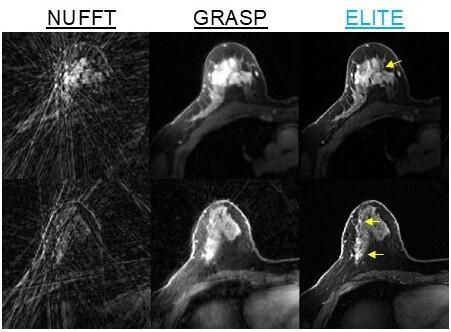
ELITE results in two patient: provides high temporal and spatial resolution, reduces noise, and enhances the visualization of breast tumor (marked in yellow) and blood vessels morphology
(Photo: Technion)
Breast cancer is diagnosed in about 2.3 million people worldwide each year, most of them women. Dynamic MRI is used mainly to screen people at high risk for the disease and is considered highly sensitive, with accuracy above 90%, compared with about 50% to 60% for ultrasound and mammography combined.
But MRI has long faced a central limitation: the more detailed the image, the longer the scan usually takes. That creates a problem in dynamic imaging, where doctors need to follow the movement of contrast material through tissue in real time. Traditional MRI exams typically produce one image every one to two minutes at best, making it difficult to capture rapid changes in the tissue.
Dr. Eddy Solomon of the Technion’s Faculty of Biomedical Engineering, the lead author of the study, said the team aimed to bridge that gap by combining several computational tools. The method uses mathematical modeling to identify structural and functional patterns in different tissues, along with a deep neural network known as ResNet, which was trained to remove noise and distortion. It also reconstructs missing information from undersampled measurements.
The result, the researchers said, is the ability to generate one MRI image per second.
That near-continuous tracking of contrast material could allow physicians to identify small tumors more accurately, better distinguish between benign and malignant tumors, and more precisely characterize biological features of tumors, including blood flow and vascular permeability.
In a study involving 54 patients, the researchers reported improved tumor visibility compared with existing methods, high image quality and high diagnostic sensitivity. The shorter scanning process could also allow more women to be examined using the same MRI machine, potentially increasing access to testing.
The new study builds on research published last year in Radiology: Artificial Intelligence, in which Solomon and collaborators from New York University created a repository of 300 breast cancer MRI scans designed specifically for the development of AI-based imaging methods.

Dr. Eddy Solomon
(Photo: Leo DeLuca)
Although ELITE was tested specifically for breast cancer imaging, the researchers said it may also be useful for brain, head and neck imaging. They also said the method could eventually contribute to improvements in other imaging platforms, helping create faster, more accurate and more personalized diagnostic systems that give doctors deeper biological information in real time.
The study included researchers from Weill Cornell Medical College and NYU’s Center for Advanced Imaging Innovation and Research. It was supported by grants from the National Institutes of Health and RSNA Research, the research arm of the Radiological Society of North America.
Solomon’s research focuses on developing MRI scanning methods from both computational and physics-based perspectives. His goal, according to the Technion, is not only to accelerate scans and improve accuracy, but also to make MRI more accessible to patients for whom the technology is currently difficult to use.