

Four robotic surgeries to implant an artificial urinary sphincter were performed for the first time in Israel several weeks ago on women suffering from severe incontinence, at the Galilee Medical Center’s Obstetrics and Gynecology department in Nahariya. While the procedure is primarily known for use in men, it is currently offered to women at only a limited number of hospitals worldwide.
The technique has now reached Israel and was carried out for the first time on four women, ages 44 to 75, who had previously undergone multiple surgeries to treat the condition. For them, this was a last resort.
Gallery
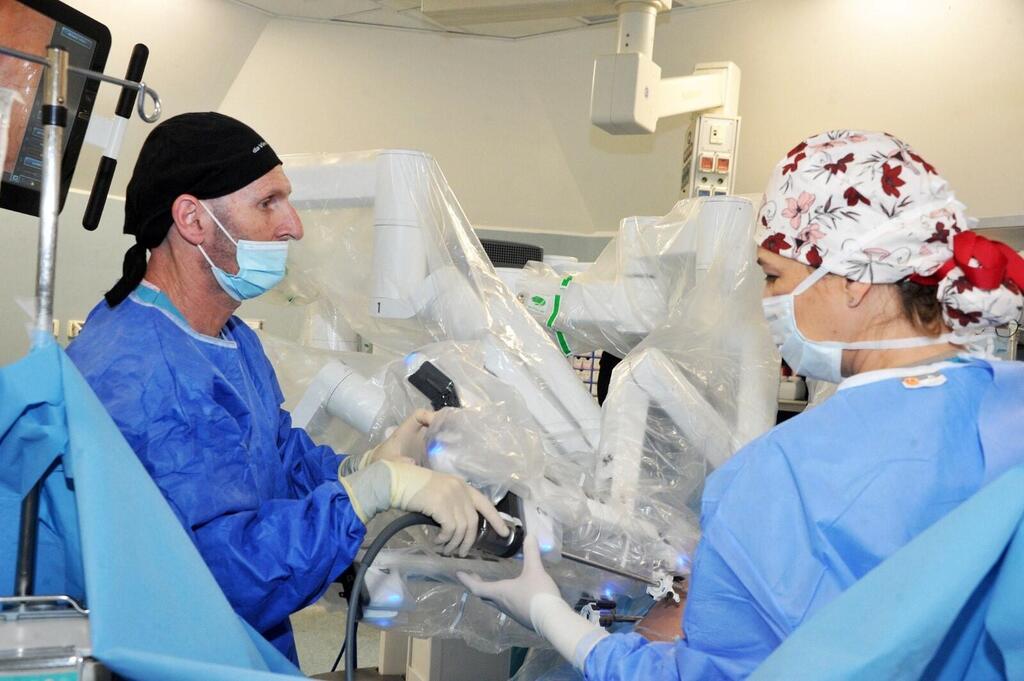
Prof. Lior Lowenstein and Dr. Susana Mustafa-Mikhail during surgery at Galilee Medical Center
(Photo: Roni Albert)
“This is a breakthrough,” said Prof. Lior Lowenstein, director of Obstetrics and Gynecology at Galilee Medical Center, associate Dean of Education and head of Azrieli School of Medicine at Bar-Ilan University.
“Where previously I had nothing more to offer these women, we can now open new therapeutic avenues. The surgery itself represents hope where none existed before."
Stress urinary incontinence (SUI), a condition three times more common in women than in men, often results from intrinsic sphincter deficiency (ISD). "It can be caused by multiple childbirths, instrument-assisted deliveries, prior surgeries, or genetic factors, and has a serious impact on quality of life", explains Prof. Lowenstein.
Urinary incontinence generally falls into two categories: stress incontinence, which occurs during physical activity, coughing, or laughing; and overactive bladder, characterized by sudden urges and frequent urination, including nighttime trips to the bathroom, explains Prof. Lowenstein.
First-line treatment usually involves pelvic floor physiotherapy. In more severe cases or when therapy fails, surgical options like mid-urethral slings (in which a synthetic sling is implanted beneath the urethra to support it and prevent urine leakage during increased abdominal pressure) may be considered, he adds.
However, when these methods fail, options become limited. “We often hit a dead end,” said Prof. Lowenstein. “Many women are left to live with the condition, which severely affects their daily lives, intimacy, and social participation. Many simply avoid certain activities altogether."
The use of a robot reduced complications
While artificial urinary sphincters have been used in men for decades, anatomical differences and technical complexity have made it difficult to offer this option to women, until now. The procedure involves placing a device that mimics the function of a natural sphincter, allowing controlled urination. In men, this is more straightforward due to the external structure of the urethra, whereas in women, open surgery was previously the only option, which increased the risk of complications.
However, Prof. Lowenstein notes that the wider adoption of robot-assisted implantation techniques in recent years has brought about a significant shift, improving imaging and control of the surgical tools used for precise operations around the bladder neck. As a result, there is potential to reduce surgical injury and complication rates. The innovative procedure was performed using the Da Vinci surgical robot.

From Left: Dr. Susana Mustafa-Mikhail, Prof. Gilles Karsenty, Prof. Lior Lowenstein. The knowledge gained in France is now being used to perform the procedure in Israel
(Photo: Galilee Medical Center)
Prof. Lowenstein explains that implanting the artificial sphincter is “like placing a ring around the outlet of the bladder, which can be controlled to stay open or closed. When the ring is closed, it applies pressure to the bladder tube from the outside, preventing the bladder from emptying or leaking. It’s like a party balloon with a ribbon tied tightly so air doesn’t escape. When you want to urinate, there’s a button that opens the valve."
The surgeries were led by Dr. Susana Mustafa-Mikhail, head of urogynecology and pelvic floor reconstructive surgery at Galilee Medical Center, in collaboration with Prof. Gilles Karsenty from Aix-Marseille University Hospital in France.
“Prof. Karsenty is a senior urologist and one of the world’s leading experts in this field. Before the surgeries, Dr. Mustafa-Mikhail and I traveled to work alongside him during two days of operations. A few months later, he came to assist us in performing the first surgery of its kind in Israel,” said Prof. Lowenstein.
All four patients underwent pelvic X-rays 24 hours post-surgery to verify the correct placement of the device. Weekly follow-ups showed no complications, and doctors expect to activate the sphincter pumps within a week, enabling full control over urination.
Prof. Lowenstein emphasized that this is a highly complex procedure requiring significant surgical expertise and close follow-up. “This isn’t an instant fix. It’s part of a larger therapeutic process involving a period of adjustment, guidance, and follow-up."
The Obstetrics and Gynecology department stressed the importance of raising awareness about urinary disorders, which often go undiscussed despite their serious effect on daily life. The collaboration with Prof. Karsenty is part of the department’s broader effort to integrate global knowledge and standards into its clinical work.
According to Prof. Lowenstein and Dr. Mustafa-Mikhail, the success of these surgeries could pave the way for more such procedures in women: “This device dramatically improves quality of life, reducing reliance on pads, social isolation, and physical limitations."