


Adolescence is a complex period for teenagers: the body changes rapidly, growth accelerates, and awareness of every physical change is at its peak. For some girls, these years also bring an unexpected medical challenge: scoliosis, which usually develops during the years of rapid growth.
It is not merely a matter of posture or appearance, but a complex condition that affects the structure of the spine, range of motion, self-image and mental well-being. What causes it, how can it be detected in time, and what does the path from initial diagnosis to treatment decisions look like?
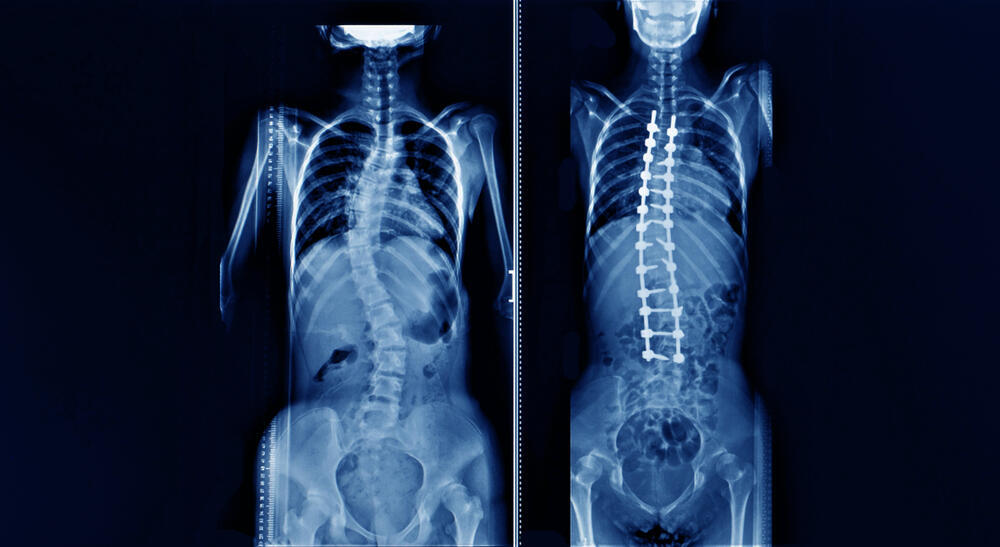
What is scoliosis?
“Scoliosis is a three-dimensional condition that affects the spine and usually begins with the body’s growth process at the start of adolescence,” explains Dr. Eyal Behrbalk, an orthopedic spine surgeon at Assuta Ramat HaHayal medical center.
“It is mainly characterized by deformity in the thoracic and lumbar spine. Instead of the spine appearing straight when you look at it, it takes on an S shape, like a snake. Scoliosis is also a rotational condition. It causes rotation of the vertebrae and usually creates a hump near the right shoulder blade, as well as another prominence in the lumbar spine on the left side.
It is far more common in adolescent girls than in boys, at a ratio of six to one. In other words, for every six cases in girls, there is one case of scoliosis in boys.”
Despite extensive research worldwide, the cause of the most common type of scoliosis remains unknown. “We do not know what causes it,” says Dr. Behrbalk. “Despite enormous investment in research and attempts to understand the causes of scoliosis, we still have not managed to isolate the reason. That is why it is called idiopathic scoliosis, scoliosis whose cause we do not know. That is different from other types of scoliosis whose causes we do know, which are less common.”
“Common scoliosis in adolescent girls is idiopathic scoliosis that develops during puberty. It is a structural problem of the back, and for that reason, beyond a certain degree of deformity, almost nothing helps stop it. It is not something where you can simply exercise, strengthen muscles or take some active step and the back will straighten.”
Beyond the medical aspect, Dr. Behrbalk stresses that the visible appearance of scoliosis can have a significant emotional effect on patients and their families. “Cosmetically, it is very frightening. The emotional aspect is critical. These are adolescent girls, already navigating a difficult and sensitive stage of life.”
"Many times, they arrive at the initial diagnosis and treatment very frightened, and rightly so. It is not like a 70-year-old adult, who experiences things differently. Here we are talking about a teenage girl and her parents who need to accompany their child, the person most precious to them. It is a completely different experience, one that requires a much broader support system.”
How is scoliosis diagnosed?
In many cases, diagnosis begins with the girl’s own instinct or with a simple visual observation, even before a medical examination. “Usually, an adolescent girl will report that she suddenly sees in the mirror that the shape of her back is not symmetrical,” Dr. Behrbalk says. “Sometimes there is a sideways tilt, and the body shifts slightly to one side because of the scoliosis. The girls report it, and sometimes it is accompanied by back pain, mainly where the right-sided hump is in the thoracic spine.”
The pain, Dr. Behrbalk says, is not necessarily severe, but it is noticeable. “It is not intense, but it bothers the patient. That is why she comes to her mother and father in the first place. The parents look, see that the back is not symmetrical, and that is how they come for a medical examination.”
The diagnosis itself begins with a simple clinical exam. “We start by looking at the back and asking the teenager to bend forward,” Dr. Behrbalk explains. “Forward bending of the back accentuates the scoliosis, and we measure it. We have a very simple device called a scoliometer, which we place on the patient’s back to measure the angle during the physical examination.
"If scoliosis is suspected, either because the scoliometer suggests it or because visual examination raises suspicion, we send the patient for simple X-rays. The imaging allows us to measure how severe the scoliosis is and determine treatment.”
How is scoliosis treated?
Treatment for scoliosis is not uniform. It is determined first and foremost by the patient’s stage of growth and the severity of the curve at the time it is detected.
“The younger the patient is when the condition is discovered, the larger the curve, and the more growth potential the girl still has, the greater the chance that the scoliosis will reach high degrees and that she will need surgery,” Dr. Behrbalk says.
“The closer scoliosis begins to the end of growth potential, at age 14 or 15, when girls are finishing puberty, the lower the chance of surgery.”
Assessing growth potential is a central part of decision-making. “We always have to think about the girl’s growth potential,” he says. “We can estimate it according to the start of menstruation. Usually, a year and a half to two years after menstruation begins, the girl stops growing. If a teenager comes to me with significant scoliosis and has not yet started menstruating, I know she has substantial growth potential and that we may need to intervene surgically. In addition, we take an X-ray of the left hand to determine bone age accurately, which gives us another indication of the teenager’s growth potential.”
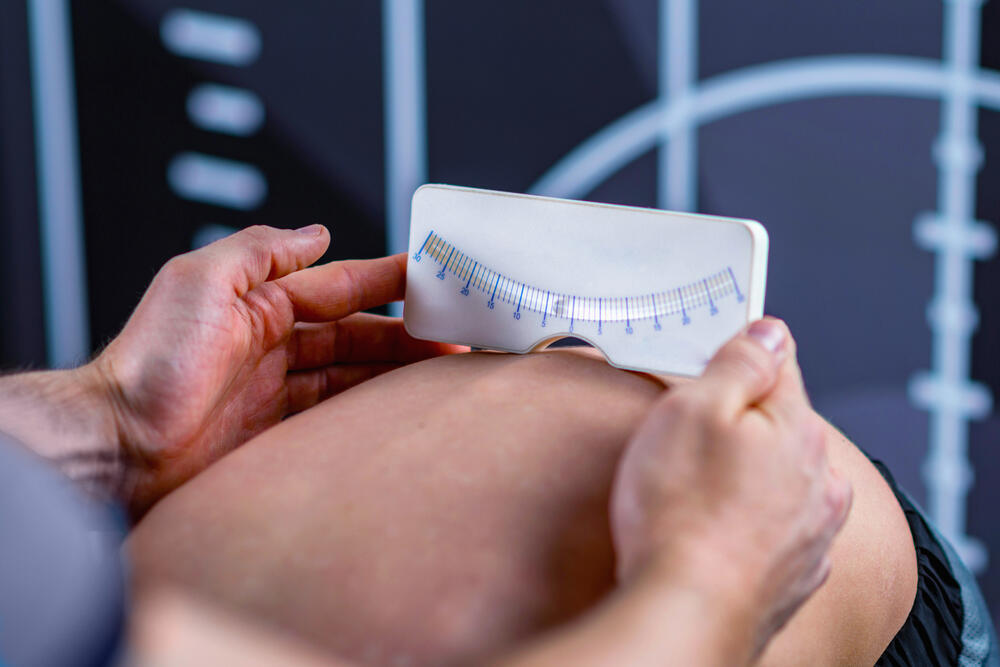
Scoliometer, a device used to screen for scoliosis
(Photo: Shutterstock)
After the tests are completed, the treatment decision is made in a joint conversation with the family. “If the scoliosis is less than 20 degrees, it does not require treatment, only monitoring. The patient comes every six months with new X-rays, and we check that the scoliosis is not worsening. If it is above 20 degrees, we begin conservative treatment: Schroth physiotherapy and a brace, conservative methods that try to stop the progression of the scoliosis,” he explains.
“If the scoliosis reaches 40 to 50 degrees and there is still growth potential, we begin thinking about surgical treatment. If the scoliosis is 40 to 50 degrees and there is no growth potential, surgery is not mandatory.”
He adds: “We know that if scoliosis has passed 50 degrees, even after full maturity, the curve may worsen by one to one and a half degrees every year for the rest of life. So if a 15-year-old patient reaches more than 50 degrees, right at the threshold for surgery, and it worsens every year, by age 30 or 40 she may reach 70 to 80 degrees of scoliosis, with a very significant impact on quality of life. That is why, in these cases, we discuss surgery.”
As for surgery, Dr. Behrbalk describes several methods, beginning with the classic approach: posterior surgery. “We make a skin incision in the back and insert screws and rods. The screws are inserted into the back using navigation, and the rods are locked onto the heads of the screws, essentially fusing the spine. It is the classic operation, and it is an excellent surgery.”
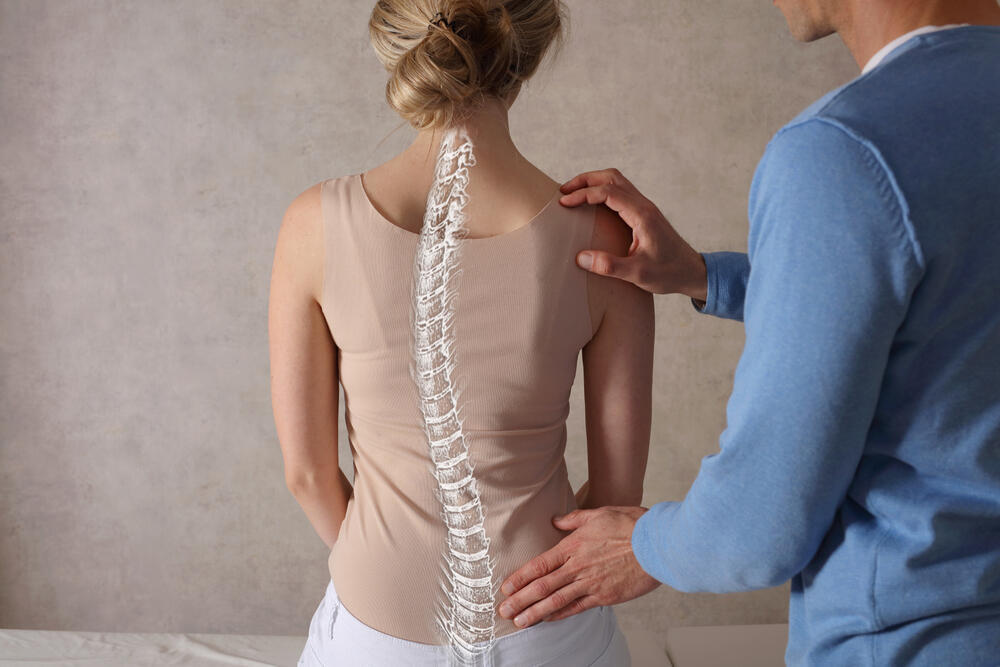
More common among adolescent girls
(Photo: Shutterstock)
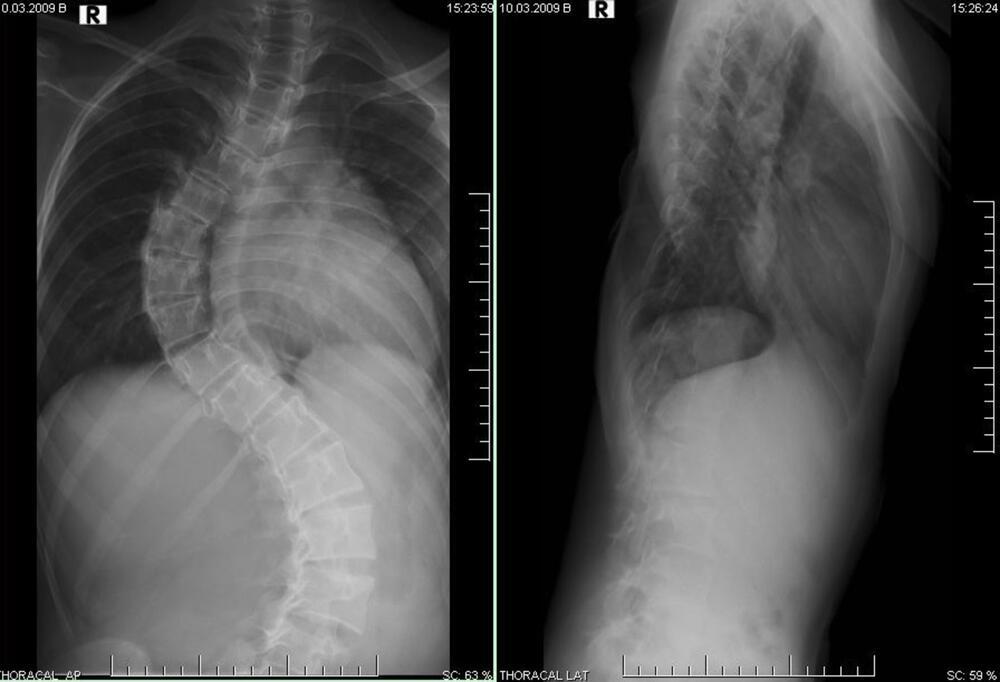
Scoliosis as seen on an X-ray
(Photo: Shutterstock)
However, he points to its main drawback. “The screws and rods fuse the back and prevent movement,” he says. “There is almost no movement in the thoracic spine, and most movement is in the lumbar spine. When the fusion extends down into the lumbar region, the consequences are felt over time. If I correct the spine and go down to half or two-thirds of the lumbar spine, I have stopped movement in some of the intervertebral discs in the lumbar spine.”
“The girl becomes less flexible. In addition, all the discs where movement remains are placed under a great deal of stress, because the girl still wants to bend forward and straighten up, but the back is fused. The discs where movement remains therefore work harder and have the potential to wear down at a younger age. In the general population, discs wear down after age 50. In people with spinal fusions, the discs wear down at younger ages because of the load created by the fusion.”
A new surgical approach
In recent years, however, another surgical approach has been developing. It aims to treat scoliosis without paying the price of full fusion and loss of movement: VBT, vertebral body tethering, which is performed in adolescents at an earlier stage of growth and with milder scoliosis; or ASC, anterior scoliosis correction, which is a motion-preserving operation for adolescents at a later stage of growth or with larger curves.
“Classic fusions have existed since the 1960s and 1970s, while VBT and ASC surgeries have existed for about 15 years,” Dr. Behrbalk says. “In these procedures, we insert screws into the vertebrae of the spine not through the back, as in the classic approach, but from the side, through the chest, between the ribs and after deflating the lung on the side through which we enter.
"Then, unlike the classic method in which a rigid rod is attached to the screw heads, we place a flexible cord and lock it to the screw heads between the vertebrae. The cord preserves full flexibility of the back, and there is no fusion of the vertebrae.”
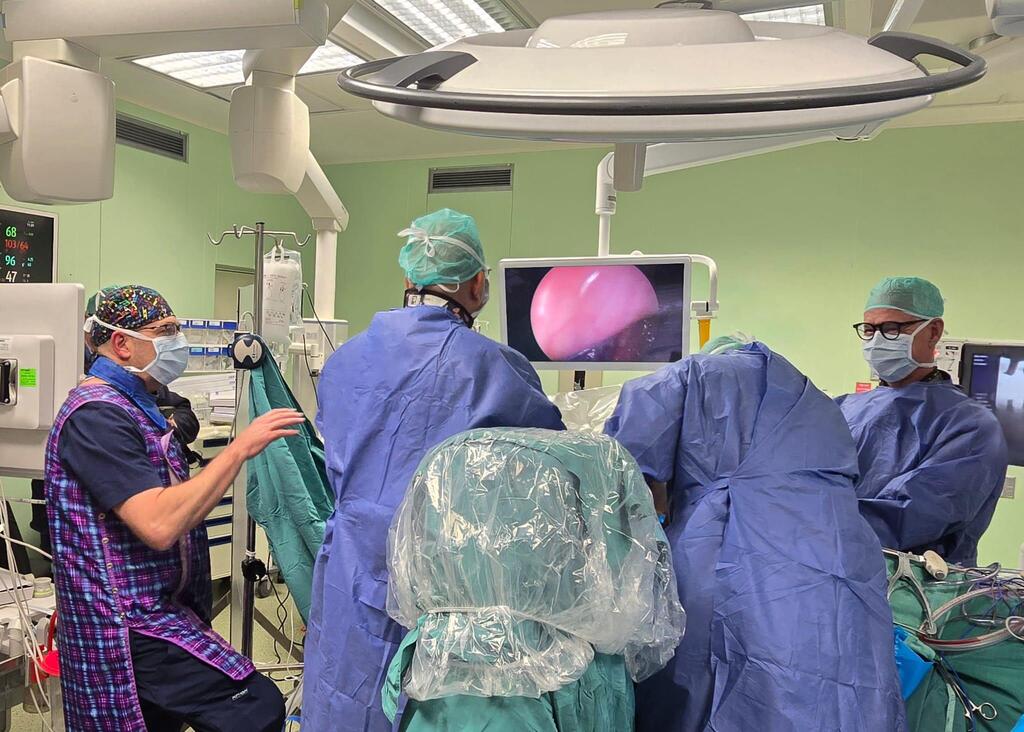
Scoliosis surgery at Assuta
(Photo: Assuta)
The biomechanical principle is simple but effective. According to Dr. Behrbalk, VBT surgery can allow the scoliosis to correct itself over the years, provided there is still growth potential. “Imagine a concave bowl, and you place the screws on the concave side. “As the girl grows, the untethered side continues to grow, while the tethered side is held back. Over time, that growth imbalance helps the spine correct itself, alongside the correction achieved during surgery.”
Here too, timing is critical. “The earlier we understand that the scoliosis requires surgical treatment, the better it is to seek consultation and receive a recommendation on whether to proceed with surgery,” he says. Still, he emphasizes that the operation is not suitable for every case.
“There are girls in whom the rib hump component is very significant, or cases of large, rigid scoliosis,” he says. “In those situations, when the goal is to reduce the hump and the degree of scoliosis, the classic surgery works better.”
Dr. Behrbalk adds that in more challenging cases involving rigid thoracic scoliosis, another type of surgery may be performed: hybrid surgery. “This type of surgery combines the classic method of fusion with screws and rods in the thoracic curve, where there is less movement than in the lumbar spine, together with motion-preserving VBT surgery for the lumbar curve. That way, we can provide a solution for more severe scoliosis cases as well.”
Over the years, the boundaries of the method have continued to expand. “As the method showed success in simpler scoliosis cases, we began performing it in increasingly complex curves. The indications for surgery have become more refined over the years,” Dr. Behrbalk says.
He adds that the approach, which until recently was something patients had to travel abroad to receive, is now being implemented in Israel, both in several public hospitals and recently as part of the private hospital activity at Assuta Ramat HaHayal.
According to him, the goal is not only to make the surgery available in Israel, but to create a structured treatment pathway for patients, combining leading international expertise with local support in Hebrew and within the Israeli healthcare system.
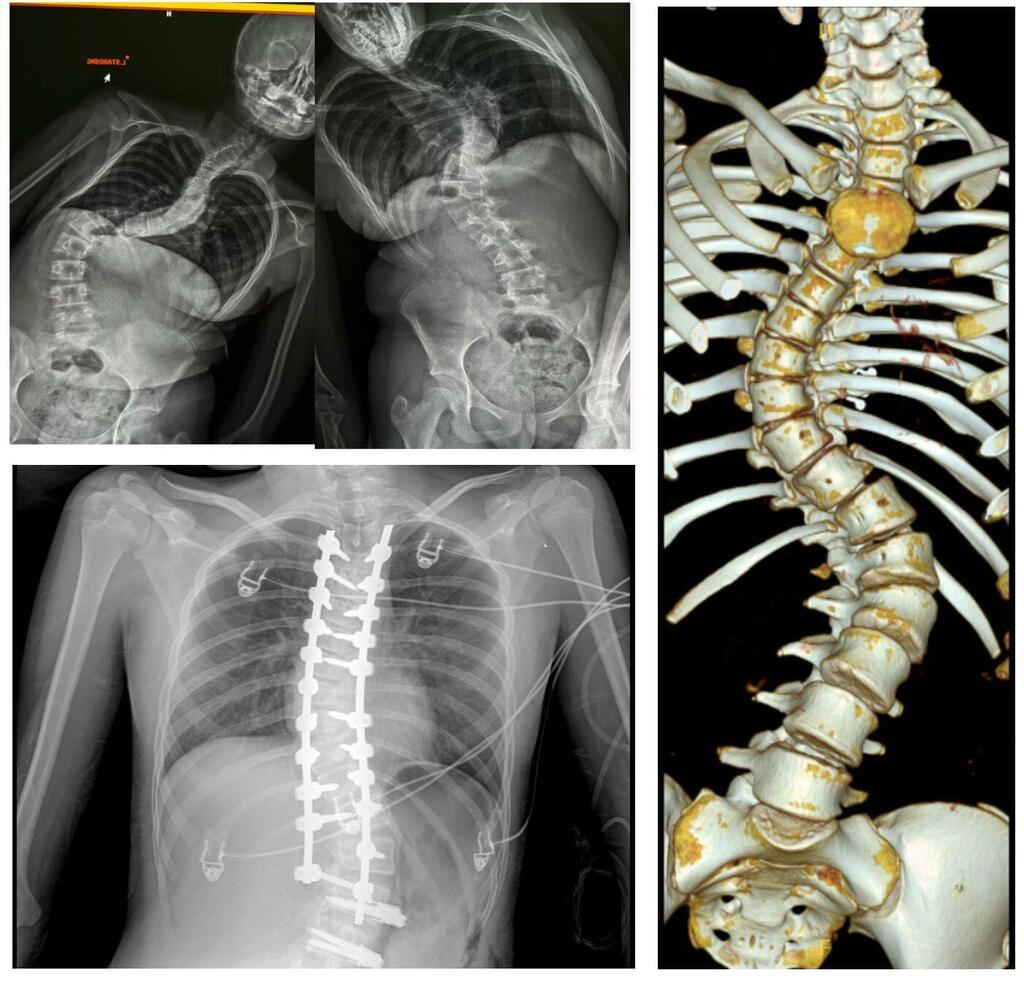
Hybrid scoliosis surgery in a 12-year-old girl
(Photo: Assuta)
“Israel has a wonderful healthcare system, but in edge-case pathologies, we are still a country of 10 million people, not 350 million people. The knowledge is amazing, but still relatively limited compared with the United States,” he says.
“At Assuta, we were able to connect adolescent girls who need these surgeries with Prof. Baron Lonner, a world-renowned expert in scoliosis correction using this approach. Prof. Lonner alone has performed more than 550 motion-preserving scoliosis surgeries and more than 2,500 classic fusion surgeries. He is one of the three leading people in the world in correcting scoliosis in adolescents. Aside from that, he is also a warm Jew. He loves us, supports us and is willing to come and operate with us in Israel.”
He adds: “Until recently, girls who needed these complex surgeries had to fly to New York to see Prof. Lonner, a process that was extremely difficult for them and their families. Assuta contacted him, and we managed to bring him here. Today we have an excellent multidisciplinary team at the hospital: Dr. Udi Arazi, head of orthopedics at Assuta; Prof. Baron Lonner from New York; and me, assisting in the surgery. Alongside us, there is also a social worker and a full supportive framework from Assuta.”
He concludes: “It is important that the knowledge remain here in Israel and that the next generation of surgeons in the country be trained. We definitely believe that the knowledge Prof. Lonner brings us should remain in Israel, for the benefit of Israeli patients.”
One diagnosis, countless questions
Michal Balas, mother of 12-year-old Liel, went through the experience of dealing with scoliosis less than a year ago. As a widow raising her daughter on her own, the news came as a complete shock.
“We discovered it in May 2025, after her bat mitzvah,” she says today. “The girl suddenly said she had a hump. We asked her where she felt it, why she thought she had one. While we were talking, we lifted her shirt and saw the protrusion on her back. We did not understand what scoliosis was. I did not know that some children are born with a curved spine.
"We went to a family doctor, were referred to an orthopedist and had an X-ray. He said it was scoliosis. We were very frightened. He said her angles were very high. She had both a thoracic curve higher up and a lumbar curve lower down.”
At that stage, the questions and searches began. “I started really looking into what scoliosis is, what it means for us, what needs to be done,” she says. “Usually there is a kind of brace that children wear. Sometimes it helps and sometimes it doesn't, depending on each child and the severity.”
But later, the outlook changed. “The orthopedist said she would probably need surgery. He looked at the X-ray and said we would need to fuse her spine by putting in two metal rods, on two sides of the upper back, and basically fuse each vertebra with screws down to the waist.”
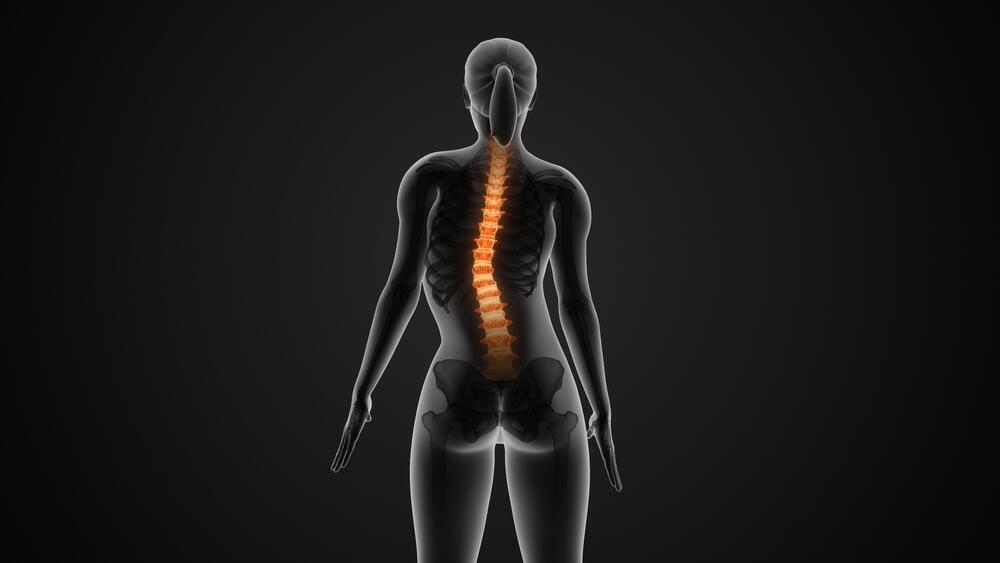
Scoliosis
(Photo: Shutterstock)
But Balas sought a second opinion. “When I heard that she needed fusion, I did not really want that,” she admits. “I was supposed to have her fused at a hospital through the healthcare services, but before that I did research. I read articles, went into all kinds of forums and spoke with parents, and I decided I did not want it.
“She was only 12 and a half. I understood that if her spine was fused, it could affect her growth, and that the added pressure on her back could lead to a slipped disc or other back pain later in life. It felt like a kind of disability, because the back is fused, including the waist. Even tying her shoes could become difficult, and she would have to lift her leg instead. I was anxious.”
The search for an alternative to fusion became a journey in itself. “I started looking for other options,” Balas says. “Through online forums, I spoke with mothers and all kinds of people who had gone through the process I was going through. They told me there was another operation, a motion-preserving surgery. That was the first time I heard about that option.”
Because of the size of the curve, the family was offered hybrid surgery. “It is a surgery in which the thoracic spine, the part of the spine without movement, is fused with screws and rods, while the lumbar spine, the flexible part, is preserved using screws and a flexible cord,” she explains. “That allows the girl flexibility and growth, because if the upper back is fused, there is no flexibility there, and flexibility begins more from the waist.”
The search led her abroad. “I found that there was a doctor in Germany who performs these surgeries. I scheduled a surgery date after doing all the necessary imaging, and I already had a date for the operation.” But just before the trip, a phone call changed everything.
“I called Rabbi Firer because I wanted his blessing before traveling to Germany,” she says. “But he told me I was not going. I said, ‘What do you mean? I already have a surgery date.’ He told me the same doctor was currently in Israel, operating on three Israeli patients at Assuta. He knew the whole subject in great detail and told me, ‘Tomorrow, you’re taking your daughter to see him.’ I told him I didn’t have an appointment, but he and his team helped me. The very next day, I had a consultation at Assuta with Prof. Lonner.”
At the first consultation, Lonner reviewed the imaging and explained that one additional X-ray would determine whether Liel was suitable for hybrid surgery. “I did it, and two weeks later he told me he could operate on her,” Balas says.
The 12-hour surgery took place this past January and was successful, Balas says. She credits the medical team, including Dr. Udi Arazi and Dr. Behrbalk, for guiding her through the process and answering every question along the way.
Today, Balas says, Liel is stable and doing well, and the main feeling is relief. “My daughter feels excellent. She is managing with Optalgin and fluids, not strong painkillers. She is still limited because she is recovering from surgery and cannot do everything on her own yet, but we got through it. We are very pleased with both the surgery and her recovery.”
Beyond the medical decisions, Balas says much of the journey has been about helping her daughter manage everyday life after surgery. “I spoke with parents of older children, ages 17 to 21, and for them it was harder because their children were already past adolescence. Their bones were less flexible, the surgery was more complicated, and they were used to being more independent,” she says.
“Liel is still young, 12 and a half. With a lot of conversations and encouragement, she understands that this is temporary. I am with her. I took time off work, and whatever she needs, I am here for her.”