

Some months ago, in her 19th week of pregnancy while mourning her father’s sudden death, Lior Biran, 40, received a call from the genetic clinic. The amniocentesis revealed a rare syndrome that severely damaged the fetus’s kidneys.
“We didn’t want to bring a child into the world only to suffer through dialysis,” she says. “With unbearable pain, we decided to terminate the pregnancy. It was the hardest decision I’ve ever made as a mother. I had dreamed of this little girl, my first daughter after two boys."
At the hospital, Biran was asked to sign burial forms. "We didn’t really read what they said,” she recalls. “Our minds were elsewhere." She was transferred to the maternity ward. The delivery was complicated and ended in surgery. "When I woke up, they told me the baby hadn’t come out whole. We had bought a little blanket to wrap her in for one last hug, but they wouldn't let us,” she says.
Gallery
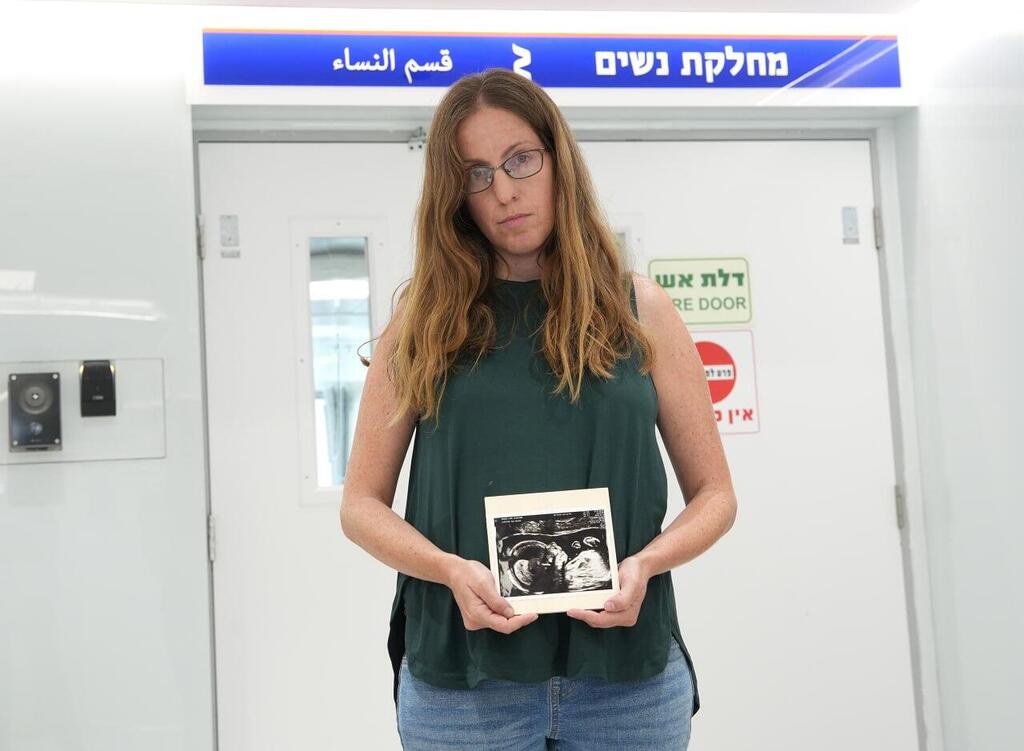
Lior Biran experienced a stillbirth, challenged with securing a dignified burial. "It was emotionally crushing"
(Photo: Efi Sharir)
After the trauma of the delivery, the couple hoped for a gravesite they could visit. But both the hospital and the burial society informed them the baby would be “buried with the hospital waste."
“They essentially told us that our little diamond would be thrown in with the rest of the hospital’s trash, unmarked pits filled with tissue and remnants,” Biran says, in tears.
According to current guidelines, if a fetus is delivered before the 20th week and not intact, it is buried together with other hospital waste under public health regulations for medical disposal.
But for grieving parents, this is devastating. The Health Ministry has promised for years to create a new, clearer policy for the burial of fetuses and newborns, as existing guidelines are vague and poorly implemented. In the meantime, hundreds of families face not only the heartbreak of stillbirth, but a system that adds bureaucracy and pain to their loss.
Eventually, Biran and her husband decided to bury their baby fetus themselves, in the same plot of Lior’s father.
“The idea that we had to cover her ourselves, and carry her in our private car, in the place where a living baby should have been strapped into a new car seat, was emotionally crushing,” she says.
Before they could carry out the burial, Biran shared her story in a Facebook group. She was contacted by Azriel Berkley-Dahl, senior case manager at ITIM, a nonprofit that assists families dealing with stillbirth. Thanks to the organization’s intervention, the hospital designated a new burial section for “stillbirth fetuses,” and Biran’s daughter became the first to be buried there.
“For years the Health Ministry has claimed it’s working on a new protocol, but nothing has moved,” says attorney Ohad Weigler, public policy center manager at ITIM. “We met in January 2023 with the official tasked with writing it; he’s no longer in the role. I send follow-up emails every few months, but no one responds."

Mothers who experience stillbirth often face insensitivity. Illustration
(Photo: shutterstock)
Weigler explains that in cases of fetal death after the 20th week or above 500 grams, parents are entitled to several burial options, including hospital-coordinated services and parental attendance at the funeral.
“Many parents want that option. They are entitled to it. But the Health Ministry’s circular is unclear. It’s not mentioned in the forms they’re asked to sign at the hospital, so they don’t even know it exists, and in practice, it doesn’t”, Weigler says. He adds that in many cases, hospital staff are unaware of these rights, and some give families misleading information.
Three weeks ago, the issue was raised in a Knesset Health Committee hearing. Lawmakers learned that some hospitals still lack a designated “stillbirth coordinator,” as required.
Hila Cohen-Ice, who lost her son Yonatan in a stillbirth at 38 weeks, testified that a hospital representative told her that her son would be buried with an adult who had died that same day, which is against regulations.
She said the hospital’s rabbi later claimed that by signing the burial forms, she had also given up her right to know what happened to her baby.
“Your jar is still here”
Another troubling issue involves postmortem examinations. According to health ministry guidelines, a fetus sent for pathology must be buried within 10 days. In reality, that deadline is often not met.
Shimrit (full name withheld) had a stillbirth. A month later, when she contacted the cemetery, she was told the baby still hadn’t been buried.
“The pathology lab told me, ‘Your jar is still here.’ That’s my daughter. I felt her kick. You're not allowed to call her that,” she says pinfully.
In many cases, parents are never told where their fetus was buried. Hospitals often decline to provide information or take responsibility. Eden Harfi, 27, miscarried during her first pregnancy, and the fetus was sent for pathology examination. For weeks, she and her partner tried to find out when the autopsy would end and when they could arrange a burial.
“They kept telling me to call next week,” she says. "Only four months later were we told the report was ready, but by then, the fetus had been buried without our knowledge, despite repeated requests to attend the ceremony.
“When I asked the hospital representative if she at least knew where they buried her, she said she didn’t.”
Harfi says she was also treated dismissively by hospital staff. “To them, it was, ‘It happened, it’s over, move on.’ No social worker ever spoke with us. They said she was busy with war casualties. We had to pay for private care because our souls needed it,” she says.
Health Ministry response:
“The ministry expresses its condolences to families enduring these unbearable moments. Naturally, all medical staff are expected to treat patients with the appropriate sensitivity, particularly in emotionally difficult situations. The ministry recognizes the existing gaps in this area and is working to address them through a new, updated protocol that will provide clear, accessible information for both medical teams and parents."