

“We are all hostages,” said one family member. “They’re in Gaza, and we’re hostages of our own lives … my life also stopped the day he was kidnapped.”
“As long as his body isn’t here, the trauma and emotional pain persist,” said another. “You don’t believe them … that they [the government] are truly with us … you feel despair, uncertainty about who will help us.”
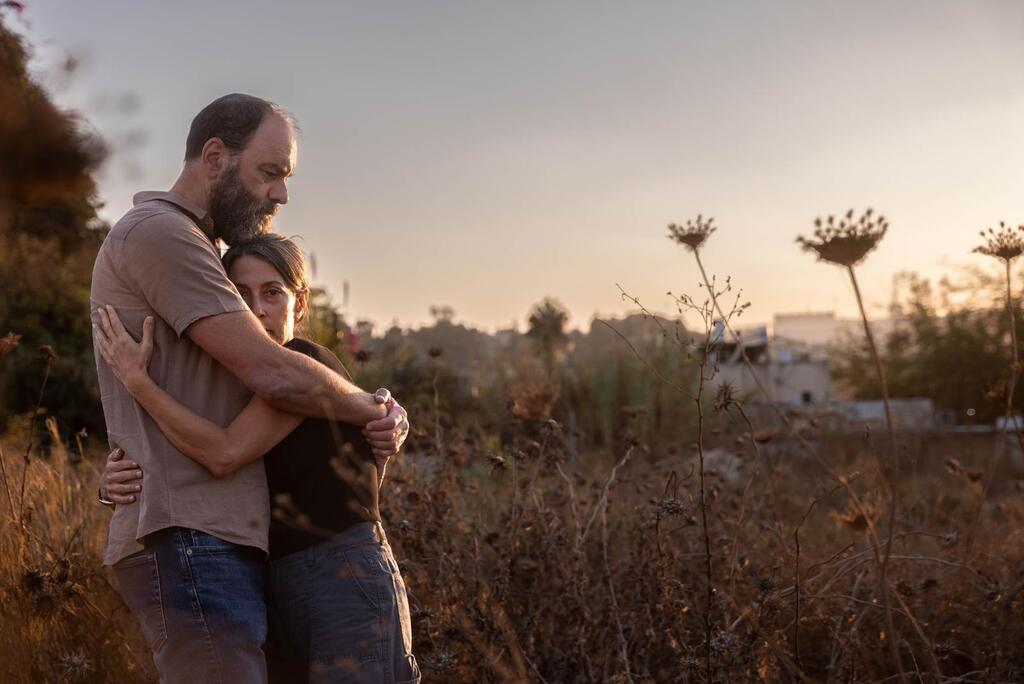
Jon Polin and Rachel Goldberg, parents of murdered hostage Hersh Goldberg-Polin
(Photo: Chen Schimmel)
These are some of the voices of 18 family members of hostages, interviewed as part of a new study exploring how relatives of Israelis abducted to Gaza during the Oct. 7, 2023, attack experience and process their trauma. The research examined how these families make sense of their ordeal within a broader social, communal and geopolitical context.
The study, published in the peer-reviewed journal Psychological Trauma: Theory, Research, Practice, and Policy of the American Psychological Association, offers a new framework for understanding the deep psychological toll of hostage-taking in wartime. It was conducted by Dr. Einat Yehene and Shir Israeli of the School of Behavioral Sciences at the Academic College of Tel Aviv-Yaffo, together with Prof. Hagai Levine of the Braun School of Public Health and Community Medicine at the Hebrew University of Jerusalem and Hadassah Medical Center.
“This study offers a crucial lens for the international community,” Yehene said. “First, it shows how a trauma should be understood within an ecological framework beyond the individual level, reverberating across extended familial circles, communal-societal and national levels. It provides a universal language to describe the profound and destabilizing trauma of mass hostage-taking and cases of ambiguous loss where loved ones’ fate or whereabouts are unknown.”
She added that “understanding this as a collective, multi-layered trauma occurring also at the sociopolitical levels is essential for developing effective humanitarian and mental health responses in conflict zones globally.”
Interviews were conducted up to 10 months after the Oct. 7 massacre, when none of the participants’ loved ones had yet been released. The interviewees, aged 20 to 80, were parents, children, siblings, cousins, in-laws, grandparents and aunts of hostages. Each interview lasted up to 90 minutes.
“We realized that when someone is taken hostage, actually his family is taken hostage with him, and to some extent, the community and the nation share a similar reaction,” Levine said. “This is related to this very unique situation of ambiguous loss and of not knowing what happened to their beloved, which is different from mourning. We studied this unique phenomenon to try to give it names from a scientific point of view. I can tell you the families are grateful for our work and for providing validation of what they feel with scientific tools.”
The researchers introduced a new concept: dynamic–static ambiguous loss, describing the constant tension between emotional fluctuation and paralysis.
Yehene explained that the idea of ambiguous loss itself isn’t new. But in this case, shaped by war, mass abduction and ongoing uncertainty, families experienced what she called “frequent and violent oscillation” between hope, fear and despair.
“We know from literature and clinical work that families dealing with ambiguous loss always oscillate between hope, fear and despair, living in limbo,” Yehene said. “Here, because of the mass kidnapping and the war, there were many, many more triggers.”
When the first hostages returned, for example, they brought signs of life from others, but also distressing accounts of inhumane conditions, torture and injuries sustained since Oct. 7.
Each time Israel announced the discovery of a hostage’s death in captivity through intelligence findings, families relived the trauma. Negotiation talks sparked fragile hope that often turned back into despair. Hamas propaganda videos also retraumatized families repeatedly.
One harrowing episode happened recently when the remains of Ofir Tzarfati, whose body had been recovered by Israeli forces in late 2023, were returned by Hamas, forcing his family to rebury him. That incident, Yehene said, deeply unsettled other families, who began to question whether they had truly buried their loved ones in full or had also been misled. “People talk about it like a roller coaster,” Yehene noted.
The researchers identified five additional core themes in the experiences of hostage families beyond the concept of ambiguous loss.
The first was that families had to cope with their own private trauma while living amid a broader national trauma. The country was at war, people were displaced, and many had lost faith that the state could protect them.
Family members became advocates, channeling their pain and energy into a constant struggle for their loved ones’ release. The researchers said this activism provided a sense of purpose but also led to emotional exhaustion and burnout.
As they advocated, they forged a new “family” with one another — fellow relatives of hostages and close allies — creating a support network that became a vital source of healing.
The study also found that the ongoing fight and trauma of having a loved one kidnapped took a severe toll on family members’ mental and physical health. Many suffered from anxiety, depression, cognitive decline, sleep disorders and significant disruptions to their work and home lives.
“Their lives were frozen,” Yehene said. “All they do all day long is just advocate for their loved one. And this really erases all previous identities, almost like a tunnel-vision effect. All their attention and energy is channeled into the fight of bringing the loved one.”
Researchers further observed that many families sought to preserve a psychological connection with their captive relatives through symbolic acts, such as sending mental messages, addressing them in media interviews or holding public rituals to maintain their emotional presence.
The team said their findings point to the need for a socioecological approach to guide policymakers and therapists in supporting affected families.
“We did find new themes relevant to wartime, namely, navigating the private trauma within a collective trauma,” Yehene said. “Families are not only families of people who were unfortunately taken, but are also dealing with grief. They are victims of the trauma themselves. They are dealing with a loss of community and of displacement. Sometimes they had more than one family member. It’s a different context that is not known in the literature.”
The researchers developed a set of recommendations from the individual to the national level to help shape responses that could also be applied to other conflict zones. Their work, they said, offers policymakers and mental health professionals an evidence-based framework for assessing and addressing the ripple effects of trauma that spread from individuals to society at large.
“To help the families, we need to address each layer — the individual needs, the family needs, the community needs and the national needs — in terms of recognition, investigations, future benefits and how we understand these trauma victims,” Yehene explained. “It also means that, because of this mass trauma and its ripple effect, we need to consider a national program addressing how the trauma affected not only the families but also the children, the public. The educational system and healthcare providers should be informed.”
On the individual level, the researchers recommended that healthcare providers intervene early to identify self-neglect symptoms and that families be approached through a multidisciplinary framework offering counseling that addresses vocational, parental and marital challenges.
Within families, they stressed the importance of paying attention to indirect and less visible victims — those whose suffering may go unnoticed but is equally profound.
At the community level, they suggested that collective rituals, rallies and solidarity-building activities could help strengthen resilience and foster a sense of shared purpose.
On the national level, the team called for a state commission of inquiry to investigate the events of Oct. 7, saying such a move could help bring closure.
“I think this is the most relevant thing for the current moment — to bring back the last 11 hostages,” Levine said. “This is actually essential for their own families but also for the community of the hostages’ families and the larger public.”
He added that the study should not simply sit on a shelf, but serve as a reference point for future crises, even though this is unique in many ways.
“The conclusions from the study do not only apply to hostage situations but actually to other situations of ambiguous loss,” Levine concluded.