

“In the near future, AI, bots and intelligent agents will flood hospitals everywhere. We will have to ask ourselves the real question: What should we do with the extra time that AI will free up for our doctors and medical staff?” This is how Dr. Yona Vaisbuch, Deputy Director for Transformation and Clinical Operations at Rambam Health Care Campus, described the AI revolution taking place in hospitals.
The impact of AI on medical teams was among the central issues discussed at the Rambam Tomorrow Innovation Conference, held at Rambam Health Care Campus in collaboration with ynet. Hundreds of experts, entrepreneurs, venture capital executives and leaders from the medical and technology sectors gathered to explore the future of healthcare, from new medical technologies and the growing use of AI in hospitals to regulatory challenges and patient privacy concerns.
Rambam’s conference on Innovation in Tomorrow’s Medicine


Among those looking further ahead was Michael Kagan, chief technology officer of AI chip giant Nvidia, who predicted sweeping changes in medicine, particularly in genetic research and the potential to prevent diseases before they develop.
“All of medicine will change,” he said. “We are working on various projects in which we are learning the language of the genome. In the future, it will be possible to take a DNA test and not only find out what is happening today, but also what is expected in the future, allowing us to prevent diseases before they develop rather than just treat them.”
Entrepreneur Maor Shlomo, who sold his AI startup Base44 to Wix for $80 million in 2025 and later established a private investment fund focused on cancer research, described how artificial intelligence is already transforming drug development.
"AI helps find better drugs and analyze clinical trial results. I think some of the treatments we use today will seem terribly outdated in just a few years. The coming years will undoubtedly be very, very interesting and will completely transform how we care for ourselves and the world of medicine."
'Doctors will be able to treat many more patients'
Beyond these predictions, the conference highlighted innovations already changing medical care, including tools that help surgeons pinpoint where to place electrodes in the brain and assess a woman's risk of developing ovarian cancer.
Such developments are part of a broader effort to bring medical research into clinical use. Rambam MedTech, the hospital's technology commercialization company, currently holds more than 80 patents, primarily in medical devices, as well as pharmaceuticals and digital health.
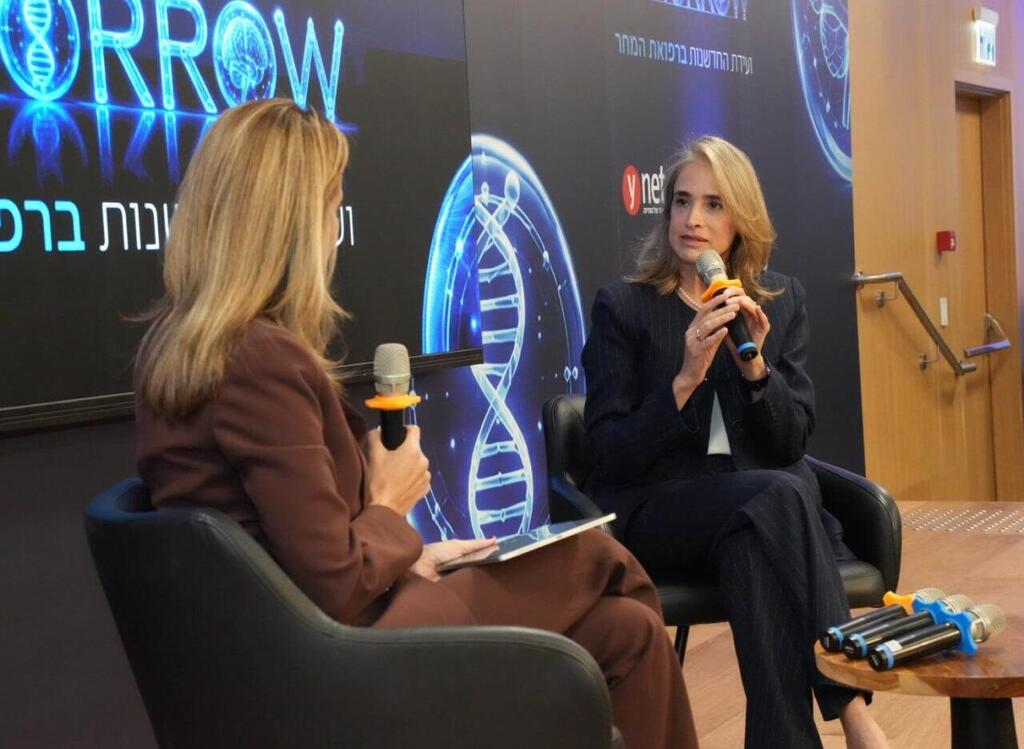
Rambam CEO Dr. Michal Mekel in an interview with Sharon Kidon at the Rambam Tomorrow Innovation Conference
(Photo: Rambam Health Care Campus)
Robotic surgery is another area attracting investment. Entrepreneur and investor Alon Gonen described a company he recently backed that is developing a system for performing cataract surgery remotely.
"Not long ago, I invested in a company that performs cataract surgery using a robot remotely controlled by a doctor. This allows the doctor to treat many more patients."
Dr. Michal Mekel, CEO of Rambam Health Care Campus, echoed that assessment.
"The entire field of robotics is going to completely transform what the treatment environment looks like," she said.
When a patient is admitted to an intensive care unit today, every heartbeat, blood oxygen reading and respiratory measurement is recorded and stored. However, hospitals do not always make use of this information. In the age of artificial intelligence, such data has become a valuable scientific and economic asset.
Lior Bonfis, president of Philips Israel, explained how technology can help address the overwhelming volume of information in hospitals.
"The ability to integrate different sets of data reaching a doctor simultaneously is a technology that could guide us in the future. It will free up doctors' time to focus on procedures and outcomes rather than the surrounding administrative work."
Dr. Eyal Zadicario, chief operating officer and general manager of Insightec Israel, emphasized the potential for greater precision in medical decision-making.
"AI will be able to make more accurate decisions tailored to individual patients and specific diseases. These are decisions that today still require extensive medical knowledge, beyond simply collecting and analyzing data."
But alongside the rapid technological advances, the conference also addressed a question troubling many patients and doctors alike: Will technology eventually make the human element obsolete?
Dr. Michal Mekel, director general of Rambam Health Care Campus, gave an unequivocal answer.
"We don't want technology to replace doctors. The challenge is finding ways to use AI to support them, take unnecessary tasks off their hands and free them up to focus on what really matters: caring for patients. AI will never be able to look a patient in the eye."
- The Rambam Tomorrow Innovation Conference was held in collaboration with ynet and Rambam Health Care Campus.