

Particles sinking through a liquid can slow dramatically and even briefly move upward when they pass between layers with different densities, according to a new study by researchers at the University of Haifa and Tel Aviv University.
The study proposes a new mathematical equation describing that unexpected motion. Developed with the assistance of an artificial intelligence system, the equation reproduced the particles’ slowing, their prolonged stay in the transition zone between the layers and, in some cases, their temporary reversal of direction.
“The importance of the study lies not only in the equation we obtained, but in the ability to describe with a single formula a complex physical phenomenon that previous models struggled to explain,” said Dr. Teddy Lazebnik of the University of Haifa’s Department of Information Systems and the Department of Computing at Jönköping University in Sweden, one of the study’s authors.
“The artificial intelligence did not replace the researchers and did not discover a new law of nature on its own. It helped us search within a framework defined by experimental data and the laws of physics and reach an equation that can be understood, tested and incorporated into existing models.”
Understanding the movement of particles through liquids made up of layers of different densities is important for studying both natural and engineered processes, including sediment settling in lakes and river estuaries, the dispersal of pollutants, wastewater treatment and material separation.
In a uniform liquid, the sinking of a particle can generally be described using gravity, buoyancy and the drag exerted by the liquid.
The phenomenon becomes more complicated when a particle passes from a lighter layer into a denser one. In the transition zone, additional forces act on the particle, affecting its speed and sometimes even the direction of its movement.
Previous models have struggled to describe every stage of that motion using a single equation.
In the new study, Lazebnik, Prof. Alex Liberzon and research student Chen Mortenfeld of Tel Aviv University’s School of Mechanical Engineering sought to identify an explicit mathematical expression for the additional force created as a particle crosses between liquid layers and to determine whether it could describe the particles’ movement more accurately than existing models.
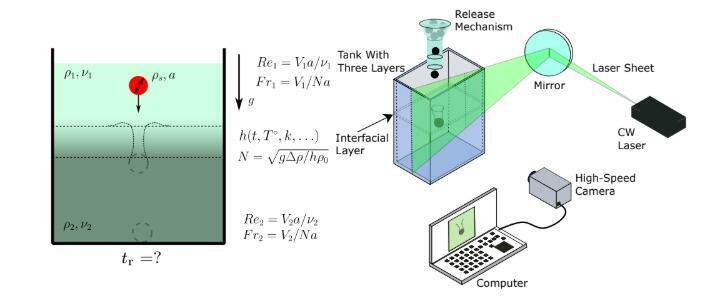
A tiny metal sphere passing between two liquid layers
The researchers analyzed 321 experiments in which individual spheres about 10 millimeters in diameter sank through a tank containing a lighter upper layer, a denser lower layer and a transition zone between them.
Some experiments used water-and-salt solutions, while others used more viscous mixtures of water and glycerol.
Using high-speed cameras recording at up to 500 frames per second and laser illumination, the researchers tracked the spheres with precision down to thousandths of a millimeter.
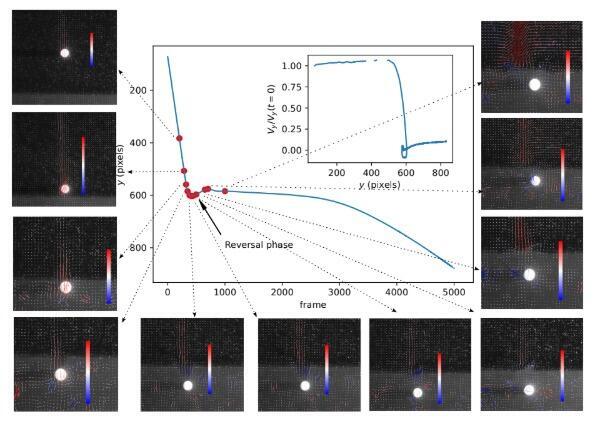
That allowed them to document the complete path of each sphere and calculate changes in its speed and acceleration as it passed between the layers.
The data were then fed into SciMED, an artificial intelligence system whose development was led by Lazebnik and which searches for explicit mathematical formulas that fit both experimental data and physical laws.
From the formulas proposed by the system, the researchers selected one that both matched the data and retained mathematical simplicity and physical logic. They then compared it with an existing model that describes the additional force using a mathematical variable known as “virtual mass.”

Dr. Teddy Lazebnik
(Photo: Tali Bakun)
In 272 of the experiments, or 84.7% of all the recorded trajectories, the sphere slowed after passing between the layers and then returned to its normal sinking speed. The new equation indicates that the additional force does not act only at a single moment. Instead, it develops gradually and can sometimes oscillate, a pattern that may explain why the sphere can temporarily reverse direction.
The improvement over the existing model was especially pronounced in trajectories involving prolonged slowing or a change in direction, as well as in predicting how long the spheres remained in the transition zone. “The advantage of an explicit equation is that we do not receive only a prediction,” Liberzon said. “We can see how the force changes over time and understand the mechanism operating in the transition region.”
“If the equation is validated under additional conditions, it could improve predictions of how sediments and pollutants move and accumulate and assist processes such as wastewater treatment and material separation.”
The researchers stress that the equation was tested only across a defined range of particle sizes and flow conditions and therefore should not yet be regarded as a general law applicable to every system.