

In Israel on a fact-finding visit, Dr. Lewis Bernstein is testing whether an eight-week, multigenerational mentoring program powered by curated Sesame Street clips can restore connection and promote resilience
After more than two years of war, Israel is searching for ways to rebuild not only its security, but also its social fabric. A retired Sesame Workshop executive from the global nonprofit behind Sesame Street is now visiting the country and exploring whether a multigenerational mentoring model he developed abroad could help do both.
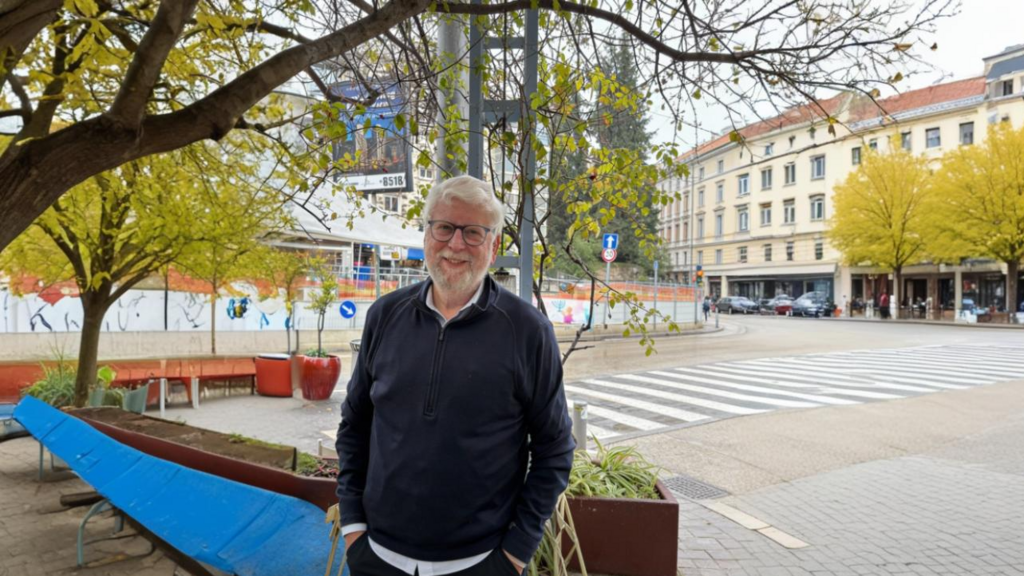
Dr. Lewis Bernstein
(Photo: Maayan Hoffman/The Media Line)
Dr. Lewis Bernstein is in Israel on a fact-finding mission to assess whether the Three Gees Workshop nonprofit and its Sesame 3G Mentoring program could take root in the Jewish state. The initiative brings older adults, teenagers and young children together to build meaningful connections through shared activities, aiming to strengthen communities amid deep national strain.
“I see it as a real potential,” said Bernstein, who held a range of senior roles at Sesame Workshop over more than four decades, including executive producer of Sesame Street seasons 34 to 36.
Bernstein, an Orthodox Jew from Riverdale who previously lived in Israel and is fluent in Hebrew, said that “the ability to reach across barriers with a project like this is really possible.”
Bernstein was completing his college degrees around the time Sesame Street was launched in 1969 by Joan Ganz Cooney and Lloyd Morrisett, and when he learned about the program, he knew he wanted to work on it, so he applied for a job.
“I saw what they were doing. It wasn’t just teaching young children about cognitive skills and preparing disadvantaged kids. It was really trying to break barriers between blacks and whites and Hispanics and trying to humanize the other,” Bernstein said.
They offered him a job. Bernstein would study Talmud in the mornings and conduct research for the show in the afternoons and early evenings. What began as a temporary position turned into a 33-year career, during which he held a wide range of roles, from research to work in the international department and nearly everything in between.
Over the years, Bernstein helped launch the Israeli version, “Rechov Sumsum,” as well as the Arabic-language show. He also worked on French, Spanish and German versions of the program. At one point, he even helped pilot an Israeli-Palestinian version during the time of the Oslo Accords, an effort aimed at humanizing the other side. However, the project ultimately did not move forward at that time.
Later, in 1998, a full joint co-production titled Rechov Sumsum/Shara'a Simsim was successfully launched.
“I had worked domestically with people like Jim Henson, who was a genius,” Bernstein recalled. “He was responsible for the creativity of the puppets. The writers were responsible for writing the segments. I was responsible for giving them the curriculum.”
That role, Bernstein said, required striking a careful balance. His focus was on integrating education into the show in a way that felt natural and engaging, without overwhelming young viewers.
About a decade ago, Bernstein retired, though he remained closely connected to Sesame Workshop and its alumni community. Then COVID-19 hit, pushing much of the world into crisis mode. Bernstein said he began noticing that many high school and college students were feeling lonely and depressed, and suicide rates in the United States were rising.
At the same time, many older adults were fearing that they “no longer mattered,” Bernstein said.
“They were missing a sense of purpose, while the teens were disconnected, separated and needed support,” he continued. Bernstein believed that the teens’ strength would come out when they started giving and not just receiving.
Those trends helped spark the idea for a new initiative. The concept was to create a program in which teens would mentor young children, giving the teens a sense of purpose. At the same time, Sesame alumni would mentor the teenagers, creating a multigenerational support structure.
Bernstein assembled a volunteer group and launched a pilot project during the pandemic with 23 Sesame alumni, some retired and some still working. They partnered with both public and private high schools, recruiting 23 high school students. The group also worked with the Children’s Aid Society, which serves children in disadvantaged neighborhoods. In addition, they partnered with a Montessori school on New York City’s Upper West Side that served a more advantaged population.
Once the groups were formed, the teams underwent training. The older adults participated in a 90-minute session focused on facilitating discussions with teens.
Organizers also selected Sesame Street segments designed for multigenerational audiences to serve as discussion starters and icebreakers. For example, they used scenes featuring Cookie Monster to explore topics such as delayed gratification.
The program itself was structured as an eight-week series, with one-hour meetings each week. The first session focused on training, with separate 90-minute sessions for teens and adults. In subsequent weeks, the teen and adult mentors met for 20 minutes, after which the teen mentored a preschool-aged child and led a session with the younger participant. The older participants then reconvened.
Bernstein said a Stanford psychologist later analyzed the program’s results and found them to be “really positive and strong.”
“The rifts in America are deep,” Bernstein said. He said that, with families moving farther apart, the ability of a teen to be close to a grandparent has changed. “So, one of the things we’re addressing is how do you connect generations?"
The pilot program eventually evolved into a registered 501(c)(3) nonprofit and an official workshop program. Today, sessions have been run in New York and Los Angeles, with new launches soon to be underway in Northern California and Colorado. While each program looks slightly different, all are rooted in the same core idea of using Sesame Street content as a trigger for connection across three generations of mentors and mentees.
After October 7, Bernstein wanted to bring the program to Israel. However, time and financial constraints made an immediate launch difficult. Instead, he adapted the model by working with students from a New York Jewish day school attended by his grandchildren and Hebrew-speaking grandparents like himself, partnering with a school in Israel over Zoom.
“The idea would be more about doing it for multiple generations of Israelis,” Bernstein said. “Wouldn’t it be great if new immigrants, older people who are here, pre-army students in high schools, and college kids had a chance to talk?”
Bernstein said he has considered a program bringing together Israelis and Palestinians, but believes the idea is still too preliminary and emotionally raw.
“Post October 7, none of my Palestinian colleagues called me, nor did I call any of my Palestinian colleagues afterwards,” Bernstein said. “I think that the rift is huge. There’s very little humanity that I feel towards my cousins, nor do I think they feel towards me. But at some point, that’ll happen, and that ability to reach across barriers with a project like this, I think, is really possible. But not yet.”
For now, he said, a pilot involving Arab and Jewish Israelis could be a more realistic first step. “People are so resilient, but we have so many issues internally,” Bernstein said of Israel.
In the United States, the program is supported by the Sesame Workshop Alumni Network SWAN and funded by foundations such as the Ford Foundation. Bernstein said he is currently aiming to raise around $1.5 million to expand the program across the United States before approaching Sesame Workshop about officially bringing it to the Middle East, starting with Israel.
During his current visit, Bernstein has met with former colleagues and friends to discuss a possible pilot and said he would be interested in working with local NGOs to make it happen. “I don’t think it’s going to be hard … when we’re ready to act,” he said.
Bernstein noted that Sesame Workshop would need to approve the use of its content due to copyright and licensing requirements. If that is not possible, he said he could explore partnerships with other educational or entertainment programs. He also said pilot projects could initially be run through schools, similar to the early New York Jewish day school model he ran after the war began.
“The idea of this project has so many more opportunities to explore for Israel,” Bernstein concluded. “I think that’s really powerful.”