

At a moment many describe as unprecedented instability, a conversation between leadership thinkers and a kabbalistic teacher reframed the crisis not as a failure to fix systems, but as the collapse of systems never meant to endure.
Speaking with Nicholas Janni and fellow leadership practitioner Amy Elizabeth Fox, Rabbah Saphir Noyman Eyal described the current global condition as one of intentional shattering - a stage long anticipated within Kabbalistic thought, and one that cannot be resolved through reform, mediation or improved control. “What you’re trying to do is repair and reset something so it will work again,” she said. “It will not work again. Absolutely.”
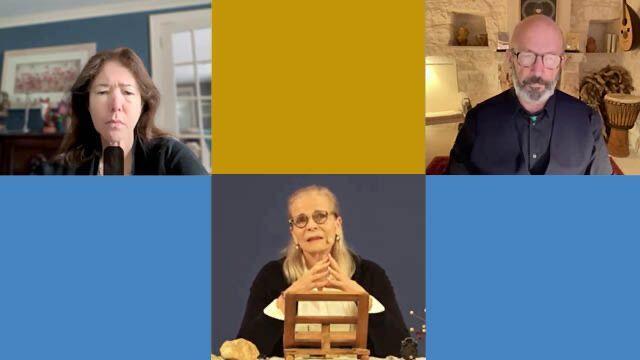
The exchange, hosted by Mishkan Hakavana, unfolded as a meditation on leadership, belief and what Kabbalah calls the “last generation” — a time marked by the exposure of humanity’s limitations and the collapse of familiar structures of meaning.
A crisis beyond business
Janni and Amy framed the discussion through their work with senior executives, many of whom are experiencing acute stress, disorientation and a sense of hollowness beneath professional achievement. What once functioned - at least outwardly - is no longer coherent.
“Things were working,” Janni said, “but at huge cost to the soul.” He described a dominant paradigm governed by cognition, extraction and control, disconnected from the body, the heart, intuition and transcendence. Under conditions of radical uncertainty, that paradigm is now visibly failing.
The result, he said, is a deepening sense of exile - loneliness, separation and loss of orientation that can no longer be masked by productivity or performance. Rabbah Noyman Eyal did not challenge that diagnosis. She intensified it.
Shattering is the design of reformation. In kabbalistic language, she explained, the shattering of vessels is not a malfunction but a necessary event in creation itself. What humanity is experiencing now is not a breakdown to be corrected, but a revelation of the limits of the “will to receive for oneself” - the ego-centered orientation that has governed modern leadership, politics and economics. “The cause is intentional, and the shattering is intentional,” she said. “It is planned not to work.”
Attempts to recruit spiritual language in service of existing agendas - whether in business, politics or well-being culture - only deepen the crisis, she argued. Treating people “more humanely” in order to extract more value remains the same logic in a softer form. “It’s the same language,” she said. “How to use someone else - but wisely.”
From this perspective, even reforms framed as ethical or compassionate remain bound to an exhausted currency. The question, she said, is not how to improve leadership, but what the new currency itself might be.
Leadership as a cell, not a center
The conversation repeatedly returned to a redefinition of leadership - away from authority and control, toward service and embeddedness. “Leadership should be like a cell in a body,” Rabbah Noyman Eyal said. “Serving something because it belongs to something.”
This vision rejects leadership as identity, power or self-fulfillment. Meaning, she argued, cannot be generated through personal purpose or emotional alignment alone. Those too are expressions of the soul clinging to form, what Kabbalah calls “still life,” the resistance to change.
The pressure humanity feels, she said, is the pressure of dissolution. The more leaders attempt to preserve familiar structures, the greater the suffering will become.
Why psychology and philosophy are not enough
Asked whether psychology, philosophy or emotional intelligence might provide the tools needed for this transition, Rabbah Noyman Eyal was unequivocal.
“My answer is no,” she said. What is required, she argued, is not insight or self-awareness, but a search — a sustained inquiry that confronts the limits of human intelligence itself. Even the way questions are posed, she said, remains shaped by the desire to gain, understand and control.
“We pose questions within the heart that wishes to get something,” she said. “To know how the world works in order to exploit it.”
Breaking that pattern requires intervention from what she described as “something higher” - not as belief content, but as an evolutionary force.
Belief beyond content
When the word belief arose, Janni challenged it directly, noting its history as a justification for violence and dogma. Rabbah Noyman Eyal agreed with the concern and offered a precise distinction.
“In kabbalistic terms, belief is not content,” she said. “It is how to rise above reason.”
Belief, she explained, is the capacity to recognize limitation, admit incapacity, and ask for help from beyond the human frame. It exists at the boundary between the present and the future — a sensitivity to what is calling, even before it can be defined.
This, she said, is why chaos can be interpreted not as failure, but as signal. “Belief suggests that whatever you are experiencing now is the limitation of something calling you.”
Reverence, fear and discernment
Later in the discussion, the concept of reverence emerged as a possible gateway. Reverence, Rabbah Noyman Eyal cautioned, is not emotional intensity or collective feeling — both of which can be mistaken for spiritual presence.
“Evil has an attendance as well,” she said. True reverence, she explained, includes awe and fear — not paralyzing fear, but a vigilance that prevents familiarity, possession or spiritual entitlement. What is revered today, she warned, can become rude tomorrow if not continually renewed.
This renewal, she said, requires what Kabbalah calls the “screen” — a disciplined apparatus of intention and discernment that must be maintained through study and community.
Study as formation, not information
Asked how such an apparatus is developed, Rabbah Noyman Eyal pointed not to techniques or practices, but to sustained study within a committed group guided by a teacher.
“Kabbalistic study doesn’t just teach,” she said. “It forms you.”
Unlike other forms of learning, she argued, this study reshapes the individual over time, revealing not answers about the divine, but truth about oneself — one’s limits, desires and capacity for relationship with what is beyond.
Humanity, she said, has grown disillusioned with truth because it was promised knowledge of infinity. That promise was false. “We cannot know the truth about the Creator,” she said. “Only the truth about ourselves.”
Why spirituality keeps failing
Throughout the conversation, Rabbah Noyman Eyal returned to a stark critique: spirituality itself has been misused, subordinated to human comfort, fulfillment and survival.
“Humanity harnessed spirituality to corporality,” she said, “instead of harnessing corporality to spirituality.”
The result, she warned, is judgment — not as punishment, but as consequence. When spirituality serves ego, suffering increases.
Well-being practices that aim to help people feel better without reorienting purpose, she argued, miss the center. Feeling better is not the goal. Becoming a vessel for something beyond the self is.
Dancing on the ruins
Near the end of the conversation, Rabbah Noyman Eyal invoked a well-known rabbinic image: Rabbi Akiva dancing on the ruins of the Second Temple, not out of denial, but because he recognized the emergence of something new.
“I’m dancing on the ruins,” she said. “Because something is going to change.”
The conversation closed not with solutions, but with a shared recognition that humanity is standing at a threshold - one that cannot be crossed through repair, optimization or spiritual enhancement.
What comes next, the leaders suggested, will require listening beyond human limitation, belief beyond content, and leadership willing to surrender mastery in order to serve what has not yet taken form.
- Mishkan Hakavana is a contemporary center for Kabbalistic study founded by Rabbah Saphir Noyman Eyal, drawing on the teachings of Rav Ashlag (Baal HaSulam) to explore leadership, belief, and transformation in times of upheaval. Amy Elizabeth Fox, Co-Founder and CEO of Mobius Executive Leadership, works globally with senior leaders on vertical development and trauma-informed change. Nicholas Janni is the author of the award-winning book Leader as Healer (Business Book Award, 2023) and focuses on embodied, empathic leadership for the complexities of the 21st century.
First published: 10:53, 12.26.25