

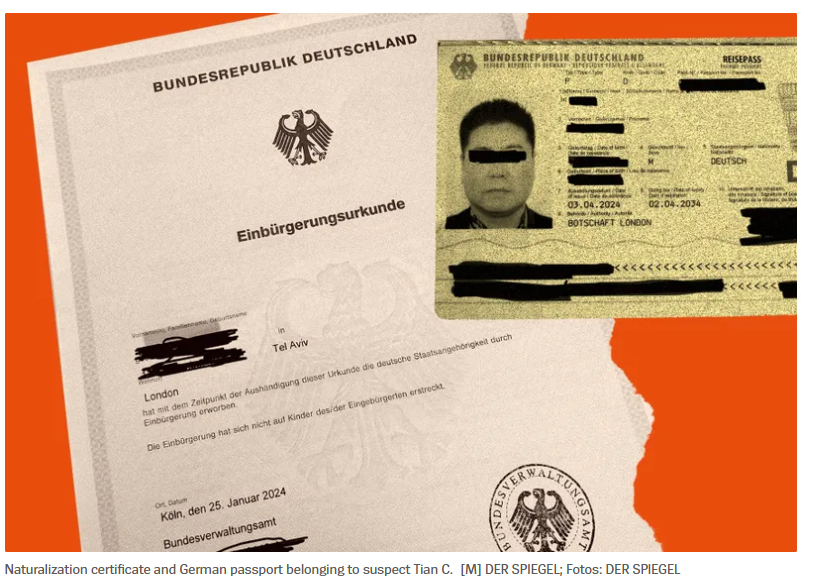
A Der Spiegel investigation published Thursday has uncovered an alleged criminal network that helped people, mainly from China, pose as the grandchildren and great-grandchildren of Jews persecuted by the Nazis in order to obtain German citizenship and passports.
According to the report, some of the applicants were Chinese nationals seeking to escape law enforcement in their own country and were able to do so with the help of German authorities that accepted fraudulent family histories linking them to Jewish victims of Nazi persecution.
The adoption of Jewish identities by Germans and others is not new and has sometimes been explained by a desire to distance oneself from the legacy of the nation that committed the Nazi crimes, or to claim moral authority and authenticity when criticizing Israel.
But the case uncovered by Der Spiegel goes far beyond that. It allegedly involved the systematic exploitation of Holocaust memory to secure residency rights and citizenship in another country.
Under Article 116 of Germany’s Basic Law, people stripped of German citizenship by the Nazis are entitled to have it restored, and that right extends to their descendants.
For the alleged fraudsters, that created an opportunity. Many were reportedly fugitives from the law who were well versed in lying, deception, forgery and reinventing their personal histories. According to the investigation, they had no hesitation about cynically exploiting a law intended to provide redress to victims of crimes against humanity.
The objective was clear: For a fugitive, a German passport is an extremely valuable asset, allowing extensive international travel, entry and residence in numerous countries and access to study opportunities abroad.
German officials’ willingness to trust applicants is difficult to fault entirely, despite the large number of applications coming from Chinese citizens. Such a scheme would have been difficult to imagine.
A basic genealogical check could have allowed authorities to trace the family trees of the Holocaust victims the applicants claimed as relatives and expose the alleged fraud.
But the issue is highly sensitive. Germany has an obvious historical interest in trying, in one form or another, to make amends for the crimes of the Nazi era. Officials may have looked the other way, or simply never imagined that anyone would exploit Germany’s historical guilt so cynically.
About a year ago, a London resident provided information about a Chinese citizen who had allegedly fabricated a family connection to Jews murdered in the Holocaust. That tip prompted police and prosecutors in Düsseldorf to open an investigation, which has since expanded.
Authorities have now identified 32 cases across several German states involving people allegedly posing as descendants of Nazi victims in order to obtain German citizenship. In about half of those cases, German citizenship had already been granted.

Jewish-owned shops burn during Kristallnacht in 1938
(Photo: Gettyimages)
The investigation found what authorities believe was a broad criminal network with extensive information about Jews who had been stripped of German citizenship during the Nazi period.
According to the report, organizers and agents who arranged the passports fabricated applicants’ biographies and advertised their “product” mainly on Chinese-language social media. There, they described in detail the easier life awaiting anyone who obtained the coveted passport.
It was an enormous sum, but apparently still within reach for the clientele involved. Most of the applicants, according to the investigation, were already known to Chinese law enforcement.
Some had fled China after allegedly defrauding individuals, institutions and banks of vast sums of money. For them, almost any price was worth paying for a new identity that would allow them to travel the world without fear of detention or being flagged by international arrest notices.
According to the Düsseldorf police and prosecutors’ investigation, the groups arranging fraudulent German citizenship applications would identify a Jewish couple who genuinely qualified under the restitution law and then invent two or three additional sons for them, who would in fact be their clients.
Parts of the investigation obtained by Der Spiegel also point to the alleged involvement of two Israelis.
One is a physician who worked in Germany until recently, and the other is a psychiatrist from a suburb in the Tel Aviv area. Their names have not been published. In the psychiatrist’s citizenship application, she was listed as the daughter of Karl Siegfried and Gertrud Süsskind, the same couple who, according to the documents, were also the grandparents of Liu Ha.
Liu is a Chinese citizen who kidnapped and murdered two businessmen. He fled China and later obtained German citizenship. When Der Spiegel asked the Israeli psychiatrist, who received German citizenship in 2017, whether Siegfried and Süsskind were indeed her parents, she said they were. Asked when they had arrived in Israel, she said 1948 or 1949.
Documents, however, show that Süsskind and Siegfried arrived in Mandatory Palestine in 1936.
Several weeks ago, according to the magazine’s reporters, they received a WhatsApp message from a British number containing a threat. “We will hunt down everyone involved in this investigation if they keep asking questions,” the message said. “Our revenge will be terrible, swift, unpredictable and irreversible.”
(Photo: S. Vatolina/Shutterstock)
Hundreds of thousands of people persecuted by the Nazis, most of them Jews, were deprived of their German citizenship after Hitler came to power. German law is intended to provide at least some measure of restitution to those victims and their families.
In recent years, the rules governing eligibility for German citizenship have been broadened. Since 2021, for example, people who fled Germany and were forced to give up their citizenship in order to acquire nationality in the country to which they escaped can also apply for German citizenship.
Applicants do not need to live in Germany, speak German or pay a fee. They need only present documents proving their identity and their family connection to German citizens who were stripped of their nationality.
According to Der Spiegel, 31 people work in the department that handles such applications at the relevant federal office in Cologne. In 2024, the department received 13,556 applications. Last year, that figure rose to 14,148. Unlike the stereotype of rigid German bureaucracy, officials in this department reportedly try to help applicants as much as possible.
They tend to trust the stories presented to them and work to facilitate applications as part of Germany’s effort to address the crimes of its past. The investigation now suggests that this goodwill created a vulnerability that allegedly signaled to fraudsters, forgers and criminals that the system could be exploited for profit and to help fugitives obtain one of the world’s most valuable passports.