

In December, Candace Owens promoted "The Talmudic Jew," an 1871 German anti-Semitic tract whose author, August Rohling, was later exposed as a fraud in Vienna courts and lost his academic position. Nazi propagandist Julius Streicher later resurrected Rohling's work for the Third Reich. Now, thanks to Owens, it's back.
The Talmud records five centuries of rabbinic debates about interpreting Biblical law and applying it to everyday life. Owens isn't alone. Pastor Matt Powell's YouTube videos claim the Talmud endorses pedophilia and bestiality. Nick Fuentes and Dan Bilzerian have amplified similar accusations. These charges mirror those leveled against Jews for centuries. Scholars have refuted them exhaustively. So why are some choosing this moment to resurrect them?

Anti-Talmudic polemics have deep historical roots. From the 13th-century Disputation of Paris to the 19th-century blood libels. When Rohling published his attack, Rabbi Joseph Bloch challenged him publicly. Vienna courts appointed Christian reviewers to examine every claim. They discovered that these quotes were a combination of outright fabrications, misreadings, and lines taken wildly out of context. Unable to defend his scholarship, Rohling withdrew his lawsuit and was removed from his position. Yet the lies persisted.
Today's accusations follow the same playbook. Critics claim the Talmud permits relations with minors, citing discussions about whether girls abused in pagan rituals could marry priests. The Talmud explicitly forbids sexual contact with minors. Yevamot 33b states that any attempt at relations with a minor equals rape. Kiddushin 41a prohibits betrothing daughters before they mature and give consent. The critics either don't know this, don't care, or willfully ignore these laws.
Another accusation claims the Talmud describes Jesus burning in excrement in hell. The passage discusses a figure named Yeshu, raised by a necromancer named Onkelos. The chronology alone disproves the connection.
Yeshu was a common name during the Second Temple era. This Yeshu was a student of Rabbi Yehoshua ben Perachiah, who fled persecution under King Alexander Jannaeus, 80 to 90 years before Jesus was born. The account describes a rebellious student who led people astray, never claimed messianic status, and was executed by Jewish authorities through stoning, not Roman crucifixion.
Leading rabbinic authorities from Nachmanides to Rabbi Menachem Me'iri noted the impossibility of identifying this Yeshu with Jesus. The Talmud discusses someone who lived a century earlier with a similar name. That is all.
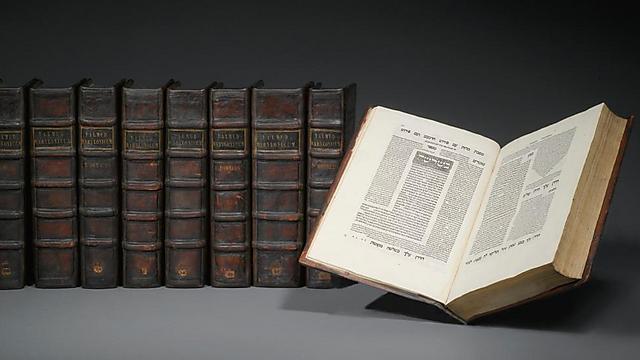
(Photo: Sotheby's)
Powell's bestiality charge relies on a midrashic homily describing Adam forming an "intimate connection" with animals while naming them, before recognizing only Eve as his partner. This poetic reflection becomes, in Powell's telling, an endorsement of bestiality. Yet he ignores when both the Bible and Talmud prescribe capital punishment for such acts (Leviticus 20:15, reaffirmed in Sanhedrin 54b). Transforming Hebrew idiom into moral depravity requires either ignorance or deception.
What unites these fabrications is purpose: portraying Jews as followers of secret, perverse laws. This taps ancient anxieties about Jewish difference and minorities maintaining distinct practices while participating in broader society. By attacking "Talmudic Jews," critics claim opposition not to a people but to an ideology. People wishing to attack Jews find attacking the Talmud easier than the Bible, which Christians also consider holy.
These attacks accelerate when Jews become convenient scapegoats. Jean-Paul Sartre observed in 1944 that anti-Semites "give ridiculous reasons, discredit serious interlocutors, delight in bad faith. They seek not to persuade but to intimidate and disconcert."
The Talmud teaches the opposite of what its critics claim. Pirkei Avot 3:14 declares that every human is beloved because all are created in God's image. Sanhedrin 105a states that righteous Gentiles share equally with righteous Jews in the world to come. In its pages, the Rabbis seek to elevate every detail of mundane human experience in the service of God (Berachot 63a; Avot 2:12).
Far-right influencers who claim to defend Western civilization but recycle medieval slanders undermine their own principles while spreading falsehoods.
 Rabbi Daniel Rowe Photo: Courtesy
The reappearance of these accusations aims to drive a wedge between Jews and Christians, particularly among younger conservatives, by repackaging old polemics as suppressed truths.
Open inquiry should always be welcomed. But serious criticism requires primary sources, historical context, and engagement with those who know the tradition. Few would accept caricatures of their own beliefs without such care. Jewish texts deserve the same standard. The Talmud has endured centuries of misunderstanding. It will endure the internet age as well.
Rabbi Daniel Rowe currently serves as the Educational Visionary of Aish, a global Jewish educational institution, and resides in Jerusalem. Rabbi Rowe is known for his ability to tackle difficult topics and has numerous videos and articles online. He is an expert on Jewish and Muslim history and has given several talks on the subject of the Judeo-Muslim dynamic.