

Iran’s Jewish community is showing signs of a return to routine after the recent war, even as regional tensions persist.
Rabbi Yehuda Gerami, the community’s chief rabbi, is usually highly active on social media but stopped posting during Operation Roaring Lion In recent days, he has resumed publishing photos and videos from community events.
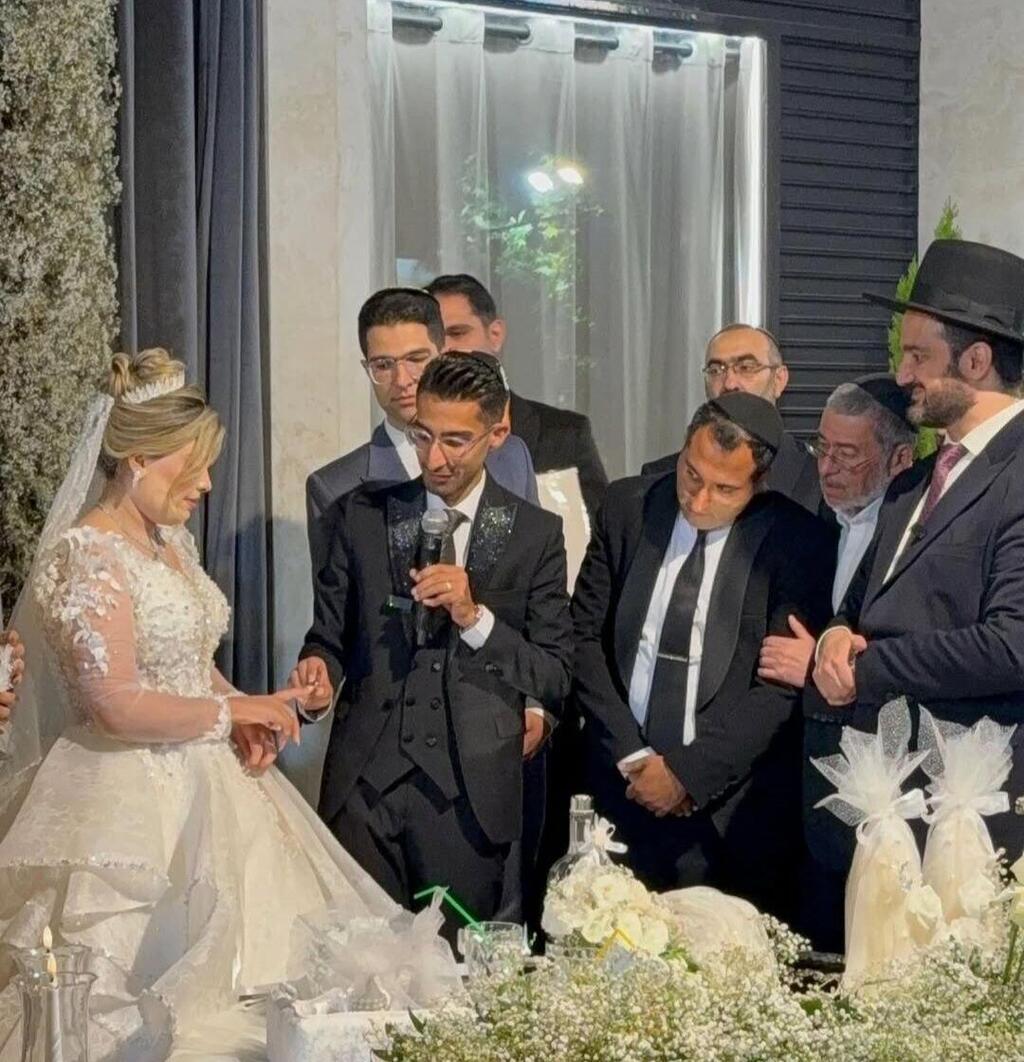
Among other things, he documented weddings he attended in Shiraz and Isfahan, adding brief blessings for the couples. He also recently posted a video from a pidyon haben ceremony in Iran, writing: “May you merit raising him to Torah, marriage and good deeds.”
Although Iran’s Jewish community cannot maintain direct contact with figures in Israel because of the restrictions imposed by the Iranian regime and concern for the safety of its members, its social media posts sometimes offer a glimpse into daily Jewish life in the country.
Recent reports suggest that in several areas, including education, the community is gradually returning to routine. Overnight Wednesday, the Tehran Jewish Association published an announcement addressing an issue that had concerned community members: the scheduling of high school matriculation exams on the Sabbath.
“Thanks to the efforts and follow-up by the head of the scientific and educational committee of the Tehran Jewish Association, Ilan Mishaelian, with the Education Ministry, all Jewish students in all cities in Iran can receive assistance from a ‘secretary’ during exams on the Sabbath,” the statement said. The reference is to someone who will assist students in writing the exam itself.
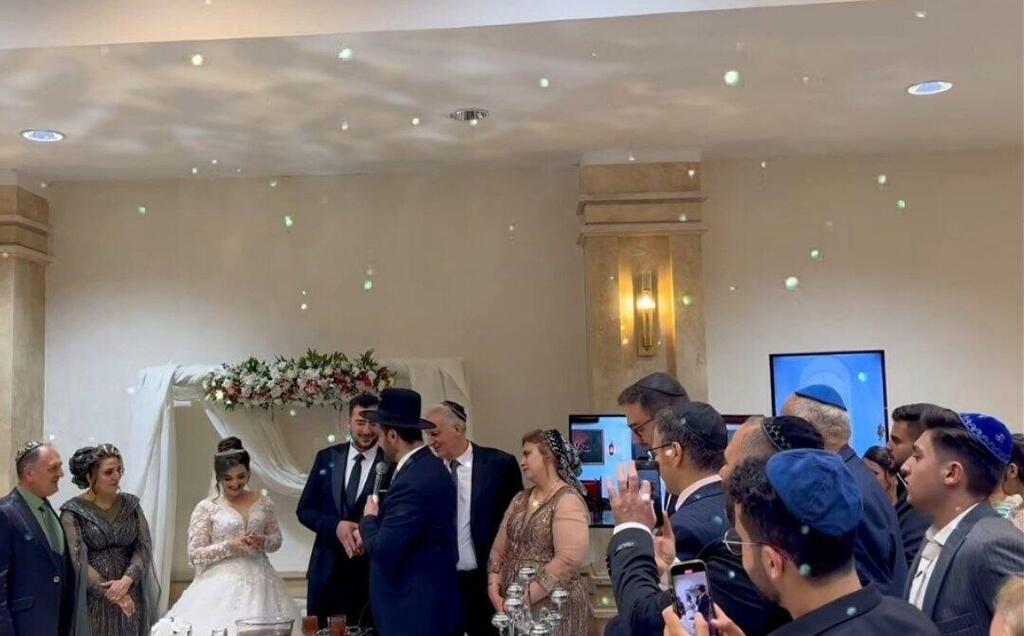
Rabbi Gerami officiates a wedding for a couple in Isfahan
(Photo: Rabbi Yehuda Gerami Instagram)
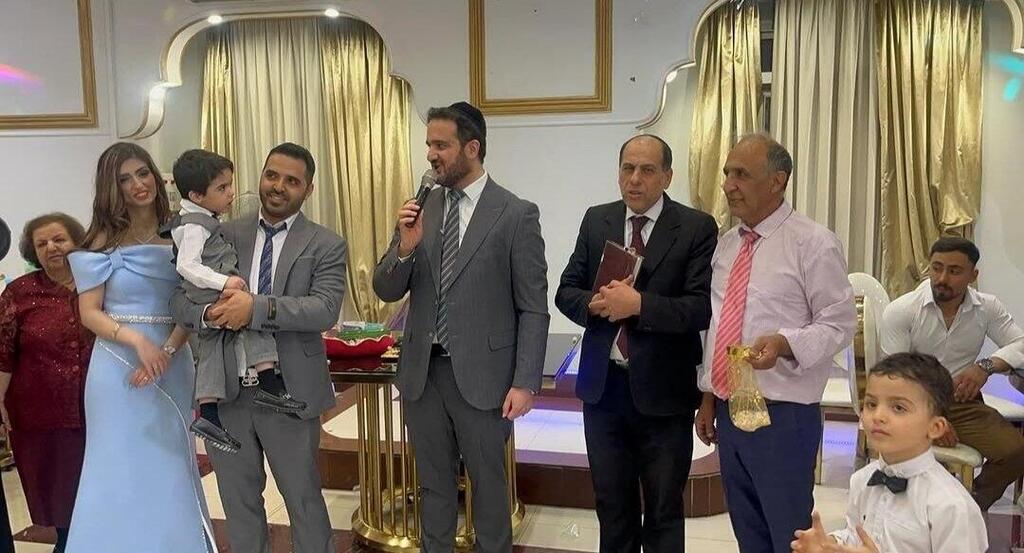
Pidyon haben ceremony
(Photo: Rabbi Yehuda Gerami Instagram)
The statement said the arrangement does not require approval from welfare authorities and involves no payment. It also emphasized that because of time constraints and the current circumstances, it was not possible to postpone the final exams scheduled for Saturday to another date.
Jewish students were asked to inform their school administration in advance if they wished to use the arrangement before the exams. The Jewish community’s statement included documents showing correspondence that preceded the approval, with one document noting that this procedure had also been used in previous years.
The Iranian regime has made considerable efforts in the weeks after the war to showcase the Jewish community’s support for the regime. Iranian channels affiliated with the regime have used every opportunity to present Jews in the country as supporters of Supreme Leader Mojtaba Khamenei, as condemning the killing of his father Ali Khamenei and as opposing Israeli and U.S. action against Iran.
This was especially evident after the Rafie Nia synagogue in Tehran was damaged during the recent war, when the Iranian regime used the incident to claim that Israel was harming Iran’s Jews.
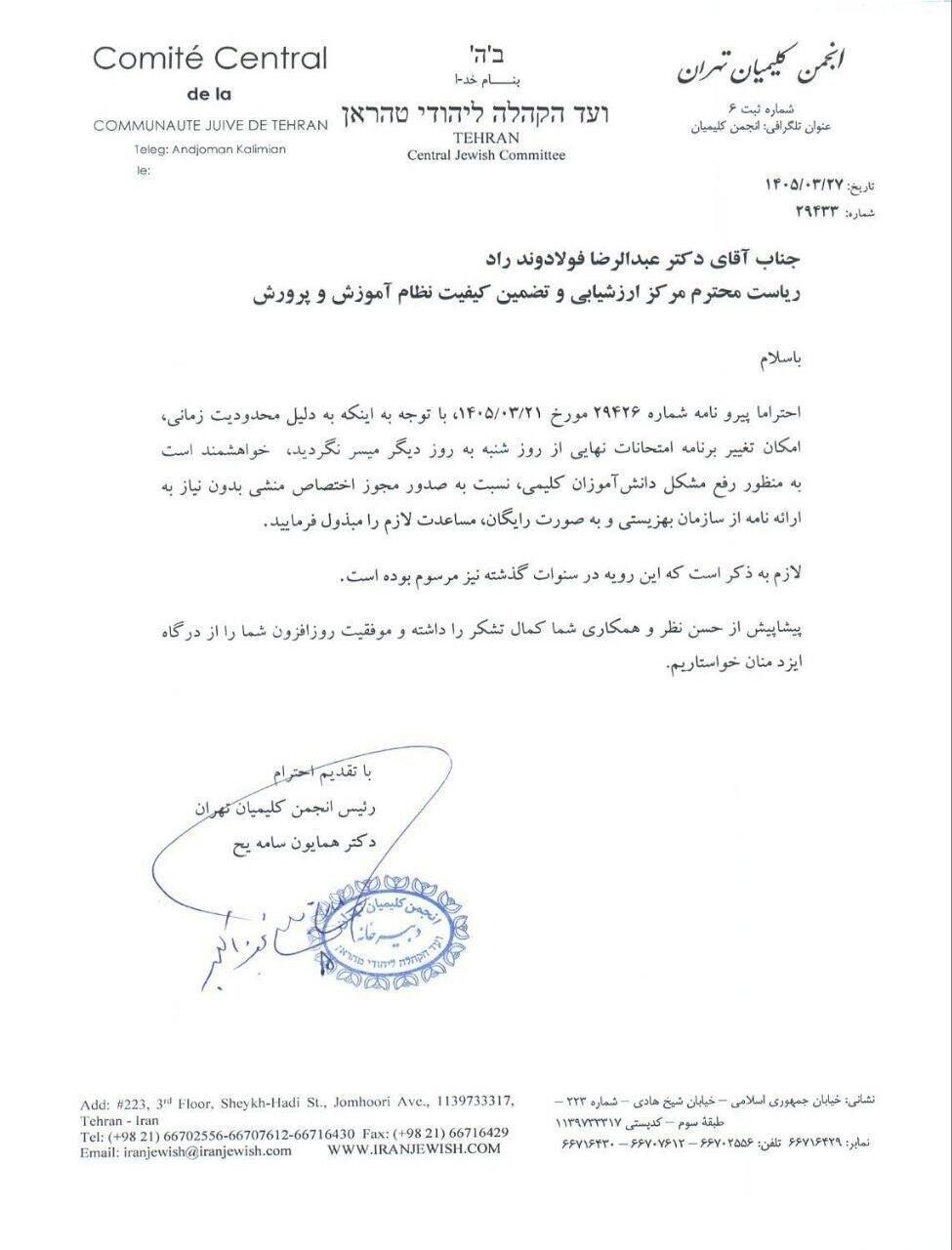
The letter regarding the Sabbath exam
Babak Itzhaki, a reporter for the opposition channel Iran International, spoke to ynet about the current situation of Iran’s Jews.
“They are not hostages. They are there by choice. Anyone can take a passport and leave Iran,” he said. “They align with the regime, and this is something that has been customary among Jews for many, many years, not only under this regime. Jews always supported whatever regime was there in order to protect themselves.”
Itzhaki points to two main approaches in Israel toward Iran’s Jews.
“There is a view that standing alongside the regime, supporting it and attacking Israel and IDF soldiers may serve the regime, but it harms their brothers in Israel,” he said. “According to this view, it would be better for Iran’s Jews to leave the country, because even if the regime is replaced, there is no guarantee that the new government will forget their support for the previous one.”
The synagogue in central Tehran that was damaged in the strike


“On the other hand, there are those who believe they should continue supporting the regime and remain in Iran because they are preserving a Jewish heritage that is about 3,000 years old,” he added. “There are Torah scrolls there that are more than 1,000 years old, some of the world’s oldest synagogues, cemeteries and the tomb of Esther and Mordechai. Without them, the fate of Iranian Jewry could resemble that of Afghan Jewry, of which almost no trace remains.”
“Today, the Jews who remain in Iran express support for the regime and serve as a propaganda tool for it,” Itzhaki said. “Anyone who knows the reality understands that their statements do not necessarily reflect their true views. This is the way they are choosing to act now. Whether it is the right way or not, history will judge.”
Asked about the Jewish community’s return to routine, Itzhaki said: “They are returning to routine along with the rest of Iran’s population. There are no attacks on them because they are Jewish.” According to him, the Iranian regime makes sure to distinguish between Jews and Zionists, and members of the community are therefore gradually returning to daily life.
“The economic difficulties affect everyone, including them, but in that sense they are no different from the rest of Iranian society,” he said.
Beni Sabti, an Iran researcher at the Institute for National Security Studies, also spoke to ynet about the community’s current activity.
“They continue to praise and glorify the regime and have also returned to routine in terms of weddings,” he said. “They ignore reality. ‘It has nothing to do with us.’ They do not mention the war in the letters, the documents published overnight, and they show that they are ‘in the same problem as everyone else.’ In their world, things are generally good for them.”
Sabti added that there have recently been reports and rumors about the imprisonment and execution of Jews, but said no one had heard of such cases and that based on the available information, the reports appear to be false.