


A painting by Russian artist Wassily Kandinsky that was lost by its Jewish owners during the Nazi occupation of the Netherlands and spent nearly five decades in a German museum has sold for more than $42 million at Christie's auction house in London, three years after being returned to the family's heirs.
The 1907 masterpiece, Das bunte Leben (The Colorful Life), fetched 31.56 million pounds at the October 14 auction, substantially exceeding its presale estimate of 18 million to 25 million pounds. Bidding lasted nearly six minutes, and the identity of the buyer has not been disclosed.
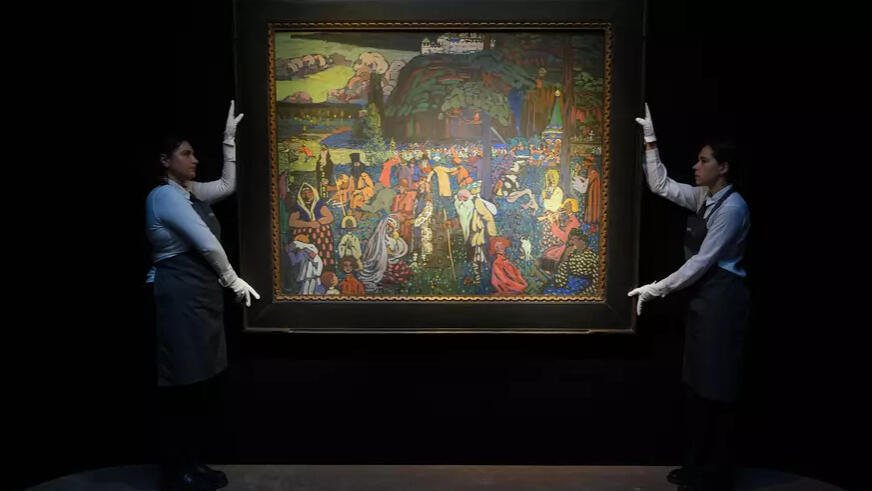
Wassily Kandinsky's 1907 painting The Colorful Life, sold at Christie's in London after being returned to the heirs of its former Jewish owners
(Photo: AP/ Kirsty Wigglesworth)
The painting was the highest-priced work sold during the auction, which took place as part of London's Frieze Week art events. According to Christie's, it was also the most expensive artwork sold at auction during Frieze Week in the past five years.
Created in Paris in 1907, The Colorful Life is regarded by art historians as a turning point in Kandinsky's development from figurative painting toward the abstract art for which he would become internationally renowned. The large, vividly colored canvas depicts a dreamlike landscape filled with figures in traditional clothing, drawing on Russian folklore, religious imagery and scenes of everyday life.
Before World War II, the painting belonged to Emanuel Albert Lewenstein, a Dutch Jewish industrialist who operated a sewing machine manufacturing business, and his wife, Hedwig Lewenstein-Weyermann. The couple acquired the work in 1927 as part of their collection of modern European art.
Emanuel died in 1930 and Hedwig in 1937, leaving their collection to their two children, Robert and Wilhelmine, who subsequently lived outside the Netherlands as Nazi persecution spread across Europe.
In October 1940, five months after Nazi Germany invaded the Netherlands, the Lewenstein collection was offered for sale at an Amsterdam auction house. The Colorful Life, which had been held for safekeeping at the Stedelijk Museum, was among the works sold.
The precise circumstances surrounding the sale have remained historically unclear, including who authorized it and who received the proceeds. However, the sale took place after the Nazi occupation authorities had begun systematically stripping Dutch Jews of their rights and property.
In 1972, the German state-owned bank Bayerische Landesbank acquired the painting and subsequently loaned it to Munich's Lenbachhaus museum, where it remained on display for approximately half a century.
After years of provenance research and legal proceedings, the Lewenstein heirs succeeded in securing the painting's return. In 2023, a German government advisory commission examining Nazi-looted cultural property recommended restitution, concluding that there were substantial indications the painting had been lost because of Nazi persecution.
The commission emphasized that property losses suffered by Jews in the occupied Netherlands should generally be presumed involuntary unless convincing evidence demonstrated otherwise. It found insufficient grounds to establish that the painting had been voluntarily sold.
The painting was returned to the heirs in June 2023, bringing a decades-long restitution effort to an end. Its appearance at Christie's this month marked the first time the work had been offered for sale since its recovery by the family.
Despite the high price, the auction did not break Kandinsky's record. In March 2023, another restituted painting, Murnau mit Kirche II (Murnau with Church II), sold at Sotheby's in London for approximately $45 million, setting an auction record for the artist.
For the Lewenstein heirs, the latest sale marks the culmination of a long effort to recover an artwork that had disappeared from their family's possession during one of the darkest chapters of European Jewish history.