

At first glance, the verses of the Book of Esther designed by Hadassah Moskowitz appear to be written in a foreign language. A closer look reveals Hebrew text styled in the spirit of Persian calligraphy.
The Persian-Hebrew typeface offers a renewed reading of the biblical scroll, whose story is set in ancient Persia.
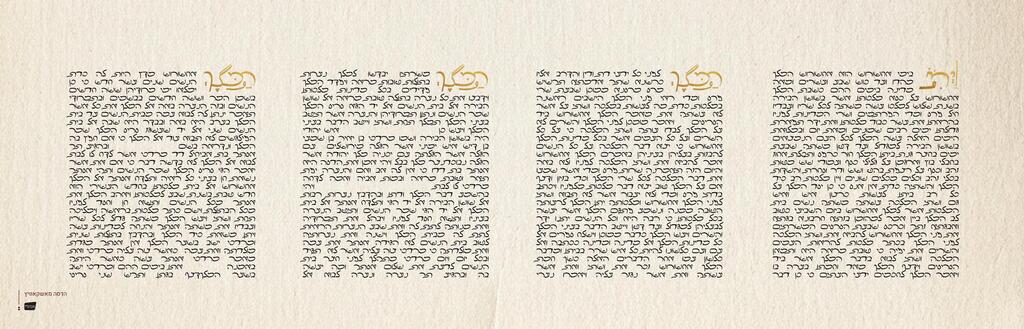
Moskowitz, 22, from Mitzpe Yericho, is a fourth-year student at the Emunah Academic College of Arts and Design. Titled “Ishtar,” the project is her graduation work in the visual communication department under the guidance of Shahar Vitonsky.
Against the backdrop of the war between Israel and Iran, and hopes for a better future that could renew ties between the two peoples, the project has taken on added relevance.
Through typographic research, Moskowitz created a writing system that merges Hebrew letters with the decorative art of Persian script. The goal, she said, was to give the scroll a visual language more aligned with the geographic and cultural background of its narrative.
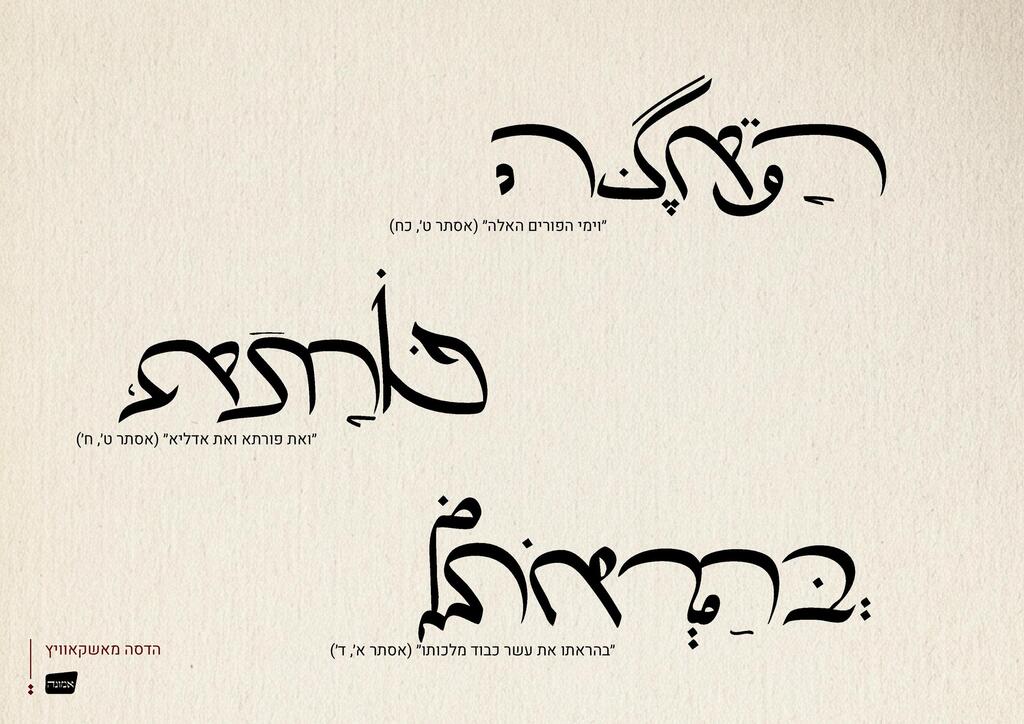
Words from the Book of Esther deisgned by Moskowitz
The design blurs the boundaries between Hebrew and Persian and requires readers to pause and read the text anew. The project’s name, “Ishtar,” was inspired by the book “The Queen” by Tamar Eilam Gindin and Maayan Eshkoli, one of several works she studied while researching the scroll’s roots.
Asked whether the project has taken on special meaning amid the war with Iran and whether she hopes for renewed ties between the nations, Moskowitz said: “I didn’t choose the subject because of the war with Iran. But as the project progressed and the situation developed, I realized something bigger was happening, even a certain sense of mission. I saw a new connection forming — linking the scroll to its Persian roots and reconnecting Iranians to their original heritage. The link to Purim and to history repeating itself added another layer of depth.”
Moskowitz does not have Persian roots; her family background is Hungarian, Polish and Lithuanian.

Hadassah Moskowitz
“The idea was planted in my first year, during my first semester, when I was introduced to calligraphy in a course taught by Colette Ziv,” she said. “I felt connected to the field and deepened that interest throughout my studies. When I reached my fourth year and had to choose a topic for my final project, I knew I wanted to focus on calligraphy and was looking for a theme. In a conversation with my mother, she mentioned the Book of Esther almost in passing, and that’s where the research began.”
Her connection to the Book of Esther is also personal. “My name is Hadassah, which is another name for Queen Esther,” she said. “My mother teaches at a seminary, and before I was born she was teaching about Esther’s character and felt connected to her. She couldn’t name me Esther because that is my grandmother’s name, so they chose Hadassah.”
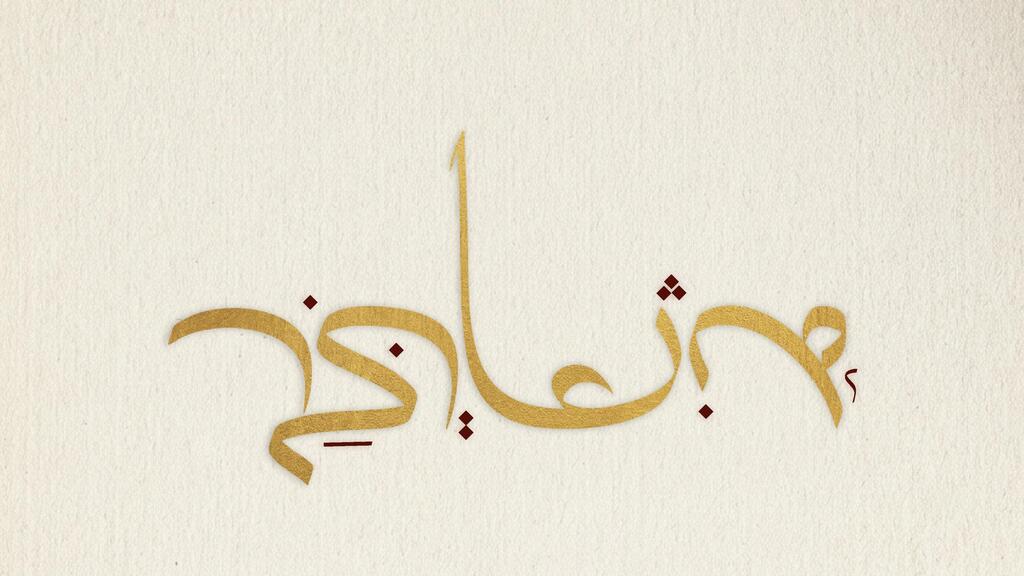
The images accompanying the article are preliminary sketches, as the project is not yet complete. The final version is expected to be presented at the college’s graduate exhibition in July.
Dr. Efrat Grossman, head of the college and a scholar of Hebrew typography, praised the work. “Hadassah’s project is moving and brings the visual communication department’s engagement with typography to its peak,” she said. “The script design in this scroll is not merely an aesthetic choice. It engages with the story of the Jewish community in Persia, which preserved its faith and language within a different cultural space. The letter here is not just a functional graphic symbol but a bearer of identity and meaning, telling a story through form.”