

It may seem surprising, but the Jewish Kaddish prayer, which among other things accompanies loved ones’ farewells, only became associated with mourning a few centuries ago, specifically in the late 13th and early 14th centuries.
How did the Kaddish become linked to both national and private memorial days? Behind the spread of the prayer of praise and hallel to God lies a story tied to persecution and a crisis of faith.

The familiar Kaddish is written in Babylonian Aramaic — likely because it was a language the general public understood at the time the text was composed. It opens with the words: “יִתְגַּדַּל וְיִתְקַדַּשׁ שְׁמֵיהּ רַבָּא” (“may His great name be magnified and sanctified”).
Though the Kaddish is already mentioned in the Talmud in Tractate Berakhot, says veteran journalist Shaʼul Maizlish, co‑author of The Mystery of the Kaddish (together with Leon Charney), it was initially recited mainly after a rabbi’s sermon, or on occasions such as the conclusion of a Talmud tractate or the death of a communal leader. The major shift began after a series of global and Jewish events, which, in his view, led one of the great medieval rabbis to turn the Kaddish into the prayer recognized today throughout the Jewish world, especially in times of disaster, death, and grief.
From the Crusades to the Imprisonment of the Maharam
In 1286, the Maharam (Rabbi Meir of Rothenburg) was imprisoned in the fortress of Ensisheim after attempting to reach the Land of Israel. The imprisonment of one of Judaism’s leading rabbis shook the Jewish world and prompted Jewish communities to open their purses to raise the enormous ransom demanded by the German emperor. Funds were collected, but according to tradition, the Maharam informed his son‑in‑law and disciple, the Ra’ash – Rabbi Asher ben Yechiel – that he refused to be released, asserting he would not allow extortion to become a precedent. In the tragic conclusion, he remained in prison under dire conditions, suffering from diabetes and other illnesses, and died there.
Kobi, father of fallen soldier Yonatan Samerano, recites Kaddish at Rachel’s Tomb.


This was a difficult period for the Jewish people, one of many across history. Not long had passed since the Crusades, in which entire Jewish communities were destroyed. Hardships and persecutions accumulated, and many Jews began to raise their voices in protest to Heaven. “This movement recalls what happened after the Holocaust,” Maizlish says, “when a major breach of faith occurred, and people stopped going to synagogue and fulfilling commandments.”
The Ra’ash conveyed to his teacher the spiritual climate outside, and the Maharam ruled that a declaration was needed, one that includes justification of divine judgment, whereby the Jew accepts the painful event while affirming continued devotion to the Holy One, blessed be He. The Maharam added an important condition: the Kaddish must be recited only before a quorum of ten (a minyan). In this way, the rabbi not only strengthened faith in God, but also drew Jews back into the synagogue, into a community where they could recite Kaddish for their loved ones who had passed.
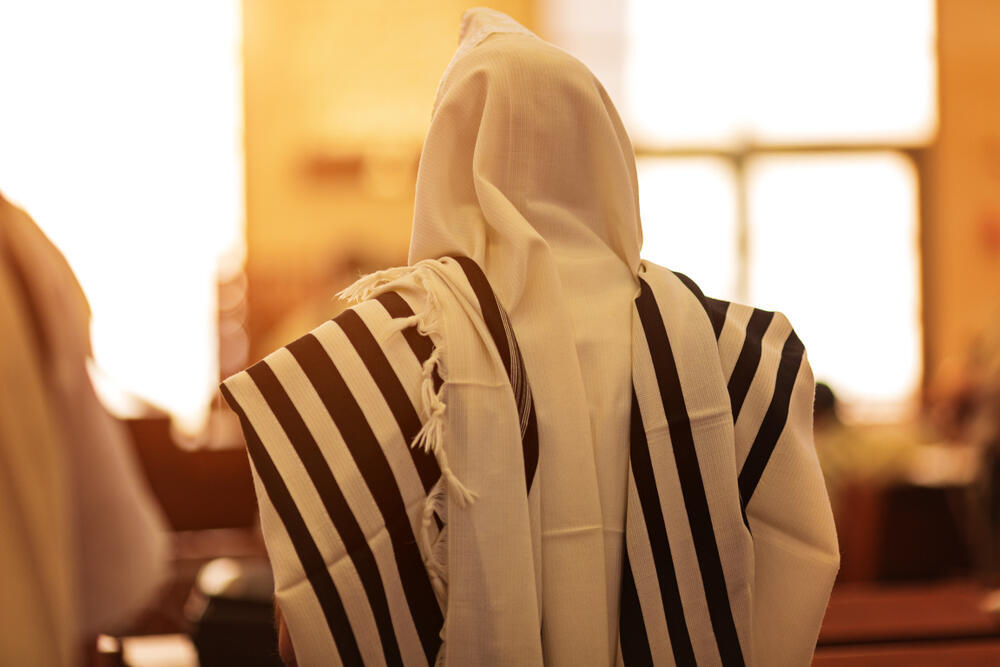
There are five different types of Kaddish, each recited on distinct occasions
(Photo: Evgeniy pavlovski / Shutterstock)
Thus the status of the Kaddish in the form known to us was established: a prayer of acceptance and continued faith despite all. “Until then, the Jewish burial rite included only placing the body in the grave,” Maizlish explains. “Unlike other nations, which dressed the deceased in fine garments and held elaborate ceremonies, Jews treated burial as entirely practical.”
The Spread of Kaddish Across Communities
The Ra’ash began promoting the Kaddish among Jewish communities, and it spread swiftly. Meanwhile, pogroms and antisemitism continued, and the Ra’ash and his family realized that the ground was burning beneath their feet. They also remembered that the German Emperor Rudolf still awaited the ransom, which would no longer come. Acting on the Maharam’s advice, they decided to flee eastward toward Spain. The Ra’ash sent his son Rabbi Yaakov (“Ba’al HaTurim”) to scout for locations, during which he passed through many communities, including Alsace in France. He continued to promote the prayer wherever he went. “In Monaco, for example, there is a siddur from that era in which the Kaddish already appears as part of funeral services,” Maizlish notes.
In Spain, Rabbi Asher met one of the great Spanish rabbis, Rabbi Shlomo ben Avraham ibn Aderet (the Rashba). He told him about the Kaddish and the Maharam’s innovations. The Rashba responded that conditions for Jews in Spain were relatively better and the need for collective reinforcement less acute, but he accepted the Maharam’s enactment without dispute. He only suggested adding a more personal petition to the Kaddish, less national in tone. Thus phrases such as “and healing… deliverance and rescue for us and all his people Israel” and “Amen” were integrated. Troubles, as is well known, reached Spain in later centuries with the Jewish expulsion and the spread of the Inquisition.
The Kaddish did not stay confined to the Iberian Peninsula. Rabbi Yosef Karo, author of the Shulchan Aruch, brought the prayer to Safed, and of course it appears in the central code of halacha. There the term “Kaddish Yatom” (“Orphan’s Kaddish”) was used for the Kaddish mourners customarily recite in the first year after parents’ death (and on memorial days), one of five types of Kaddish recited on various occasions. In those settings an additional belief took hold: that reciting the Kaddish assists in elevating the soul of the deceased in the world to come.
With the help of Rabbi Moshe Isserles (the Rema), who authored HaMapah in Poland according to Ashkenazi custom alongside the Shulchan Aruch, the Kaddish spread into Central and Eastern Europe — and from there throughout the world. In Yemenite Jewish communities they added the name of Maimonides (whose authority was revered there) to the Kaddish: “in your life, in your days, in the life of our teacher Moses son of Maimon.”

Jewish graves in Lublin, Poland
(Photo: Jolanta Wojcicka / Shutterstock.com)
It appears the link between Kaddish and loss did not emerge from nothing. Already in the Talmud a portion of the Kaddish is mentioned in the context of the post‑destruction period and exile, tied to the desire to praise God especially after a painful event involving desecration of His name. “Rabi Yosi said: Once I walked on the road and entered one of the ruins of Jerusalem to pray… I heard a heavenly voice like a dove’s lament, saying: ‘Woe to the sons, because of their sins I destroyed My house and burned My sanctuary and exiled them among the nations… At the moment Israel enter their synagogues and study houses and answer ‘May His great name be blessed’ the Holy One, blessed be He, nods His head and says: ‘Blessed is the king who is glorified in His house thus; what stronger father would exile his children from his table? Woe to those children who were exiled from their father’s table.’” (Tractate Berakhot 3a)
In "Arukh HaShulchan", Rabbi Yechiel Michel Hacohen Epstein later wrote: “The Kaddish is a great and awe‑inspiring praise ordained by the Men of the Great Assembly after the destruction of the First Temple — a prayer over the desecration of God’s name, destruction of the Holy Temple, the ruin of the Land of Israel, and the dispersion of Israel to the four corners of the earth. We pray ‘may His great and holy name be magnified’ as the prophet (Ezekiel 38:23) said: ‘I will magnify Myself and sanctify Myself, and let it be known before many nations, and they shall know that I am the Lord.’
In a 10th‑century siddur composed by Rabbi Saadia Gaon, the custom to recite Kaddish at funerals is mentioned for the first time, but the author appears not to endorse its recitation at that moment: “There are people who say this Kaddish after burying the deceased; that is not part of the core law,” he wrote. Only in later periods, following the Crusades and amid Jewish struggle under forced conversion and persecution, did the connection between the Kaddish, mourning, and loss become firm.
Around the Kaddish, now closely identified with death, more and more stirring stories accrued about the final moments of Jews. One is the story of the Admor of Karlin, Rabbi Avraham Elimelech Perlov, who arrived in Israel from Poland in 1939 but chose to return to the killing fields, claiming he could not abandon his followers. When he returned to Poland, he was offered escape again but refused and requested to leave the car. When taken by the Nazis on his final journey, he left behind a siddur open to the page of Kaddish.

Today, the Kaddish is associated with the end of life
(Photo:Yair Sagi)
“Seeing what was coming,” Maizlish says, “the Admor while in Poland — before the full scale of the slaughter was yet revealed — directed that this prayer be repeated again and again, and within a few years it became the Kaddish on the ashes of millions of Polish Jews.”
“Today, the Kaddish is identified with the end of life even more than the Shema,” he notes. “Not everyone knows how to say the Shema, but every Jew who departs from a loved one meets the Kaddish at a funeral and in moments of disaster.” Moments of this kind, once personal and familial, became over the past two years a narrative of collective Israeli tragedy.
Kaddish of October 7
Daphna Shaia is an educator from Petah Tikva. When her husband was summoned to the front on October 7, 2023, she, like many others, stopped sleeping, not just out of worry for his life, but also due to the harrowing images streaming on television. “One report was about three of the dead from the Netiv HaAsara path. It hit me with a troubling question: Who says Kaddish for them? Is there even someone doing that?” she recalls.
Shaia didn’t remain passive. She contacted her family and synagogue friends and asked for help from those willing to assume the Kaddish for fallen soldiers. Within hours she received more than 100 responses. Realizing that the effort required more resources, she partnered with her cousin Esti Levi. Their initiative produced hundreds of Kaddishes for soldiers and casualties who had no one to recite the prayer for them, after the two identified the people in need sensitively. Later they joined forces with the Chesed Chaim V’Emet nonprofit of Dror David Amos, a former career soldier and reserve officer, and the numbers grew rapidly.
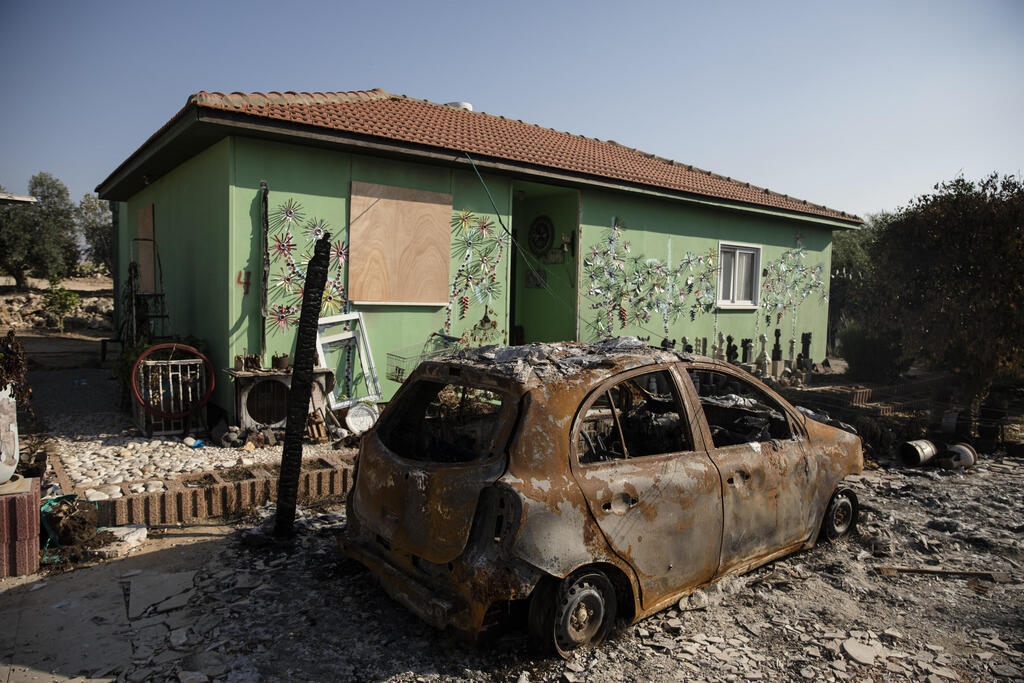
Destruction in Nativ HaAsara following the October 7 terror attack
(Photo: Amir Levy/Getty Images)
What is so special about the Jewish Kaddish? “By reciting the Kaddish, the ‘Kaddish‑giver’ carries the deceased everywhere with him,” says Shaia. “Once you accept undertaking the Kaddish, you pledge to go to synagogue three times a day or find someone to replace you and carry the Kaddish for the fallen. Naturally, you also learn about the person and his life story.”
Shaia recounts that family trips, requiring staying in areas without a synagogue, were canceled because of her husband’s commitment to recite Kaddish for one of the fallen, the late Roee Miller. On one occasion, despite their efforts, they could not find ten people — only eight. “We found ourselves talking to him all day saying, ‘Roee, sorry, sorry we failed the mission.’ It is a shared fate. As a ‘Kaddish‑giver’ you are committed to the soldier you pray for, just as you are committed to a child’s needs in your family.”
Between the Kaddish‑givers and bereaved families a new kind of Jewish fellowship emerges. “When I see a car sticker with the name of a fallen soldier for whom I organized Kaddish, I honk and ask the driver if he knows the fallen or their family,” she says. “If he says yes, I ask him to tell the family that someone is reciting Kaddish for their dear one, since in most cases the family doesn’t even know.”