


For nearly 20 years, Barbara Hines was a devout Buddhist. She studied personally with the Dalai Lama, served on official committees within his organizations and appeared to have found her spiritual home in the monasteries of Tibet and Bhutan. Before that, she had grown up in a Christian environment in the suburbs of Sydney, Australia, attending a Methodist church every Sunday without knowing anything about Judaism.
But beneath her Buddhist devotion and Christian upbringing lay a family secret that had remained buried for decades. Her parents, Holocaust survivors who had escaped Nazi persecution, had concealed their Jewish identities out of a deep fear that history might repeat itself. Their daughters grew up knowing nothing of their family's past.
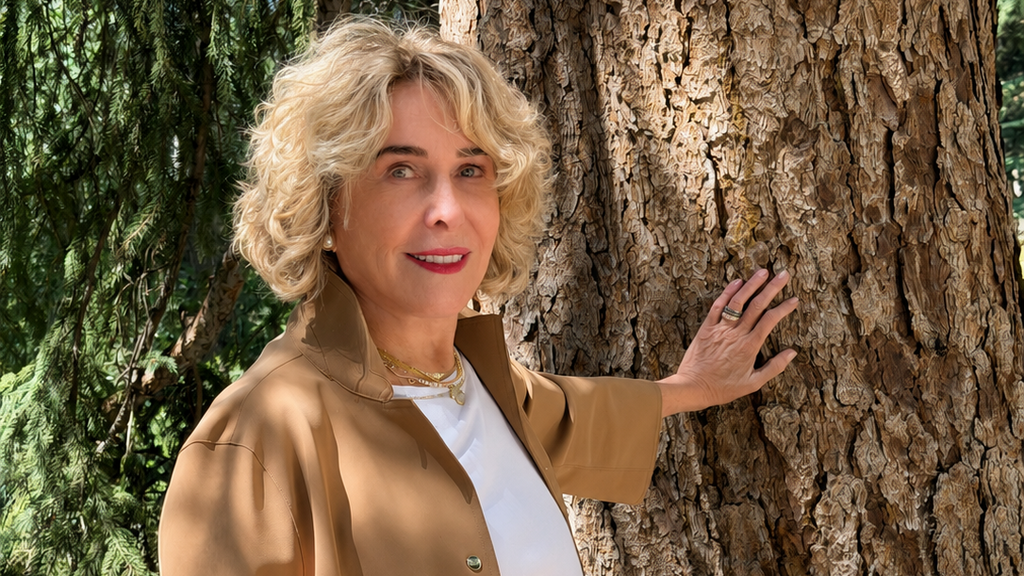
It was only years later, through an unexpected journey of discovery undertaken by her younger son, that the truth finally emerged. Along with it came the devastating revelation that 86 members of her extended family had been murdered in the Holocaust.
For Hines, an artist and philanthropist, the discovery prompted a life-changing decision. She would not allow Adolf Hitler to determine her future or deprive her of her heritage. She embraced Orthodox Judaism and began observing Jewish religious law.
‘I didn't know what a Jew was’
Born Barbara Fritzsche, Hines spent her childhood in Sydney's northern suburbs, where her family appeared much like any other household of postwar European immigrants. The surrounding community was predominantly Anglo-Saxon, far removed from the city's Jewish neighborhoods. German was spoken at home, and every Sunday morning her parents sent her and her sister to a nearby Methodist church.
"For them, it was free babysitting on Sunday mornings," she recalls with a smile. "And that was our social activity for the week."
At the public school she attended, an hour each week was devoted to Christian religious education. Ironically, it soon became her favorite subject. She eagerly absorbed the biblical stories of the patriarchs and the Torah, unaware that she was studying the history of her own people.
At the time, the word "Jew" meant nothing to her. "I didn't know what a Jew was back then," she admits.
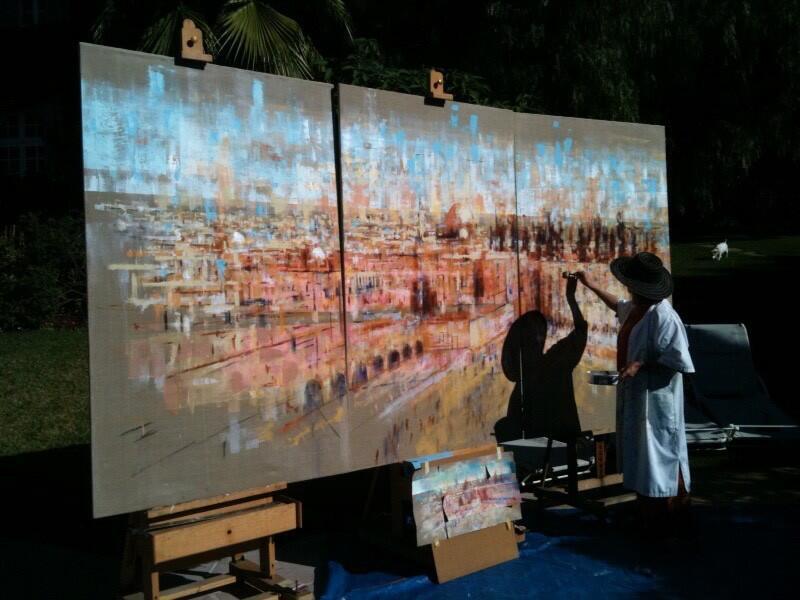
Hines painting
(Photo: Courtesy)
Behind that seemingly ordinary childhood, however, was the profound fear that had shaped her parents' lives.
Her father, Rolf Otto Julius Fritzsche, had been imprisoned during World War II because his mother was Jewish. He was formally discharged from the German air force, the Luftwaffe, after being classified as a "half-Jew." The family still possesses the official document recording his dismissal.
One night, prisoners were marched out of their cramped cell toward a forest. Her father managed to escape. He and his partner, Hines' mother, Ursula Micheel, subsequently survived the war in hiding.
After the war, her father found that he could no longer look into the eyes of Germans his own age without wondering what they had done during the Nazi years. He decided to leave Germany behind and move his family to the other side of the world.
The decision to conceal their Jewish identity completely, never tell their daughters about their ancestry and raise them in a Christian environment was rooted in fear. "They were simply afraid it would happen again," Hines explains.
The grandmother who finally revealed the truth
The first clues about Hines' Jewish heritage began to surface when she attended the University of Sydney. Without deliberately seeking them out, she found herself surrounded by Jewish friends.
One day, a close friend invited her home. Years later, the friend told Hines that her father had looked at Barbara and remarked in Yiddish, "She has a Jewish head." They had recognized something about her that she herself had yet to discover.
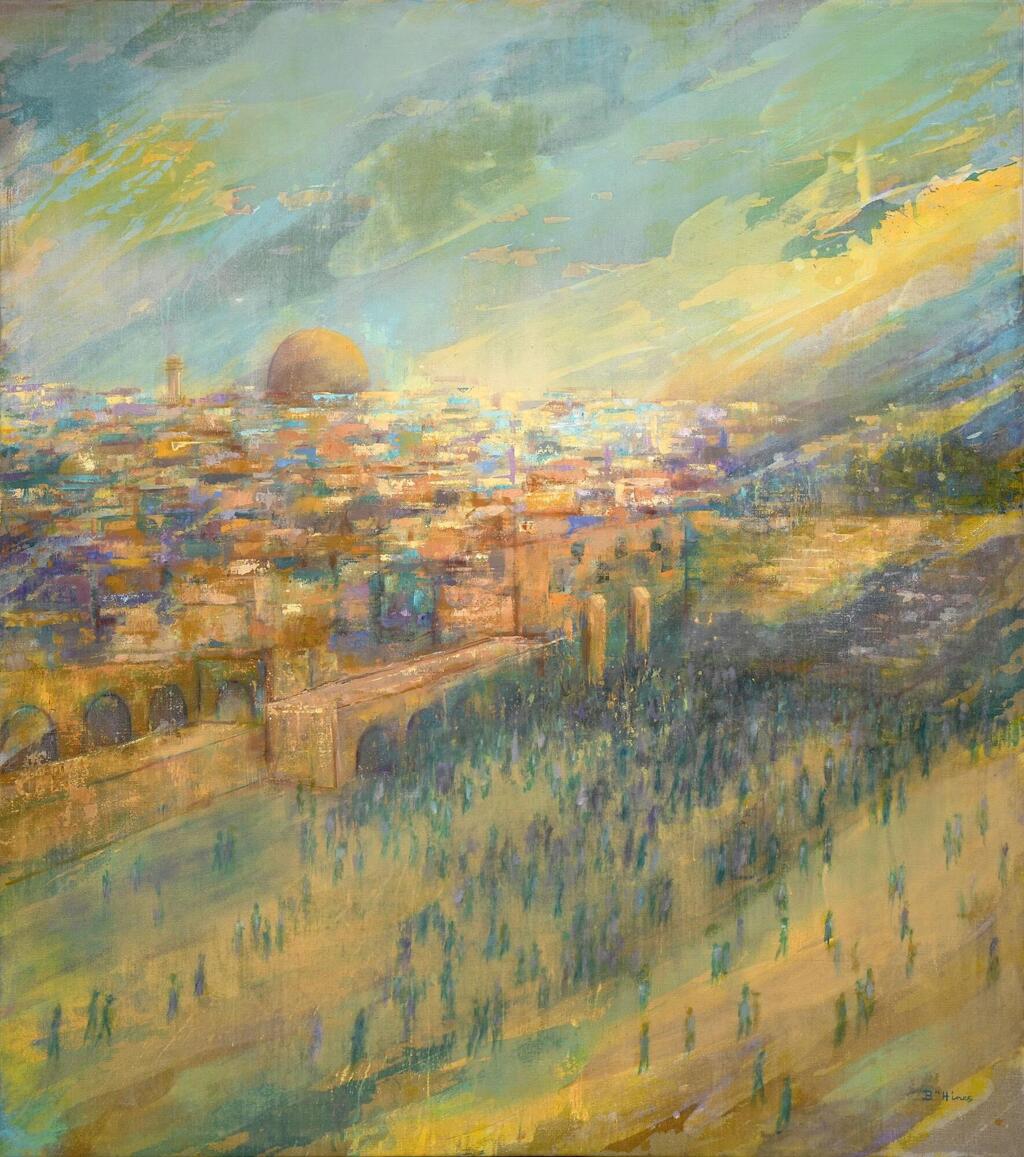
A painting by Hines that will be featured in the exhibition
(Photo: Yochai medina)
Even the language spoken in her childhood home carried traces of the identity her parents had tried to erase. Hines remembers a German teacher at school pointing out that some of the words and expressions she used did not exist in standard German. When she mentioned this to her mother, the explanation was straightforward: "Oh, where I come from in Saxony, that's just an accent, a local dialect."
Only much later did Hines realize that those expressions were Yiddish, remnants of a family language that had survived despite the effort to conceal its origins. The first major revelation came after she completed her university studies and decided to travel to Germany to explore her roots and meet members of her extended family.
Shortly before she left Australia, her father decided to share information that her cousins might otherwise reveal. He told her that his mother, Barbara's grandmother, had been Jewish and, for the first time, described his imprisonment and dismissal from the German military. Her mother, however, remained silent.
Although the revelation was significant, Hines initially regarded it as little more than an interesting piece of family history. She did not connect it to her own identity, set the information aside and continued with her life.
She later met and married Gerald Hines, a businessman and real estate magnate. The couple settled in Texas, where their two children were born, before moving to London to give them a European education.
Throughout those years, Barbara's spiritual journey took her in a very different direction. She began practicing yoga and eventually found her spiritual home in Buddhism.
For nearly two decades, she was deeply committed to the religion. She attended retreats around the world, traveled to Bhutan and Tibet, studied with the Dalai Lama and served on official committees associated with his organizations.
She raised her children with an openness to different religious traditions. While their London school provided Christian education, Hines taught them about Buddhism and practiced meditation with them at home.
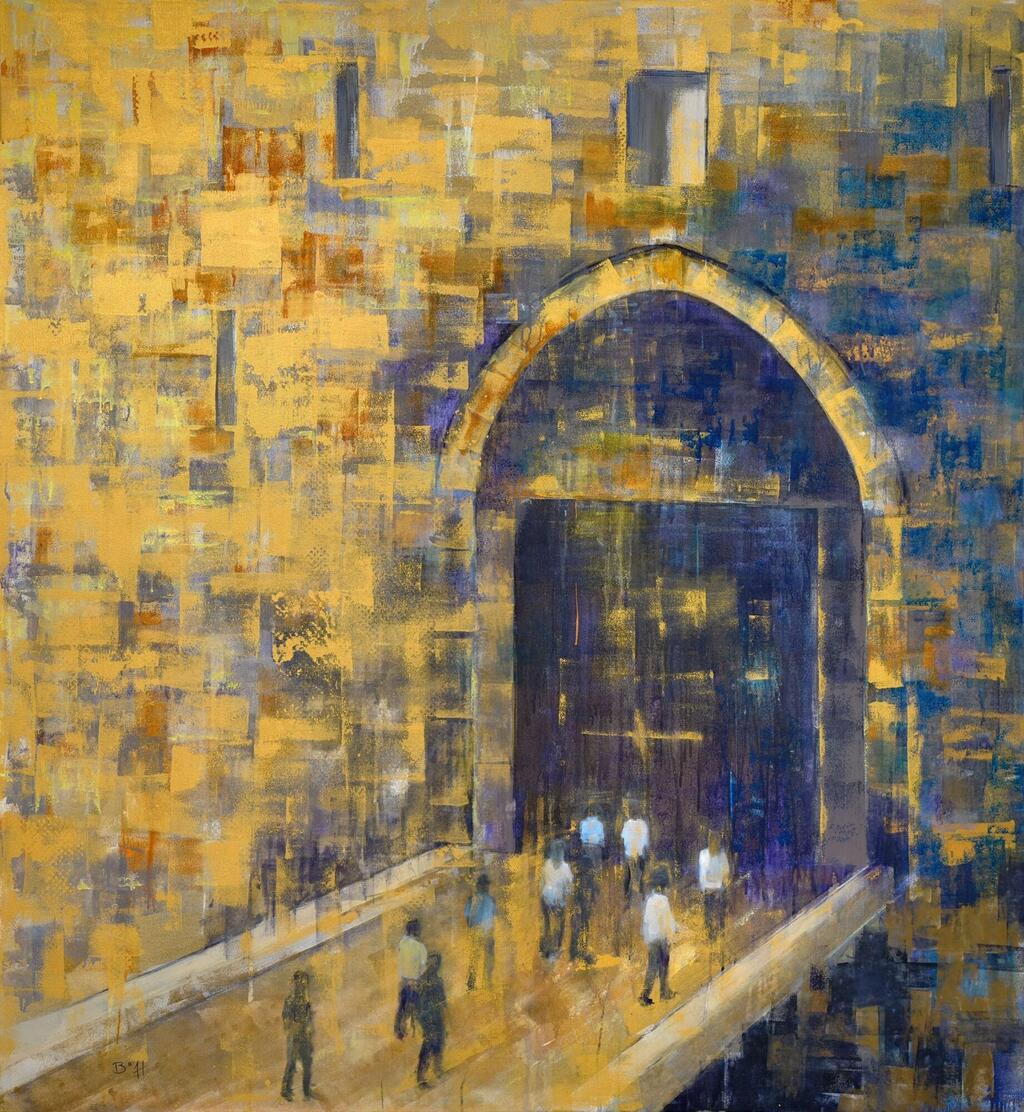
Jewish art by Hines
(Photo: Yochai medina)
But the Jewish identity that had been concealed for generations would eventually resurface through her younger son, Trevor. As a teenager with a passion for old books and history, Trevor began independently researching the origins of Christianity.
One day, he came home and announced that he had found too many contradictions in Christian teachings and believed that the truth lay in their original source, Judaism. "He told me he wanted to become Jewish," Hines recalls. "And I was fine with that, as long as he had a connection with God."
The story took an extraordinary turn when Trevor telephoned his grandmother in Australia to tell her about his decision. By then in her 80s, she finally broke her decades-long silence and revealed the full family history.
Jewish ancestry was not confined to Barbara's father's family. Her mother's mother and grandmother had also been Jewish. The family had survived Nazi persecution through nominal religious conversions, forged documents and the placement of crosses throughout their home to conceal their identity. Trevor ended the call, looked at his mother and said the words that would change her life. "Mom, that means you're actually Jewish."
The Jewish spark that changed everything
Hines describes what happened next through a concept familiar in the Chabad-Lubavitch Hasidic movement: pintele Yid, the inner Jewish spark believed to exist within every Jew.
"A Chabad rabbi once explained to me that it's the spark of Abraham, something genetic that exists inside every Jew, like a ticking time bomb," she says. "It sits quietly inside you, and then one day, boom, it explodes and lights up."
For Hines, that moment came when she walked into her son's bedroom and found him wearing tefillin, the small black prayer boxes and leather straps worn by observant Jewish men during weekday morning prayers. "I had no idea what they were. I thought it was some crazy cult," she recalls.
Her initial alarm soon gave way to intense curiosity and a determination to learn. To make it easier for Trevor to eat at home while following Jewish dietary laws, she began studying the rules of keeping kosher. From there, her interest expanded to Judaism as a whole.
Meanwhile, her sister began investigating their family tree and uncovered a devastating fact: at least 86 members of their extended family had been murdered in the Holocaust. The discovery shook Hines profoundly, but it also strengthened her determination to reclaim the identity that had been denied to her.
"I realized that my heritage had been taken away from me because of Adolf Hitler," she says. "I asked myself, am I going to let this mad, antisemitic dictator determine my future, my life and my inheritance? Am I going to let him take that away from me too, on top of all the family members who were murdered?"
From that moment, Hines never looked back. She left behind Buddhist robes and retreats in the Far East and fully embraced Orthodox Judaism. Today, she observes Jewish religious law, including keeping kosher and observing Shabbat.
Her husband Gerald remained agnostic, but supported her decision and adapted to their new family routines. Instead of going out on Friday evenings, the family began having Shabbat meals together at home.
When Barbara wanted to visit friends or neighbors on Friday nights, Gerald would sometimes drive slowly along a nearby parallel street, using his car's headlights to illuminate the dark path she was walking.
(Photo: Yochai medina)
The return to Judaism eventually extended to the entire family. Both of Hines' children married partners from Jewish and Israeli backgrounds and now lead Jewish lives.
After Gerald died, Hines decided to take the next step in her spiritual journey. She sold her home in Texas, left the United States and formally immigrated to Israel. She bought an apartment in a historic Templer building in Jerusalem's German Colony, near Emek Refaim Street, and decorated it in a warm Moroccan style.
In Jerusalem, she also found a new beginning in her personal life. Just four months ago, she remarried. Her new husband is Rabbi Dr. Natan Ophir, a scholar of Jewish studies.
Despite the challenges of living in Israel, including the wars she has experienced since moving there and the fact that her apartment does not have a reinforced safe room, Hines is convinced she has found the place where she belongs.
"Israel is full of challenges, and everything here seems to involve a struggle, but whenever I'm away, all I want is to come back," she says. "I love the resilience of Israelis. They might sometimes seem like rough, unpolished diamonds, but if someone needs help, they're immediately there. That's a real mensch."
The contrast with her childhood is particularly meaningful. "In a place where my parents were once afraid even to say the word 'Jew,' I now live with enormous pride, in the heart of Jerusalem."
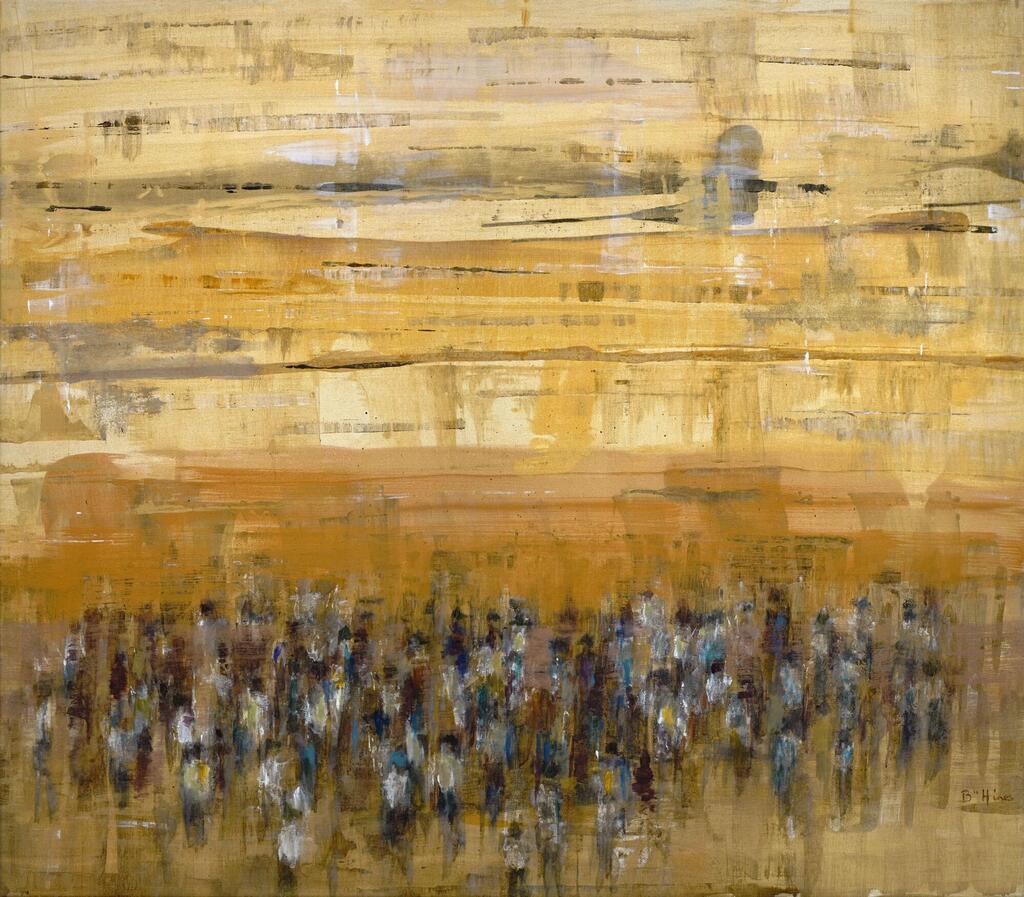
Art has been an important part of Hines' life for decades. After exhibiting her work in several galleries in the United States, she is now preparing for her first solo exhibition in Israel. Over the past 20 years, as her connection to Judaism deepened, her artistic style underwent a transformation.
She moved away from traditional landscapes and portraits toward works exploring Jewish spirituality, biblical narratives and the land of Israel. Her connection to the land is not merely symbolic. She physically mixes soil from Israel into her oil paints, incorporating the country itself into the materials she uses.
Her exhibition, scheduled to open October 15 at the Moshe Castel Museum in Ma'ale Adumim, east of Jerusalem, will run through the end of December.
Overlooking Jerusalem, the museum will display her richly layered works depicting biblical and spiritual themes, including the Clouds of Glory that accompanied the Israelites in the wilderness, Jacob's Ladder and the spiritual atmosphere of Jerusalem.
For Hines, the exhibition represents the culmination of a journey that began in a Christian household in Australia, passed through Buddhist monasteries in Asia and eventually brought her to the Jewish capital. She donates all proceeds from her artwork to charity and Jewish causes.
How do you decide which causes to support?
"I receive a huge number of requests, and I sort through them myself," she says with a laugh. "Everyone here has some project they want to interest me in. What matters to me isn't just donating the money and forgetting about it. I want to stay involved with the project, see how it's progressing and make sure it achieves its goals."
"I think you need to keep your finger on the pulse and make sure the money is actually being used in ways that reflect your values and objectives. I'm mainly looking for projects that don't receive government support, because I don't want them to fall through the cracks."