

“Maimonides rules: Throw a Torah scholar in prison? You’ve thrown away your place in the World to Come.”
That is the message on a popular sticker circulated by ultra-Orthodox activists affiliated with the Ger Hasidic movement, who are currently protesting the arrests of yeshiva students accused of evading military service in Israel. The slogan draws on a ruling by Rabbi Moses ben Maimon, better known as Maimonides or the Rambam: “One who disparages the sages has no share in the World to Come.”
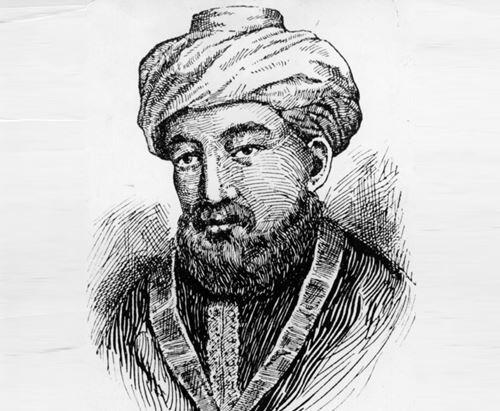
Meanwhile, critics of the ultra-Orthodox community’s emphasis on full-time religious study often quote a different passage from Maimonides, also taken from his Laws of Torah Study:
“Anyone who sets his heart on studying Torah without working, and supports himself through charity, has desecrated God’s name, disgraced the Torah, extinguished the light of religion, brought harm upon himself and forfeited his life in the World to Come.”
Despite the gulf separating the two sides of this debate, they share one fundamental belief: Both regard Maimonides as an exemplary figure whose teachings should guide their actions.
The difference, of course, lies in how they interpret his words and which statements they choose to emphasize.
Maimonides, the Great Eagle, the author of the Mishneh Torah, also known as the Mighty Hand, the Guide — these are just some of the titles and expressions associated with one of the most important figures in medieval Jewish history, Rabbi Moses ben Maimon (1138–1204).
The saying “From Moses to Moses, none arose like Moses” reflects the extraordinary esteem in which he eventually came to be held.
Yet Maimonides was not always a universally accepted authority in the Jewish world. In fact, in at least one episode, his opponents appear to have played a role in bringing about the burning of his books.
The controversy that shook the Jewish world
Just as Maimonides and his writings exerted an enormous influence following their publication, they also provoked fierce opposition that shook the Jewish world beginning in the late 12th century.
Criticism of his works centered on both Jewish religious law, known as halacha, and Jewish philosophy.
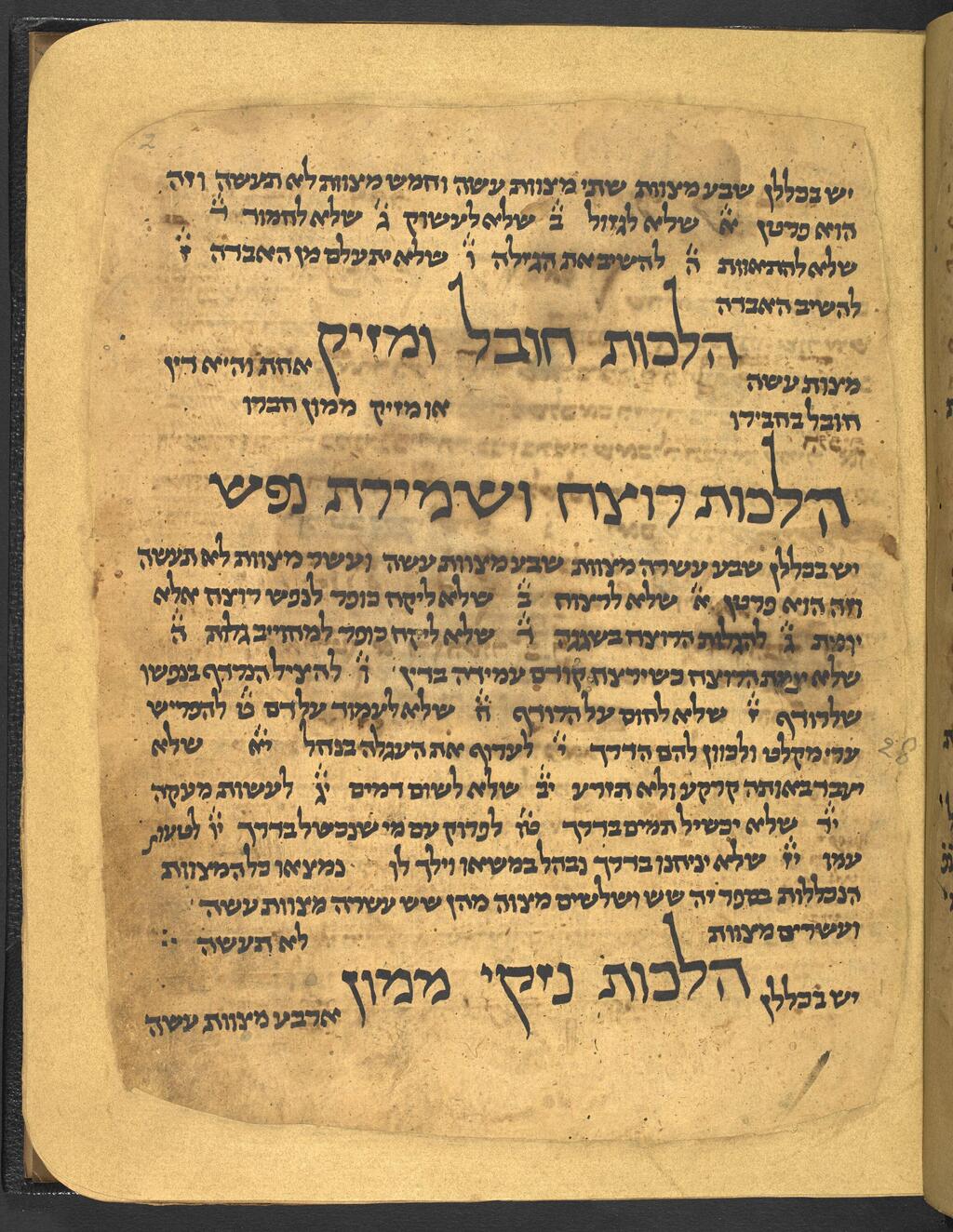
A page from an ancient Yemenite manuscript of Maimonides’ Mishneh Torah
(Photo: The British Library)
“Maimonides’ books began circulating in Provence, in southern France, and from there reached Ashkenaz, the Jewish communities of medieval Germany and surrounding regions, and eventually the entire Jewish world,” says Dr. Tal Burgansky of Ma'ale Gilboa Yeshiva.
“Precisely because Maimonides’ legal rulings were so clear and definitive, yet lacked references to their sources, they drew criticism from prominent rabbis.”
According to Burgansky, the first scholars to raise such objections to Maimonides’ Mishneh Torah were Rabbi Pinhas, a rabbinical judge from Alexandria, and Rabbi Abraham ben David of Posquières, commonly known by the Hebrew acronym RABaD.
RABaD wrote: “He thought he would correct matters, but he did not, because he abandoned the method of all the authors who preceded him, who brought evidence for their statements and attributed teachings to those who said them.”
Rabbi Abraham compiled his questions and disagreements with Maimonides’ rulings into a work known as Hasagot HaRABaD, or RABaD’s Critiques. It is printed alongside Maimonides’ text in nearly every edition of the Mishneh Torah.
Another controversy, also during Maimonides’ lifetime, unfolded farther east, in Baghdad, in present-day Iraq.
Rabbi Samuel ben Ali and his students sharply attacked Maimonides’ teachings, accusing him of effectively denying the resurrection of the dead because he described the World to Come as a spiritual existence without a physical body.
A dispute over religious law also emerged between them. However, Sarah Stroumsa, professor emerita of Arabic language and literature and Jewish thought at the Hebrew University of Jerusalem, believes the underlying cause of the struggle was the recognition among Baghdad’s scholars that Babylonia’s position as the center of authority over the Jewish world was declining as new centers of influence flourished elsewhere.
Maimonides himself was largely unmoved by the attacks.
When a student sent him a treatise written by a Babylonian scholar accusing him of denying the resurrection of the dead, Maimonides responded dismissively.
“As for the treatise, I am astonished that the student sent it to me so I could see the author’s ignorance. What do you suppose I think of him, or of anyone greater than him, as someone who knows anything? At most, he is to me like any preacher who goes astray, just as others do.”
In response to the accusations, Maimonides composed his Treatise on Resurrection in 1191.
The books that were burned
In Montpellier, southern France, lived a prominent Torah scholar named Rabbi Solomon of Montpellier, also known as Solomon ben Abraham of Montpellier.
He and two of his students, Rabbeinu Yonah of Girona, author of Sha'arei Teshuvah (Gates of Repentance), and Rabbi David ben Saul, fiercely attacked Maimonides’ philosophical work The Guide for the Perplexed.
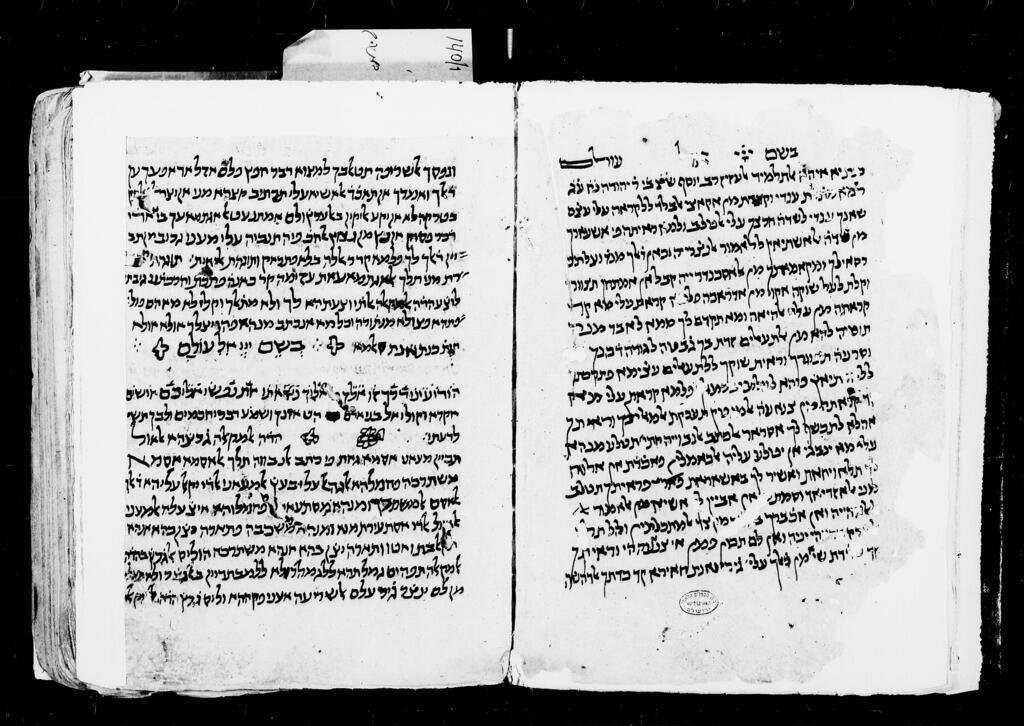
A page from a manuscript of The Guide for the Perplexed in Judeo-Arabic (Arabic written in Hebrew script), circa 1400
(Photo: The National Library)
At one point, Rabbi Solomon imposed a religious ban on the book.
They believed that studying it could undermine simple, unquestioning faith by elevating Greek philosophy above Torah study.
A counter-movement emerged in defense of Maimonides and his writings. Then came an event that shook the Jewish world.
According to medieval accounts, members of the Catholic Church burned Maimonides’ books in 1232.
Many versions of the story maintain that Jewish opponents of Maimonides had informed Dominican friars that his writings contained heretical teachings.
Stroumsa explains that, unlike the Talmud, which Christians recognized as a work possessing religious authority, Maimonides’ writings had been composed much later and were therefore more easily suspected of containing independent, heretical thought.
The disturbing episode deeply affected the Jewish world, and a significant number of Maimonides’ opponents reportedly recanted their positions.
Among them was Rabbeinu Yonah of Girona, who, according to historian Dr. Yitzhak Alfasi, regarded the burning of the Talmud shortly afterward as divine punishment for the destruction of Maimonides’ books.
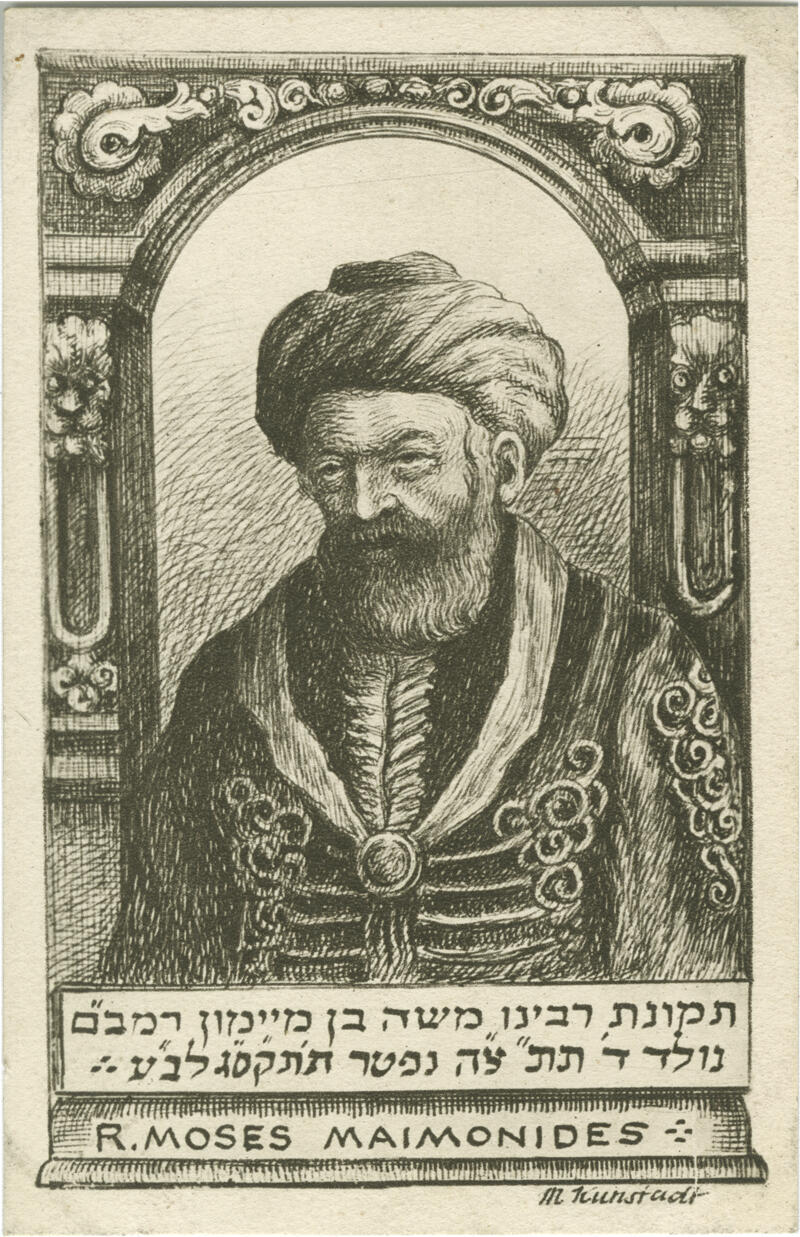
A portrait based on the likeness of Maimonides, circa 1900
(Illustration: Meir Kunstadt)
Rabbi Hillel ben Samuel of Verona recorded an account of Rabbeinu Yonah’s remorse:
“His heart and the hearts of all his supporters melted, and he undertook to go and prostrate himself at Maimonides’ grave with a quorum of 10 men. He publicly confessed before all the people, saying: ‘I have sinned against the God of Israel and against our teacher Moses ben Maimon, for I spoke against his books and distorted their meaning.’”
Ultra-Orthodox historical accounts maintain that this realization prompted Rabbeinu Yonah to compose his influential work Sha'arei Teshuvah, which deals with the process of repentance.
Burgansky, however, emphasizes that this is ultimately a “folk legend” unsupported by academic research.
In any event, the controversies surrounding Maimonides’ books did not end there.
Attacks on his legal and philosophical writings continued in subsequent periods and in other Jewish centers, including Spain, France and Ashkenaz.
Among his most prominent defenders was one of the greatest medieval Jewish scholars, Rabbi Moses ben Nahman, known as Nahmanides or the Ramban.
In a famous letter to the rabbis of France, opening with the words “Before I answer, I acknowledge my error,” Nahmanides recognized their greatness while firmly protesting their disparagement of Maimonides.
“Nahmanides’ important letter acknowledges Maimonides’ greatness as a legal authority and his enormous influence on the Jewish world,” Burgansky says.
He adds that Nahmanides did not completely reject The Guide for the Perplexed, noting that Maimonides himself had instructed readers not to publicize or openly explain its teachings.
This, Burgansky says, was not a fundamental objection to the work.
“There is no doubt that Nahmanides’ position was a central element in the controversy surrounding Maimonides’ books.”
Expanding the boundaries of knowledge
To understand how Maimonides eventually became a central figure in the Jewish religious consensus, it is necessary to go back in time.
What was his first book? Many would identify his famous Commentary on the Mishnah, but according to the traditional account, Maimonides wrote another work even earlier.

Maimonides' tomb in Tiberias, Israel
(Photo: Israel Zeller, Zalmanson Zeller, via PikiWiki / CC BY 2.5)
Tradition holds that, as a teenager, probably around age 16, Moses ben Maimon composed Treatise on Logic, a philosophical work examining the fundamental concepts of Aristotelian logic.
The work was originally written in Arabic and only later translated into Hebrew.
However, some scholars question whether Maimonides actually wrote it, and its date of composition is also disputed.
During those years, Maimonides wrote additional works, only some of which have survived.
His Commentary on the Mishnah offered a comprehensive interpretation, including legal rulings, of all six orders of the Mishnah, the foundational compilation of Jewish oral law.
A central component of the commentary is its introductions.
The first provides a historical account of the development and transmission of the Oral Torah.
Another, introducing the chapter known as Helek in Tractate Sanhedrin, includes Maimonides’ famous Thirteen Principles of Faith.
His introduction to Tractate Avot, better known as Eight Chapters, addresses prophecy, the reasons behind the commandments, divine providence, knowledge of God, the human soul, ethics and other subjects.
Professor Eliezer Schweid wrote that the order in which Maimonides composed his works was deliberate.
He gradually progressed from religious instruction leading toward philosophy to philosophical instruction addressing the Torah.
This explains why his first two major works were the Commentary on the Mishnah and the monumental Mishneh Torah, also known as the Mighty Hand, while The Guide for the Perplexed appeared only later.
In his 30s, Maimonides began composing the Book of Commandments, in which he outlined the principles governing the enumeration of the Torah’s 613 commandments and detailed each of them.
He then spent 10 consecutive years writing the Mishneh Torah, his first major work composed in Hebrew rather than Arabic, as had previously been his practice.
The book presents the legal conclusions derived from the commandments discussed throughout the Talmud, organized into 14 sections.
The Hebrew numerical value of the letters spelling yad, meaning “hand,” is 14, which is why the work is also known as the Yad HaHazakah, or Mighty Hand.
Unlike the Shulchan Aruch, the later authoritative code of Jewish law that focuses on laws applicable in practice, Maimonides left virtually no area of Torah law without a clear legal summary.
His work includes, for example, the laws governing kings, the Sanhedrin — the ancient Jewish high court — sacrifices and the sacred vessels of the Temple in Jerusalem.
Maimonides also formulated binding legal principles concerning the foundations of Judaism and human conduct within its framework.
The importance of the Mishneh Torah can hardly be overstated. It remains one of the most influential works of Jewish religious law.
“Important legal works had already been composed before Maimonides, such as Halachot Gedolot by Rabbi Simeon Kayyara and, of course, the legal writings of the Rif, Rabbi Isaac Alfasi,” Burgansky says.
“But Maimonides was the first, and in practice the only one, to take the entire Oral Torah and reformulate it.”
“The Mighty Hand is not organized around Talmudic discussions, but according to an entirely new classification that he himself created.”
According to Burgansky, a major reason for the work was the crisis in Jewish learning during the Middle Ages.
Mass migrations, persecution and the hardships endured by Jewish communities raised fears in Maimonides’ mind that Torah knowledge might be forgotten.
Much like Rabbi Judah the Prince, who had compiled the Mishnah roughly 1,000 years earlier, Maimonides decided to take action, setting the material down in writing and presenting it in an accessible, ready-to-use form.
The medieval Hebrew poet Judah al-Harizi described the undertaking in verse, portraying Maimonides as recognizing a generation hungry for Torah knowledge but unable to digest the vast body of Talmudic literature.
Maimonides, he wrote, sifted the Talmud like flour through a sieve, selected its finest substance and prepared accessible nourishment for people occupied with the demands of everyday life.
Stroumsa explains that in composing the Mishneh Torah, Maimonides sought to reduce the time devoted to shakla ve-tarya, the back-and-forth legal argumentation of the Talmud, in order to free scholars to study other fields of knowledge.
“Maimonides knew the Mishnah and the Talmud by heart, but he believed people did not need to spend the entire day studying them,” she says.
“He wanted to understand astronomy, biology and physiology. He wanted to create an entire intellectual project through which a person could attain perfection and closeness to God.”
Perfection?
“According to Maimonides, the ultimate human purpose and human perfection are, in the end, closeness to God,” Stroumsa explains.
“But this can be achieved only through philosophical knowledge, understanding the rules of logic, studying physics and, through physics, understanding metaphysics.”
These disciplines, she says, can provide a broader understanding of the system called the human being and humanity’s relationship with God.
“It is no coincidence that the Mighty Hand begins with the verb ‘to know.’”
The secrets of the Guide
Dalalat al-Ha'irin, translated into Hebrew by Rabbi Samuel ibn Tibbon as Moreh Nevukhim, or The Guide for the Perplexed, was originally written in Judeo-Arabic, Arabic expressed in Hebrew characters.
Ibn Tibbon’s translation efforts played a major role in the widespread dissemination of Maimonides’ writings.

(Photo: Alex Kolomoisky)
The book was completed around 1190.
Originally intended for Maimonides’ student, Rabbi Joseph ben Judah ibn Shimon, it became one of the most influential works of philosophy in the Jewish world, with an impact extending into Christian and Muslim intellectual traditions.
Written from a rationalist perspective, the book addresses weighty subjects including the rejection of anthropomorphism — the belief that God possesses a physical body or form — the reasons for the commandments, the creation of the world and the foundations of prophecy.
Without delving into its complex philosophical arguments, translators dating back to Maimonides’ own lifetime believed the book should be read through an esoteric approach, seeking to decipher secrets its author had embedded throughout its chapters.
This interpretation has occupied generations of thinkers and scholars.
It also forms the basis of Dr. Micah Goodman’s bestselling book The Secrets of the Guide for the Perplexed.
Goodman argues that Maimonides wrote The Guide to transmit the “secrets of faith” only to students worthy of receiving them.
He also required those capable of deciphering the secrets not to reveal them openly, except through hints.
Yet in every generation, commentators broke that oath, repeatedly publishing their own interpretations of the great teacher’s hidden meanings.
How Maimonides gained acceptance
Under the heading “In Every Province and Province,” borrowed from the biblical Book of Esther, Rabbi David Moshe Moskowitz, author of Introduction to the Works of Maimonides, describes how the Mishneh Torah spread throughout the Jewish world.
Even in Babylonia, where Maimonides had encountered fierce opposition, the situation was reversed during the 13th century.
Maimonides also came to the aid of Yemen’s Jewish communities.
On a practical level, his intervention with the ruler of Egypt helped secure the cancellation of decrees against them.
On a spiritual level, his famous Epistle to Yemen encouraged Jews to remain faithful to Judaism in the face of pressure from other major religions and explained how to distinguish a true messiah from a false one.
Perhaps the most decisive recognition of Maimonides’ authority came in the Land of Israel through Rabbi Joseph Karo, author of the Shulchan Aruch, arguably the most influential practical code of Jewish law.
Karo recognized Maimonides as one of the three pillars of legal authority, alongside the Rif, Rabbi Isaac Alfasi, and the Rosh, Rabbi Asher ben Jehiel.
He held that their rulings should carry greater weight than those of other legal authorities when determining Jewish law.
Karo also devoted himself to writing an extensive commentary titled Kesef Mishneh, printed alongside the Mishneh Torah.
Its purpose was to identify the sources underlying Maimonides’ rulings, thereby responding to objections raised by RABaD and Ramach, Rabbi Moses ha-Kohen of Lunel.
The publication of the Mishneh Torah also generated considerable enthusiasm in Spain.
Even scholars who opposed the philosophical Guide for the Perplexed praised the Mishneh Torah, regarding it as an unparalleled work of Jewish religious law.
Moskowitz concludes that the Mishneh Torah became the most authoritative legal text for Sephardic Jews throughout their communities.
Its success was so extensive that ordinary people also studied it regularly, angering some rabbis who felt their authority had been diminished.
The Mishneh Torah continued its journey into France and Ashkenaz.
There, admiration for the work developed more slowly, but over the generations it gained widespread acceptance among Jewish scholars.
That acceptance is reflected in a remarkable statement by one of the greatest Ashkenazi rabbinic authorities, Rabbi Meir of Rothenburg, known as the Maharam.
“When the book of our teacher Moses ben Maimon, of blessed memory, came into my possession, and your honor asked me this question, I said to myself: I shall consult the Urim and Thummim, and it will reveal something to me, which I shall tell you.”
In other words, Rabbi Meir ben Baruch of Rothenburg compared Maimonides’ work to the Urim and Thummim, the sacred objects through which, according to biblical tradition, the Israelites sought divine guidance.
Maimonides in the yeshiva world
Rabbi Chaim Soloveitchik, who served as one of the heads of the legendary Volozhin Yeshiva in the 1880s, developed a method of analyzing Maimonides’ writings down to individual words and letters.
His analyses produced numerous conceptual distinctions that remain central to the studies of hundreds of thousands of yeshiva students today, who sit at their study lecterns and tirelessly seek to understand Maimonides’ precise meaning.
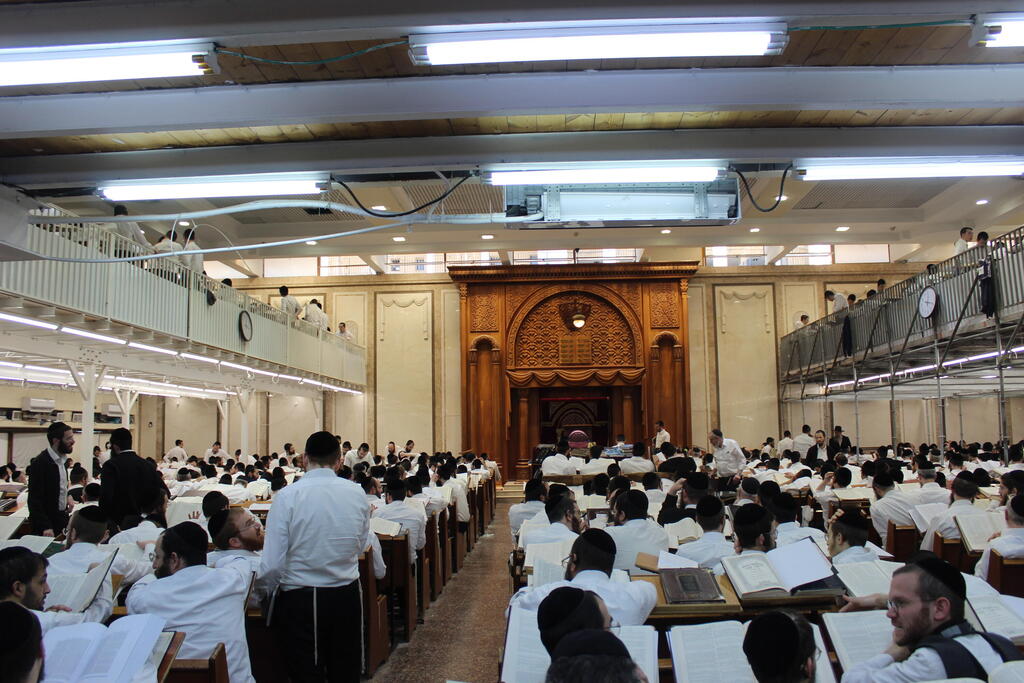
(Photo: Shmuel Munitz)
The Brisker method, the analytical approach to Talmud study developed by Soloveitchik, continues to be practiced in yeshivas.
His distinctive teachings were published after his death by his sons in Chiddushei Rabbeinu Chaim Halevi al HaRambam, or Insights of Our Teacher Chaim Halevi on Maimonides.
The fact that the founder of the Brisker method based his major work on Maimonides helps explain the intense attention the medieval scholar receives in contemporary Torah study.
But Burgansky offers another explanation for the extensive literature written about the Mishneh Torah, beginning centuries before the Volozhin Yeshiva.
“In the Mishneh Torah, Maimonides does not quote the Gemara or rely explicitly on familiar sources,” he says, referring to the rabbinic discussions that form the main component of the Talmud.
“He chose to reformulate the material, which leads to the million-dollar question: Why did Maimonides formulate it in precisely this way? Why did he use this particular word rather than another term?”
“The careful examination of every word Maimonides wrote became analytical, based on the understanding that every word truly has significance.”
Stroumsa, however, is skeptical of this meticulous scrutiny of Maimonides’ legal formulations.
“If he were sitting quietly in a corner, listening to the way people analyze his words, I’m not sure he would enjoy it,” she says.
“He did not want endless hairsplitting over his rulings. Quite the opposite. His ambition was that his book would allow people to move quickly through the legal conclusions derived from the Gemara and free themselves to study other fields of knowledge.”
Stroumsa’s observation brings to mind a familiar yeshiva joke, one that also touches on ethnic prejudices within the traditional world of Jewish religious study.
A Lithuanian yeshiva dean dies and arrives in heaven, where he is welcomed into the celestial yeshiva.
Upon entering the study hall, he immediately launches into an elaborate debate over Torah law, presenting a brilliant and intricate interpretation of Maimonides.
Suddenly, he feels a tap on his shoulder.
He turns around and sees an Egyptian Jew, who tells him that he has misunderstood Maimonides.
“Who are you?” the Lithuanian rabbi asks.
“Moses ben Maimon,” the man replies.
The yeshiva dean waves him away dismissively.
“What does a Frenk know about Maimonides?”
Frenk is a derogatory term historically used by some Ashkenazi Jews for Sephardic and Mizrahi Jews.
The punchline captures the irony of Maimonides’ remarkable legacy: A medieval Egyptian Jewish scholar, whose books were once condemned and burned, ultimately became so central to Jewish religious learning that even his imagined objections could be dismissed by scholars convinced they understood his writings better than he did.