

The festival of Hanukkah, like Purim, is a post-biblical holiday, and for this reason, Ethiopian Jews, who separated from world Jewry before these holidays, did not learn about it from Jewish sources. At the same time, the Book of the Maccabees—the story of the Maccabees’ heroism against the Greeks, written as the events were unfolding—was part of the sacred books of the Ethiopian Jewish community. So what exactly was known, and by whom? Did Ethiopian Jews not know about Hanukkah, or did rabbinic tradition not know the Book of the Maccabees?
This question connects to the current debate in Israel over military conscription. We have seen opposition to enlistment and heard slogans such as “We will die and rather than enlist,” along with comparisons of the State of Israel to fascist regimes. A former Chief Rabbi of Israel even declared that “the secular must understand that without Torah there will be no success for the army,” and added, “If they force us to go to the army, we will go abroad.” This article does not focus primarily on these issues.
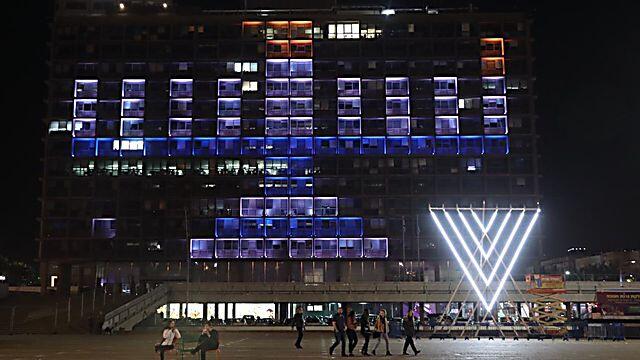
(Photo: Courtesy of Tel Aviv Municipality)
The question that concerns me is deeper: what leads parts of ultra-Orthodox society to speak this way? Is it truly possible to sit in the study hall, avoid historical action, and still win wars? And why are such statements so foreign to the traditional spiritual leaders of Ethiopian Jewry—the Kesim? Moreover, how do such views stand in clear opposition to the Jewish-Zionist idea itself? I deliberately use the term "Jewish Zionism", and not "secular Zionism." By the end of this article, it will be clear that this linguistic choice is not accidental.
The heart of the disagreement between the ultra-Orthodox world and the Zionist world today lies not only in politics or sociology, but in consciousness itself: a clash between two foundational ways of understanding reality—historical consciousness and religious-miraculous consciousness.
For generations, the holiday of Hanukkah, with its candle lighting ceremony, was unknown in Ethiopian Jewish tradition. Only in recent years was the holiday introduced into Ethiopian villages. Therefore, we must distinguish between an ancient, authentic custom of the community and a later practice adopted in modern times. What, then, was the ancient tradition?
In rabbinic tradition, for most generations, the Book of the Maccabees was recognized. It was excluded from the biblical canon and eventually hidden, for reasons that are not entirely clear. In contrast, in Ethiopian Jewish tradition, the Book of the Maccabees was part of the sacred texts included in the Bible. Community members knew its historical content well, were raised on its stories, and absorbed the magnitude of the Maccabean victory over the Greeks.
Hanukkah can be understood in two ways. One is Hanukkah as a religious holiday, emphasizing the miracle of the oil and the purification of the Temple. According to this tradition, the dedication of the altar after the Temple’s purification was celebrated for eight days, and a holiday of praise, thanksgiving, and daily candle lighting was established for generations. The second understanding is Hanukkah as a national-historical consciousness, emphasizing the Hasmonean revolt, the struggle against the Greeks, and the determination of a small nation standing against a mighty empire.
This distinction becomes especially clear when comparing rabbinic tradition with Ethiopian Jewish tradition. Ethiopian Jews possessed the Book of the Maccabees but did not know rabbinic literature. They experienced Hanukkah as a historical story of struggle, courage, and victory—not as a miraculous or folkloric tale. By contrast, Jewish tradition shaped under the influence of the Babylonian Talmud emphasized the miracle of the oil and placed the menorah at the center, almost at the expense of the historical story.
Why did this gap emerge? The sages certainly knew of the Maccabean victory, yet they chose to minimize it and instead emphasize the miracle of the oil. This was not an invention of a new story, but a shift in focus—from historical-military action to a religious-faith message.
Abraham Kahana, a modern Jewish scholar and intellectual, offered a sharp explanation: the descendants of the Hasmoneans took both the priesthood and the kingship for themselves, violating the biblical ideal of separation of powers. Moreover, the Hasmonean rulers sided with the Sadducees and persecuted the Pharisees—the sages who would later become the founders of rabbinic literature. As a result, the Maccabees were not beloved by the sages. In Kahana’s words: “They ate sour grapes, and their fathers’ teeth were set on edge.” According to this view, the sages intentionally blurred the historical aspect of Hanukkah and grounded the holiday in a new justification—a legend rooted in folklore rather than history: the miracle of the oil. Thus, religious consciousness took center stage, while historical consciousness was pushed aside.
This shift had far-reaching consequences. As Rabbi David Hayim Halevi hinted, the long experience of exile—with its physical suffering and psychological humiliation—nearly erased faith in a human, natural ability to restore national life. A scattered, exhausted, and persecuted people struggled to imagine national revival through natural means. From this reality emerged a belief in miraculous redemption, dependent not on human action but on divine intervention.
Only those who freed themselves from this miraculous religious consciousness—foremost among them the secular Zionist movement—could imagine establishing a state through natural means. In this sense, Zionism did not abandon Judaism; rather, it detached itself from miraculous consciousness and reconnected to historical consciousness.
This helps explain why the idea of founding the State of Israel emerged precisely among those seen as “abandoners of the Torah and its commandments.” As Aryeh Ben-Gurion of Kibbutz Beit HaShita once asked: What did our tradition leave us from the Maccabean wars? Not symbols of heroism or weapons of war, but a candle. And, as Aharon Ze’ev, the Hebrew poet and Labor Zionist cultural figure wrote: “No miracle happened to us, we found no jar of oil. We went down to the valley, climbed the mountain, carved the rock until blood flowed—and there was light.” Jewish Zionism seeks to renew and reclaim the role of the Maccabees of our time. It does not sever itself from tradition; rather, it reconnects with historical consciousness. "Good day, Rabbi Akiva. Where are all the holy people? Where are the Maccabees? Rabbi Akiva answered him: All Israel is holy and you are a Maccabee.” (Shaul Tchernichovsky)
It now becomes clear that it is incorrect to say Ethiopian Jews did not know Hanukkah. They knew it well—but through historical consciousness, not miraculous consciousness. This may explain a unique phenomenon in Jewish history: in Ethiopia, far from the Land of Israel, a sovereign Jewish kingdom existed from the 10th century until the early 17th century, known as the Kingdom of the Gideons. It even included periods when women ruled the Kingdom. Ethiopian Jewry is the only Jewish community since the destruction of the Second Temple to establish such a long-running Jewish sovereignty outside the Land of Israel.
 Rabbi Dr. Sharon Shalom Photo: Sasson Tiram
I am certain that these two forms of consciousness—historical and miraculous—are not only important but need one another. Favoring one while rejecting the other poses real danger to the State of Israel. Historical consciousness teaches us not to rely on miracles, but on ourselves: economic strength, technology, military power, intelligence, creativity, and responsibility. Miraculous consciousness reminds us that the Jewish story often defies logic.
The danger arises when religious consciousness detaches from history and leads to the belief that Torah study alone can win wars, making human action—enlistment, responsibility, sacrifice—unnecessary. Such a view could never emerge from Ethiopian Jewish tradition, which understood Hanukkah as a story of human struggle and decision.
Our challenge today is to create balance. Only the union of a strong, committed army with Torah study and spiritual awareness can give Israel stability and vision. As Shimon Peres once said, the two most important words in the Bible are: “Let there be light.” From a profound understanding of Jewish historical reality, Professor Avi Sagi emphasizes that Hope makes it possible to confront extreme horror from within, rather than seeking refuge in denial or escape
This, perhaps, is the secret of Jewish survival: even in darkness, the Jewish people never lost hope. On Hanukkah, when we honor one another, we see that everyone has a place. The light of the menorah first shines inward, into the home, and only then outward into the world. As Professor Tova Hartman emphasizes, publicizing the miracle comes from a strong inner light. Only the connection between inner and outer, faith and action, history and belief, can create true light—a light unto the nations.
- Rabbi Dr. Sharon Zeude Shalom is the founding director of Ono Academic College's International Center for the Study of Ethiopian Jewry.