


An imam was explaining the Muslim festival of Eid al-Adha, describing Abraham's willingness to sacrifice his son Ishmael, when a rabbi in the audience became visibly upset. During the break, he approached the organizer of the interfaith gathering with an accusation: The imam was distorting history.
The encounter, recalled by University of Haifa historian Professor Uriel Simonsohn, illustrates a centuries-old disagreement between Judaism and Islam over one of their most significant shared religious narratives. Both faiths tell the story of Abraham's willingness to sacrifice his son in obedience to God. But which son was it, Isaac or Ishmael?
Gallery
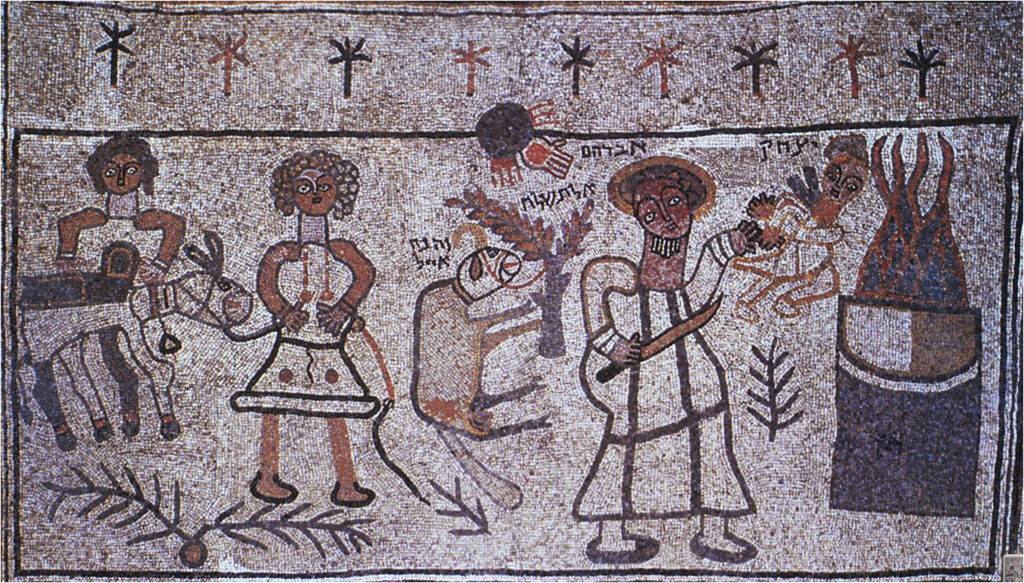
The binding of Isaac depicted in a Byzantine-era mosaic at the ancient Beth Alpha synagogue in Israel
The question takes on particular significance this Saturday, October 31, when synagogues read the weekly Torah portion Vayera, which includes the biblical account of the binding of Isaac, known in Hebrew as the Akedah.
In Jewish tradition, the binding of Isaac is considered a foundational narrative. According to rabbinic teachings, it was the 10th and most difficult of the trials God set before Abraham. The passage forms part of the daily morning prayers, is read in synagogues on Rosh Hashanah and has inspired countless religious poems, prayers and works of art.
Yet the story also occupies an important place in Muslim and Druze religious identity. During Eid al-Adha, the Festival of Sacrifice, Muslims and Druze commemorate Abraham's willingness to sacrifice his son and the divine intervention that saved the boy at the final moment.
The essential narrative is shared, but the identity of the son has become a point of disagreement with profound religious and historical significance.
The son the Quran never names
Simonsohn, who heads the Haifa Laboratory for Religious Studies at the University of Haifa, organized an interfaith meeting several years ago involving Jewish, Muslim and Christian religious leaders. The gathering took place around Eid al-Adha.
At Simonsohn's request, one of the imams spoke about the holiday and its religious significance, explaining Abraham's willingness to sacrifice Ishmael.
"During the break, one of the rabbis approached me, quite agitated," Simonsohn recalls. "He said, 'I can't believe it. The man is simply distorting history.'"
Simonsohn's response reflected the difference between historical scholarship and religious belief.
"As a historian, I found myself somewhat embarrassed," he says. "Was the binding of Isaac, or Ishmael, a historical event in the sense historians use that term? From the perspective of sacred history, certainly. But that's precisely the point. The two religions tell very similar stories, yet each sees the narrative as part of its own history."
"For the rabbi, it was obvious that the son was Isaac. For the imam, it was equally obvious that he was Ishmael. That encounter showed me how religious stories are not simply accounts of the past. They are also ways in which communities define their identities in the present."
The striking fact, Simonsohn explains, is that unlike the Torah, the Quran does not identify the son Abraham was commanded to sacrifice.
In Surah As-Saffat, chapter 37 of the Quran, Abraham describes a dream in which he sees himself sacrificing his son. Both father and son express their willingness to obey God's command, but the boy's name is never mentioned.
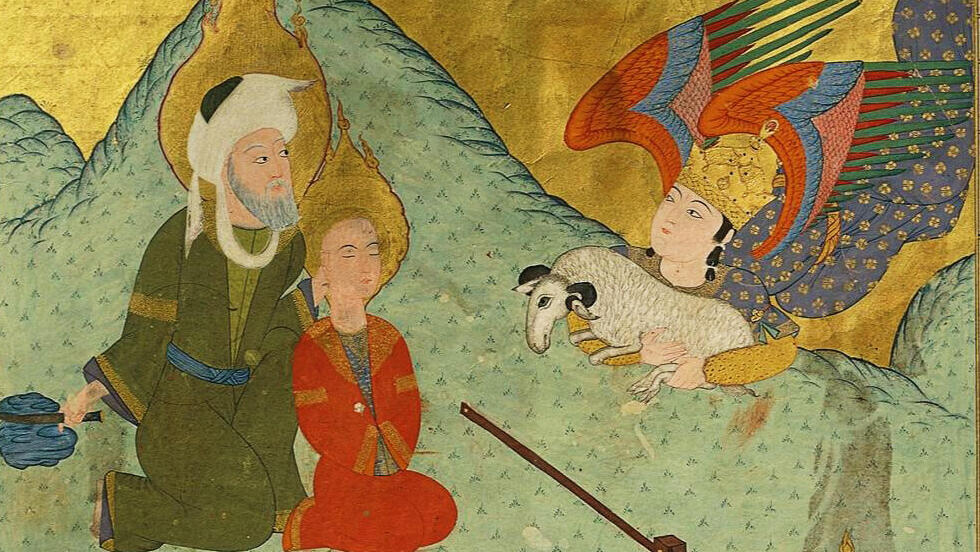
Abraham prepares to sacrifice his son Ishmael in an Ottoman miniature dating to 1583
According to Simonsohn, identifying Ishmael as the intended sacrifice was the result of a historical development within Muslim biblical interpretation.
He points to research by Islamic studies scholar Reuven Firestone showing that several traditions coexisted during the early centuries of Islam concerning the son's identity.
"Many of the traditions attributed to the earliest Muslim scholars actually identified Isaac as the son Abraham intended to sacrifice," Simonsohn says.
"Gradually, the identification with Ishmael became stronger, until it emerged as the dominant position in Muslim tradition."
For Simonsohn, the development reveals something important about the relationship between the religions.
"It's a fascinating historical process that shows how the boundaries between religious traditions were not always as sharp as they seem today," he explains. "Early Muslim interpretation was also receptive to Jewish and Christian traditions. Only over time did interpretations emerge that placed greater emphasis on Islam's distinct identity."
One story, two sacred histories
Simonsohn argues that the similarities between the Jewish and Muslim accounts are substantially greater than their differences.
"In both traditions, Abraham faces an extreme test of faith," he says. "He is asked to give up what is most precious to him, his son, out of loyalty to God. In both, it ultimately becomes clear that God does not demand the son's death, and another sacrifice takes his place."
Yet there is also an important difference in emphasis.
"In the biblical story, the focus is primarily on Abraham's trial," Simonsohn explains. "In the Quran, the son himself explicitly participates in the decision. Abraham tells him about the dream, and the son replies, 'My father, do as you have been commanded. You will find me, God willing, among those who are patient.'"
"In that sense, the Quranic story particularly emphasizes the shared submission of father and son to God's will."
The argument over whether Isaac or Ishmael was the intended sacrifice therefore concerns much more than a detail in an ancient narrative.
It is connected to the place each son occupies in the sacred history of Judaism and Islam.
In Jewish tradition, Isaac continues the covenant between God and Abraham, and the people of Israel descend from him.
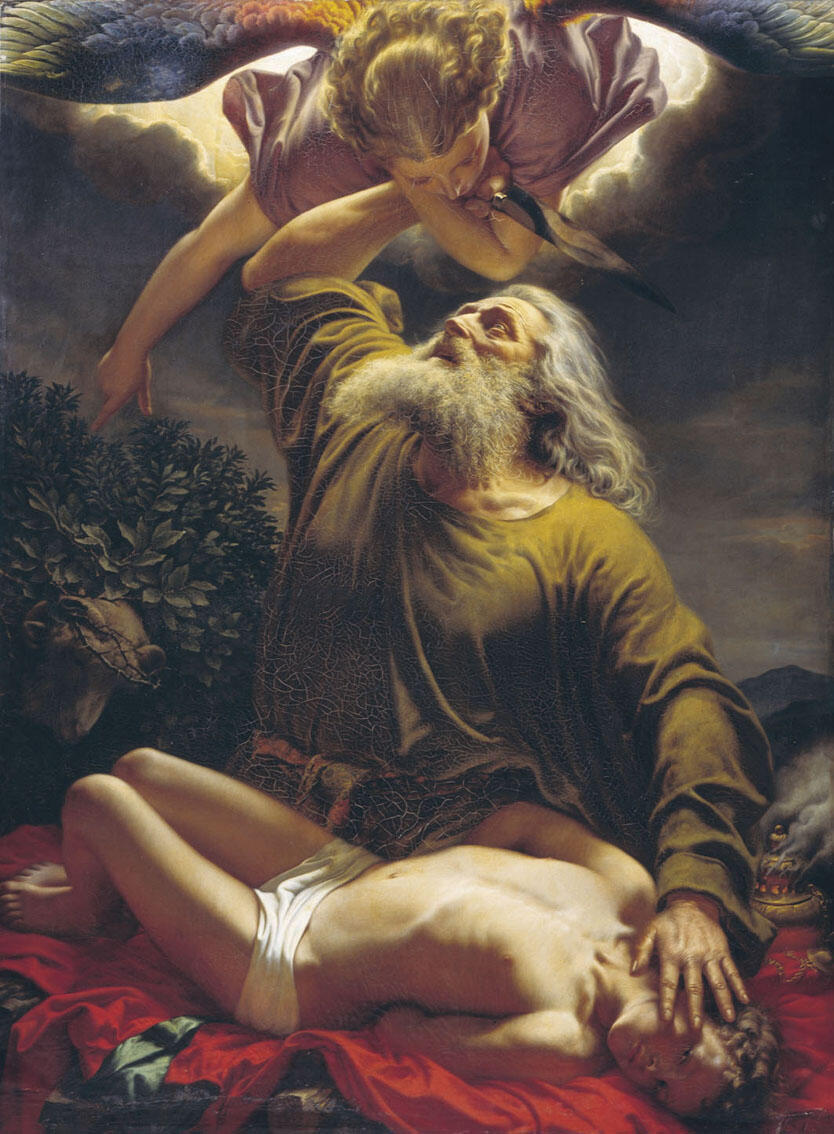
The binding of Isaac, portrayed by German artist Gerhardt Wilhelm von Reutern in a 19th-century painting
In Muslim tradition, Ishmael occupies a central position as an ancestor associated with the Arab people and as the son who helps Abraham build the Kaaba in Mecca, Islam's holiest shrine.
"As Firestone demonstrates, as Muslim identity took shape, the question of which son was bound acquired meanings associated with belonging, inheritance and divine election," Simonsohn says.
"It's an interesting example of how a shared story gradually became a way of distinguishing between religious communities."
The distinction also appears in religious practice.
In Judaism, the binding of Isaac became a symbol of faith, devotion and willingness to sacrifice. Its memory is preserved primarily through scripture readings, prayers and religious interpretation.
In Islam, the story stands at the center of Eid al-Adha, which is also celebrated by the Druze community.
"The story takes on a practical expression during the holiday through the slaughter of a sacrificial animal and the distribution of meat to family members and people in need," Simonsohn explains.
"There's an interesting difference between the traditions. In Judaism, the memory of the binding is preserved mainly through reading, prayer and interpretation. In Islam, it also receives a tangible ritual expression."
"But in both cases, this is a story that continues to shape religious life thousands of years after the time in which the traditions place it."
Simonsohn believes the narrative demonstrates both the deep connections between Judaism and Islam and the differences that developed between them.
"Both religions see Abraham as a model of faith, and both tell of his willingness to sacrifice his son and of God's intervention to prevent that sacrifice," he says.
"But the same story acquires different, sometimes competing meanings. We can see this as a source of dispute over who owns sacred history. Or we can see it as an opportunity to recognize that our religious traditions developed out of a shared world, in which stories, ideas and interpretations passed between communities and influenced one another."
"Recognizing this does not require anyone to abandon their faith. It simply allows us to understand that another community's religious memory is not necessarily a distortion of our own."
How the dispute became a theological argument
The disagreement over the binding also occupied Jewish scholars during the Middle Ages, particularly against the backdrop of religious disputes between Judaism and Islam.
One prominent figure was Saadia Gaon, the influential Jewish philosopher and rabbi who lived during the ninth and 10th centuries and addressed Muslim theological challenges to Judaism in his writings.
Among the arguments advanced by Muslim scholars was that the revelation received by Muhammad and the Quran superseded the Torah of Moses.
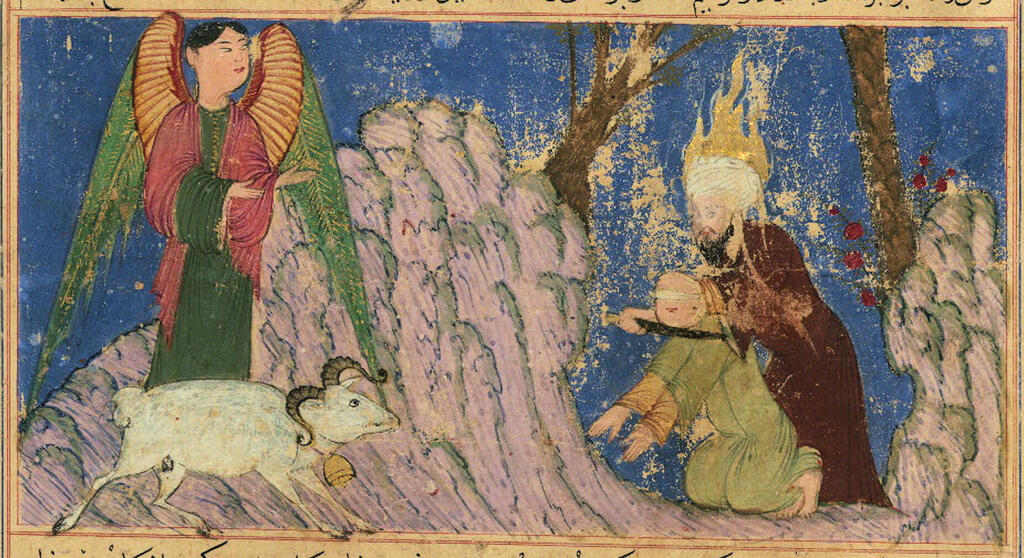
The binding of Ishmael, depicted in a Persian manuscript associated with historian Hafez Abru
Some pointed to the binding of Isaac as evidence that divine commandments could be superseded. God initially instructed Abraham to sacrifice his son but subsequently withdrew the command. If one divine instruction could be rescinded, they argued, the laws of the Torah could also be replaced.
Saadia Gaon addressed such arguments in his major philosophical work, The Book of Beliefs and Opinions, defending the enduring validity of the Torah and explaining why the binding did not demonstrate that permanent commandments could be abolished.
He distinguished between a temporary test, such as the command given to Abraham, and eternal laws.
According to his reasoning, the commandments given to the people of Israel at Mount Sinai were permanent and could not be nullified or replaced by another religion.
The debate illustrates how a narrative shared by two religions could become part of a much larger disagreement over revelation, religious authority and the legitimacy of competing traditions.
‘If it's Ishmael, he's my father. If it's Isaac, he's my uncle’
Rabbi Dr. Yakov Nagen, president of the Jerusalem Interfaith Center, believes the story can also offer a very different lesson.
Nagen says the identity of the son Abraham almost sacrificed continues to interest religious scholars today. He recalls a story involving a Muslim sheikh from Nazareth who was invited to appear on a television program.
"The interviewer told him in advance, 'I'm going to upset you, so I'll start with a question: Who was the son in the story of the binding, Isaac or Ishmael?'"
What did the sheikh answer?
"My friend replied simply: 'If it's Ishmael, he's my father. If it's Isaac, he's my uncle. Either way, this is my family, a family we should love and learn from.'"
For Nagen, that response offers an alternative way of approaching the traditions.
"Instead of arguing about who is Abraham's successor, it's a reminder that we are family," he says.
"A careful reading of the stories in the Torah and the Quran reveals that both texts also mention the other brother close to the story of the binding. Both emphasize the blessing God gave him."
Nagen refers to the work of his late father-in-law, biblical scholar Professor Uriel Simon, who developed the concept of the "binding of Ishmael" within the biblical narrative.
Simon observed that the same Torah portion containing the binding of Isaac also recounts another ordeal involving Abraham: the expulsion of Hagar and Ishmael into the wilderness.
"In both stories, the son's life is in danger," Nagen explains. "In both, an angel of God intervenes at the decisive moment, the boy is saved and a blessing is promised to his descendants."
By placing these narratives close together, Nagen says, the Torah emphasizes that both of Abraham's sons, Isaac and Ishmael, receive God's blessing.
He sees a remarkable parallel in the Quran.
Immediately after the account of Abraham's willingness to sacrifice his son, the Quran announces the birth of Isaac and describes a blessing bestowed upon him.
"We gave him the good news of Isaac, a prophet among the righteous," Nagen quotes from Surah As-Saffat, verses 112–113. "And We blessed him and Isaac."
What message do you believe emerges from this?
"That Jews and Muslims are called to recognize the blessing given to both branches of Abraham's family, and to see one another as members of the same family."
Nagen points to the Salat al-Ibrahimiyya, a prayer invoking blessings upon Abraham and his descendants that forms part of the five daily Muslim prayers.
He also notes the Quranic expression Ahl al-Kitab, meaning "People of the Book," which refers to religious communities including Jews.
"The word ahl carries meanings of family, household and belonging," he says. "These meanings invite us to think about the relationship between our traditions as one of closeness and shared belonging."
A declaration of brotherhood amid war
Nagen recently returned from the IF20 interfaith forum in Utah, in the United States, where approximately 700 religious leaders, scholars and political figures from 50 countries gathered to seek common ground in an increasingly divided world.
One of the event's significant moments was the signing of a Jewish-Muslim declaration of brotherhood.
Nagen signed the Jewish–Muslim Declaration of Fraternity in Faith alongside Imam Talib Shareef of Washington, D.C.
The declaration reflects an effort to develop a religious framework for mutual respect and cooperation without requiring either community to surrender its distinct identity.
But can such a gathering be taken seriously against the backdrop of continuing bloodshed in the Middle East? Isn't the idea of religious brotherhood dangerously naive?
Nagen rejects that criticism.
"Precisely because the danger is so great, we must also struggle over the story through which we understand our identity and our relationship with others," he says.
"The axis of evil and extremist Islam pose an existential threat to Israel, the Jewish people and many others, including Muslims. Hamas and its partners have turned religion into a weapon, using it to justify murder and hatred, and seeking to portray the conflict with us as an endless religious war."
"Confronting such evil requires clear-eyed realism, determination and the defense of our lives. But if we adopt their worldview, according to which Jewish and Muslim identities themselves require eternal confrontation, we will be playing into their hands."
Nagen believes that an essential part of confronting religious extremism is strengthening an alternative narrative, one rooted authentically in both the Torah and the Quran and grounded in mutual respect and partnership.
"This is a vision we must work to realize even while fighting determinedly against those who seek to harm us," he says.
"Even in the present reality, different forces are moving in different directions. The Abraham Accords, which bear the name of the shared father of our family, survived the war and in some areas even continued developing during it."
"We must strengthen these forces and show how deep loyalty to our own identity can become a source of connection, mutual recognition and partnership."
For Nagen, signing the declaration alongside Imam Shareef represents only one step.
"We hope to continue spreading the vision of the Jewish-Muslim covenant of fraternity in faith around the world," he says, describing plans for educational initiatives, joint study and cooperation between religious leaders and communities.
"At the heart of this vision is the recognition that Judaism and Islam are traditions following in Abraham's path, different branches of one tree, with room for each branch to grow and bear fruit."
Two brothers, one family
Still, it is difficult to ignore the fact that the relationship between Isaac and Ishmael was far from ideal even in the biblical narrative itself.
Nagen acknowledges the tension but argues that this is precisely what makes the stories relevant today.
"The stories of Isaac and Ishmael do not erase the tension and pain that can exist between brothers," he says.
"That's exactly why they offer hope. Even after separation and conflict, the family relationship can once again become a source of connection."
He notes that as early as 1908, Rabbi Abraham Isaac Kook, one of the most influential figures in modern religious Zionist thought, acknowledged the difficulties and conflicts that characterized relations between religions while expressing hope for a different future.
Kook envisioned a time when the "brotherly love of Isaac and Ishmael" would overcome the turmoil of religious conflict and transform it into "light and everlasting kindness."
He also insisted that this expansive outlook should accompany religious life as humanity moved toward a better future.
For Nagen, the message remains relevant more than a century later.
"At this moment, the responsibility falls upon us to carry that vision forward and work to make it a reality."
In the end, the question of whether Abraham nearly sacrificed Isaac or Ishmael may never be resolved between the religious traditions. But the story shared by both offers another possibility: recognizing that two communities can preserve different understandings of sacred history without denying their common ancestry.
For those seeking to turn that shared history into reconciliation, the answer offered by the sheikh from Nazareth may be the most meaningful of all: Whether the son was Isaac or Ishmael, he was still family.