

The portions of Devarim and Va’etchanan are perpetually intertwined, read respectively on the weeks immediately preceding and following Tisha B'Av. Therefore, this week, just before Tisha B'Av, in part one of this two part exploration, we will examine the depths of the leadership challenge Moses describes, and next week we will present the Torah’s blueprint for a solution.
At the opening of Deuteronomy, we witness a brief, rare moment of vulnerability. After forty years in the wilderness, on the eve of entering the Land, Moses does not just summarize the journey or review the Torah. Speaking in a highly personal, and we sense almost broken voice, he exposes his deep struggle: "How can I myself alone bear your cumbrance, and your burden, and your strife?" (Deuteronomy 1:12).
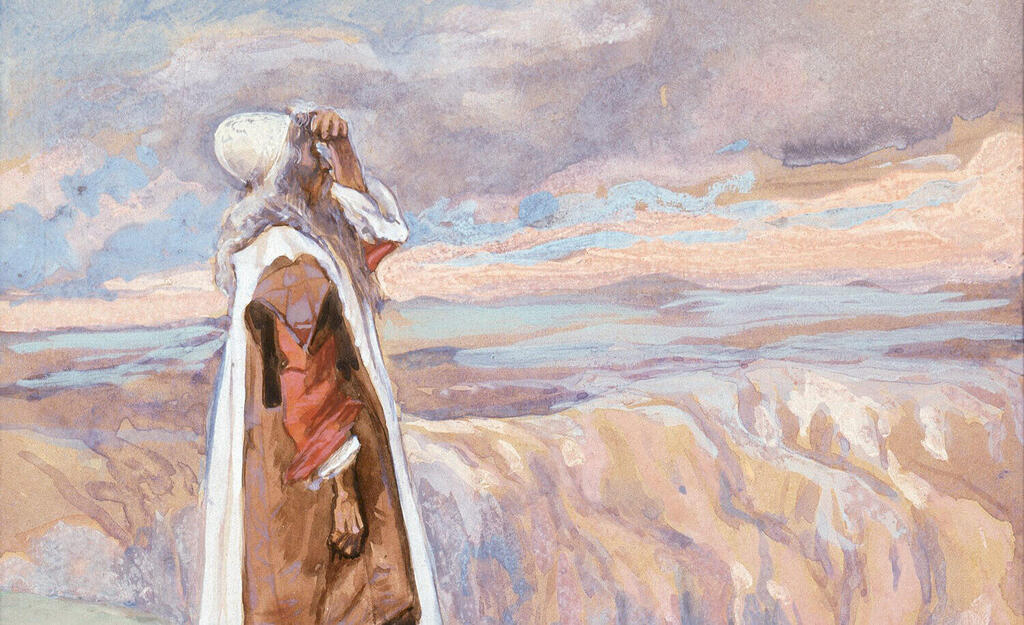
Moses views the Land of Israel
Looking at the subsequent verses about appointing judges or leaders, Rashi interprets Moses' words as a critique of the people’s behavior within the judicial and social systems. "Your cumbrance" means they were contentious; "your burden" means they were suspicious; "your strife" means they were constantly complaining. Moses describes a society plagued by legal pettiness and dissatisfaction. Nachmanides, however, interprets these terms more positively: "cumbrance" is the effort of teaching Torah, "burden" is Moses praying for the people, and "strife" refers to the judicial system. Both classic commentators view Moses’ cry as an introduction to the verses about establishing a judicial leadership system.
I want to suggest a different understanding of this verse describing Moses’ lonely leadership and the cumbrance, burden, and strife he describes. The explanation is based on the verses preceding Moses’ cry which will frame Moses’ assertion, "I am not able to bear you myself alone," in a different light. The framing shows that Moses is not merely confronting an administrative question of organizing a better court system.
The context of blessing
Importantly, Moses does not only complain; he includes a blessing. Prior to saying "How can I myself alone bear your cumbrance, and your burden, and your strife?”, he declares: "The Lord your God has multiplied you... as the stars of heaven for multitude," adding, "The Lord... make you a thousand times so many more and He will bless you as he spoke to you." (Deuteronomy 1:10-11). Multiplication and blessing is inherently good, fulfilling God's promise to Abraham that “he will be a blessing” and “the nations of the world will be blessed through him.” The nation is alive, growing, complex, and diverse.
Blessing, however, contains a profound challenge for leadership. The backdrop of blessing as the cause for Moses’s cry forces us to redefine "cumbrance, burden, and strife". "Cumbrance" is rare in the Bible. In Isaiah (1:14), God says of the holidays and sacrifices, "they are a cumbrance to Me," showing that religious service can become an empty ritual. In an era of blessing, "cumbrance" is the widespread phenomenon of religiosity devolving into hollow practice. We saw this with Korah, who used lofty religious language to mask a cynical grab for power.
Textually, "Your burden" recalls the people craving meat in the wilderness (Numbers 11). It was not just a demand for food, but a desire for a sense of abundance without a higher purpose. It is a tragic reality that immediate, base needs constantly overshadow the grand journey toward Israel.
Again, through Hebrew textual cues, "Your strife" recalls the events at Massah and Meribah. The lack of water was a genuine existential crisis, but it also exposed a chronic inability to recognize God's grace along the long road and in the sweep of history. The immediate present swallows the overarching historical narrative, blinding the people to their grand destiny and the overarching success of the long process.
The loneliness of seeing, sensing and understanding the future
Moses feels entirely alone. Not because he lacks people around him or struggles with administration. He is surrounded by a massive, blessed nation. Moses is lonely because he lives in the future, while the nation still lives in the present. He sees a Promised Land; they see a barren desert. He sees "stars of heaven"; they see a long line at the courthouse. Moses envisions an exemplary nation of mutual responsibility; they are caught up in superficial ritual religiosity and immediate distress. Moses sees an opportunity to influence history; they experience only its logistical side effects.
This profound loneliness is the agonizing solitude of a leader carrying a reality that is within reach but does not yet exist. Moses sees the nation as it could be, while they remain stubbornly tethered to their current traumas. It is the loneliness of an educator or parent who sees in someone far more than they can see in themselves.
Fittingly, Moses asks God: "Have I conceived all these people... that You should say to me, 'Carry them in your bosom, as a caregiver carries a nursing child'?" (Numbers 11:12). A baby lives entirely in the immediate present - hunger, fear, dependency. But a caregiver carries the child because they believe in the growth and future of who that child will become.
This tragic gap between present and future defines Moses’ loneliness throughout his life. He began in isolation in a basket on the Nile, ascended Sinai alone, and wore a veil because the people were terrified to approach his radiant face. He dies entirely alone. His isolation is so complete that even when his desperate plea to enter the land is refused - as we will read next week in Va’etchanan - not a single person steps forward to pray on his behalf or plead for his future.
Here we arrive at the end of Part 1 of this Dvar Torah. Hopefully next week, I will present the Torah’s model for coping with the loneliness of leadership.