


Twenty-two Jews murdered in the Iasi pogrom in Romania in June 1941 were brought to burial Sunday in a ceremony attended by President Isaac Herzog.
The remains of the pogrom victims, buried during the ceremony, were discovered only recently.
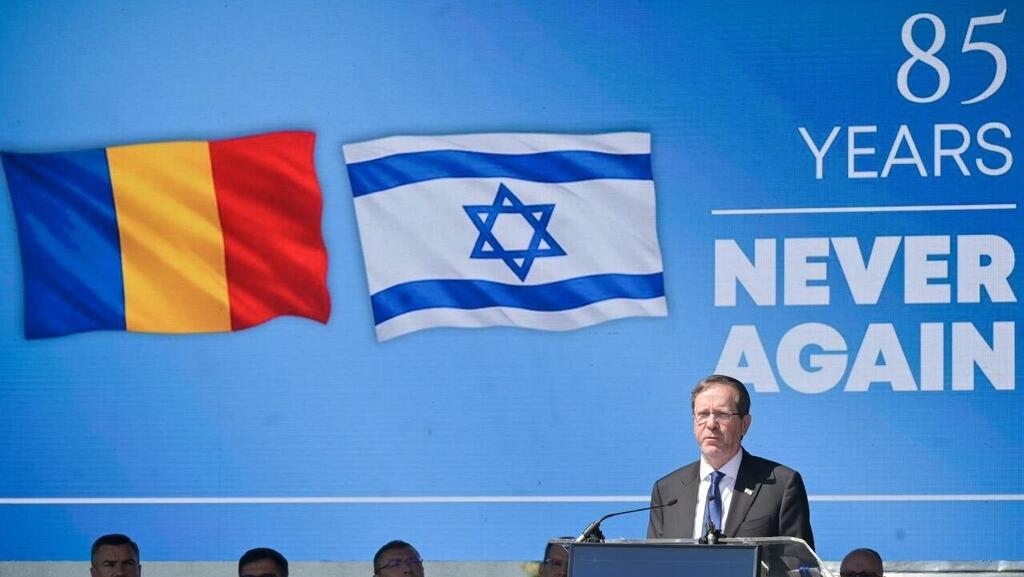
About 15,000 Jews were murdered in the Iasi pogrom and in the death trains in 1941. Some of those who survived the massacre were forced into train cars and locked inside for days as the trains moved slowly between towns, with many dying of suffocation, dehydration and mental collapse.
The Jews who remained in Iasi, in northeastern Romania, were forced to live under curfew in part of the city that had been turned into an open ghetto. They lived in constant fear of deportation to labor camps, while suffering violence and cruelty at the hands of both German and Romanian soldiers.
The ceremony opened with the recitation of Kaddish by Romania’s chief rabbi, Rabbi Rafael Shaffer. Herzog then delivered remarks in memory of the victims before taking part in the reburial ceremony for the remains of the 22 victims.
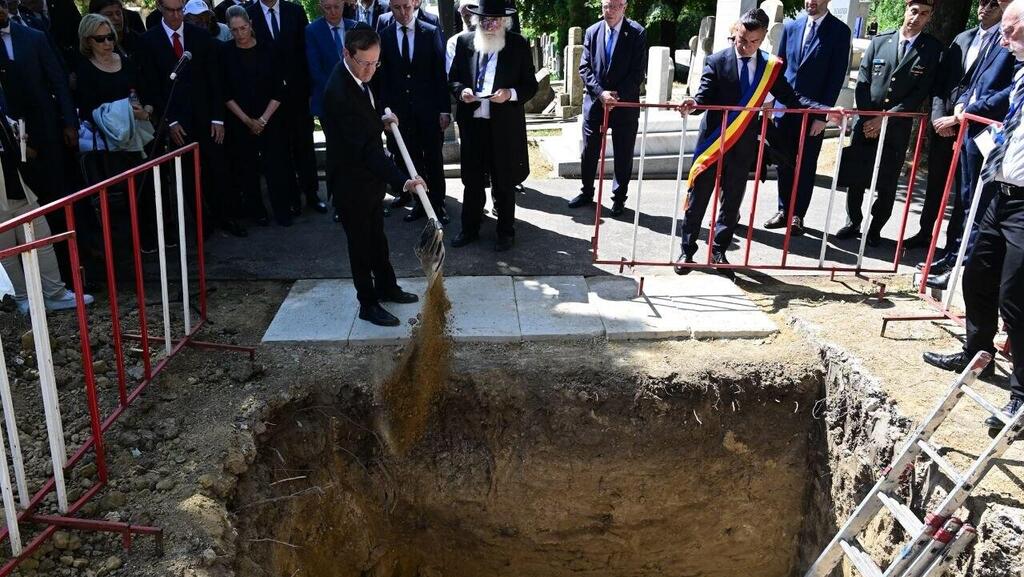
President Herzog beside the grave where 22 recently found victims were buried
(Photo: Kobi Gideon/ GPO)
The ceremony was held against the backdrop of Israel and Romania’s shared commitment to preserving the memory of the Holocaust and the history of Romanian Jewry.
“This memorial ceremony for the tens of thousands of Jewish women, men, children and elderly people murdered on this soil, in Iasi and its surroundings, between June 28 and July 6, 1941, does not erase the suffering of the victims,” Herzog said.
“Nor does it lessen the moral stain of the perpetrators of the crimes. It does not undo the murders, humiliations, beatings or death trains that were planned at the highest levels, but carried out by all layers of society in those terrible summer days, 85 years ago.”
Herzog said the ceremony also does not answer the most painful question left by the massacre.
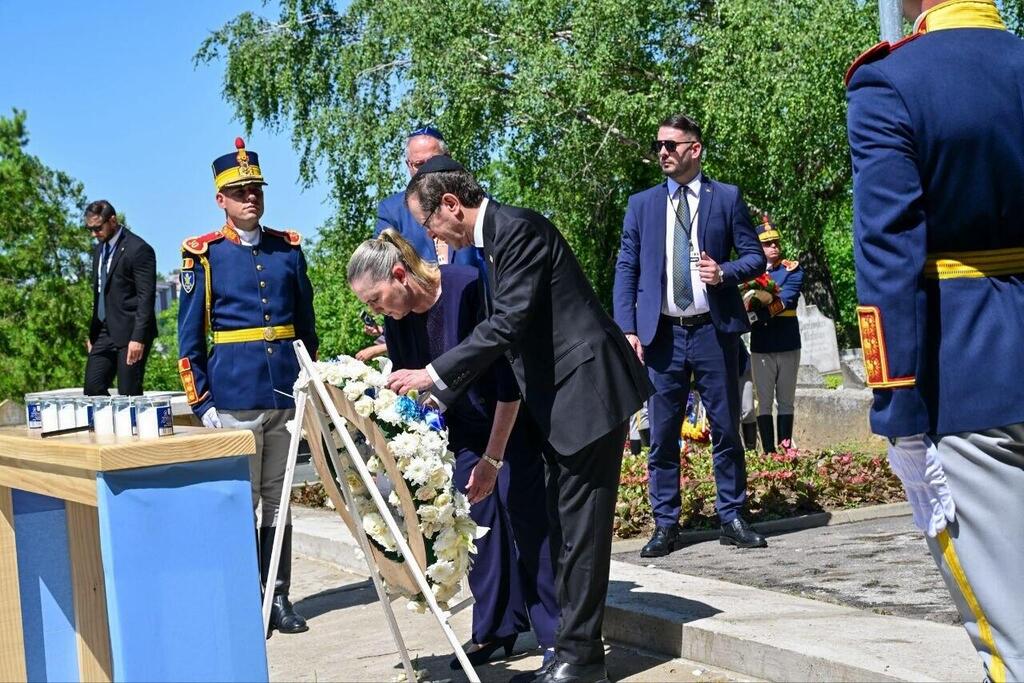
President Herzog and his wife Michal at the memorial ceremony
(Photo: Kobi Gideon/ GPO)
“How?” he said. “How can one even begin to understand cruelty on such a scale, stretching across an entire society? How could it be that in a great European city, which for centuries served as a thriving center of Jewish life, the image of God was erased? The only answer to this shattering question is deafening silence.”
Herzog said the truth of what happened in Iasi must not be allowed to fade into passive memory.
“What happened here must compel us to ask how our world of memory obligates us to build and remember in the present,” he said. “It is our duty to ensure that every boy and girl in Romania, in Europe and across the world, learns about this horror and its shame, visits this site and confronts this painful history.”
Herzog noted that decades before the pogrom and massacre in Iasi, Naftali Herz Imber wrote in the city the first version of what would later become Israel’s national anthem, “Hatikvah.”
“Imagine, as we stand here in this somber place, we mark that our nation’s hope grew from Iasi,” Herzog said. “Imber’s words became the anthem of that great human movement, Zionism, which saw Jews as taking their fate into their own hands and establishing a Jewish national home in the Land of Israel.”
The president also described the contribution of Romanian Jews to the founding and development of Israel.
“In fact, it was Romanian Jews who established some of the earliest communities in the Land of Israel, such as Rosh Pina in 1882,” he said. “They invested their blood, sweat and tears in the great Jewish and human enterprise of renewing Jewish sovereignty. Steeped in Romanian culture, they stood at the heart of Israel’s development, and to this day they remain a living and vital link between Romania and the Jewish people.”
Herzog then turned to the antisemitism facing Jews in Europe today.
“It is deeply troubling that in far too many places across Europe, under the malicious influence of an empire of evil that spreads hatred, antisemitism is again raising its ugly head,” Herzog said.
“The moral foundation that humanity built in response to the moral destruction of the Holocaust is weaker than it has been for 80 years. This is a danger to Jews, and it is a danger to all people of goodwill.”
He said the shared responsibility now is to recognize that danger, name it and confront it.
“We must actively embrace the moral call it places before us and fight it with determination,” Herzog said. “Let this be the lesson of Iasi.”