


In recent years, major European cities have become key arenas in the fight against antisemitism, but also testing grounds for the gap between declared policy and reality on the ground.
Athens, which once stood at the forefront of the struggle alongside the Combat Antisemitism Movement (CAM), an organization now working with more than 3,500 cities worldwide, is now presenting a troubling picture that raises serious questions about the direction of its current leadership.
Anti-Israel protest in Athens
(Video: Combat Antisemitism Movement)


A sharp shift in the public atmosphere recently led an Israeli family to cut short its vacation in the city and relocate to Portugal after encountering what they described as unusual antisemitism and open incitement in public spaces.
Sacha Roytman, CEO of CAM, arrived in Athens with his wife and three children seeking a brief escape from the tense reality in Israel. The choice of Athens seemed natural, a nearby, familiar and welcoming destination.
But upon arrival, the family was confronted with a disturbing reality.
“Almost everywhere in the city center we saw anti-Israel and antisemitic messages on walls and building facades,” Roytman said. He described seeing Israeli flags defaced with swastikas alongside explicit calls for violence.
“One of the hardest moments was when my children asked why there was a swastika on our flag,” he said. “This is not just discomfort. It is a hostile environment that cannot be accepted, especially in a city that hosts millions of tourists. What was once on the margins has become the norm. This is no longer a legitimate protest. It is the visibility of hate.”

CAM’s research team documented a violent incident in the city center in which a mob attacked passersby while chanting “Hezbollah, Hezbollah.”
For the Roytman family, which had sought refuge from terrorism at home, encountering open support for such terrorist groups in Greece was incomprehensible.
“The lack of a clear response or enforcement against such incitement in the heart of Europe is not just a local problem. It is a dangerous message,” Roytman said.
A leadership test
Roytman directs criticism not only at extremist groups but also at the city’s leadership.
According to him, since Athens Mayor Haris Doukas took office, there has been a noticeable weakening in enforcement and in setting a clear line against the phenomenon.

Israeli flag with a swastika במקום the Star of David
(Photo: Combat Antisemitism Movement)
“When a mayor does not set clear boundaries, silence is interpreted as acceptance,” Roytman said. “When Israelis feel unwelcome or unsafe in public spaces, it is no longer just a matter of political opinion. It becomes a matter of governance.”
A comparison to the recent past highlights the scale of change. In 2022, under former mayor Kostas Bakoyannis, Athens hosted the first international mayors' summit on combating antisemitism.
“Now, in a short time, the city that led a global fight is struggling to deal with what is happening on its own streets,” Roytman said.
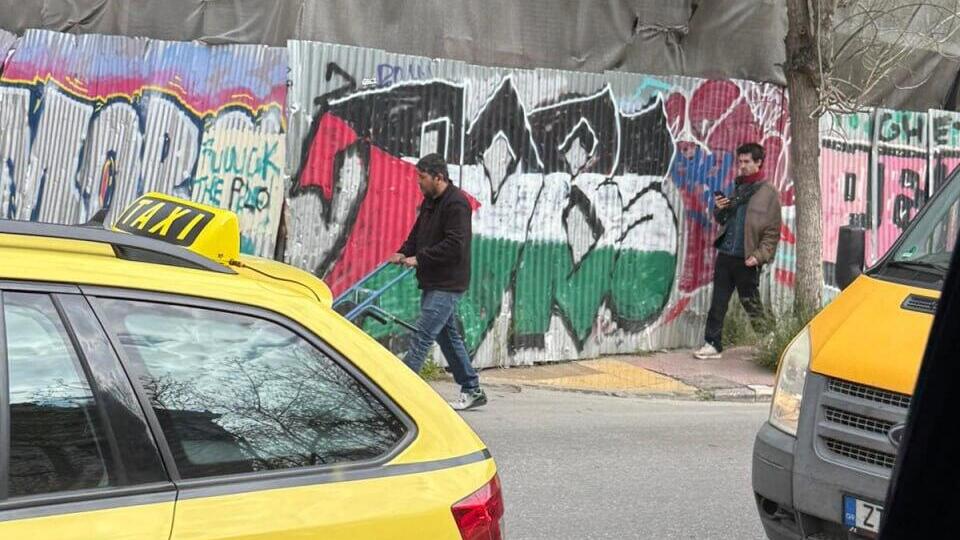
Pro-Palestinian graffiti in Athens
(Photo: Combat Antisemitism Movement)
He added that the current situation represents a betrayal of the city’s historical legacy, pointing to Archbishop Damaskinos, recognized as Righteous Among the Nations for his efforts to save Greek Jews during the Nazi occupation.
“This is the true legacy of the city, not hate graffiti and violence under Hezbollah banners. A mayor cannot abandon this history,” Roytman said.
Family leaves, warning issued
Following their experience, the Roytman family decided to leave Greece immediately.
At the same time, Roytman sent a sharply worded letter to Mayor Doukas. “Athens, the cradle of democracy, cannot allow the normalization of antisemitism in public spaces,” he wrote. “The question is what kind of face Europe wants to present.”