

Bar-Ilan University has launched a new global online course dedicated to the legacy of Rabbi Lord Jonathan Sacks, one of the most influential Jewish thinkers of our time. The course, which is open to the general public free of charge and offered in several languages, aims to make his philosophical and moral thought accessible to diverse audiences worldwide and to examine its relevance to questions of faith, society and ethics in the modern era, five years after his death.
The course, titled “The Jewish Philosophy of Rabbi Lord Jonathan Sacks,” was developed over the past year and a half under the academic leadership of Dr. Miriam Feldman-Kaye of the Department of Jewish Philosophy and a senior researcher at the Jonathan Sacks Institute at the university. It has already been taken by more than 300 Bar-Ilan University students and is now open to the general public, free of charge and in multiple languages, on CampusIL, Israel’s national online learning platform. In its first stage, the course is launched in Hebrew and English and will later expand to additional languages, including Arabic, with the goal of making Rabbi Sacks’ teachings accessible to diverse audiences around the world.
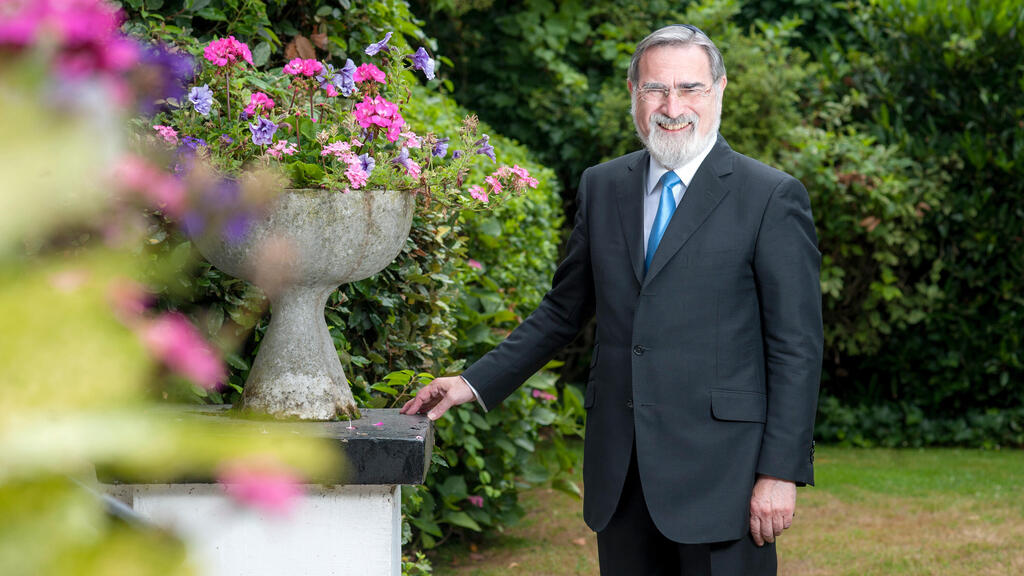
“Rabbi Sacks’ thought continues to inspire rigorous scholarship and universal moral reflection,” said Prof. Jonathan Rynhold, head of the Jonathan Sacks Institute at Bar-Ilan University. “Through this new course, Bar-Ilan University and the Jonathan Sacks Institute are expanding his intellectual influence on new audiences, bridging academia and the wider public and ensuring that his voice continues to resonate in the global discourse on faith, ethics and human dignity.”
The course was made possible through the contributions of the late Dr. Mordecai Katz and Dr. Monique Katz and their family. It offers an in-depth journey into the thought of Rabbi Sacks, a global intellectual, philosopher and spiritual leader, and explores questions of religion and modernity, science and faith, morality, interfaith relations, leadership and community. Through unique primary materials and interviews with leading scholars from Israel and Britain, participants are introduced to a body of thought that connects the wisdom of Jewish tradition with the moral, social and identity challenges of the modern age.
“Our journey into Rabbi Sacks’ thought will be multidimensional,” said Dr. Miriam Feldmann-Kaye. “We will examine his views on the role of religion in the contemporary world, his approach to multiculturalism and to the relationship between science and faith, and the depth of his understanding of morality, community and leadership. Beyond the intellectual experience, the course also offers an opportunity for introspection and moral dialogue: how his teachings can guide us in confronting the challenges of our time.”
Rabbi Lord Jonathan Sacks (1948–2020), who served as chief rabbi of the United Hebrew Congregations of the Commonwealth, is regarded as one of the most influential Jewish thinkers of our era. His writings and lectures continue to inspire leaders, educators and students around the world through his call for moral courage, compassion and a shared humanity.
“Launching the course on the fifth anniversary of Rabbi Sacks’ passing is a moving and meaningful way to commemorate his legacy,” said Joanna Benarroch, president of the Rabbi Sacks Legacy organization. “Opening his thought to the general public, in a spirit of education, dialogue and moral mission, reflects his vision precisely.”
The initiative is part of Bar-Ilan University’s broader efforts to expand digital access to Jewish thought and philosophy, with the support of the university’s Teaching and Learning Division, headed by Vice President for Teaching and Learning Yuval Shraibman and Head of Pedagogical Development Gal Yaniv. University officials said the launch of the course represents another significant step in combining academic excellence with technological innovation and public engagement through open learning.
Rabbi Sacks was born in Britain in 1948 to an Orthodox Jewish family. He studied philosophy at the University of Cambridge and the University of Oxford, earned a doctorate in philosophy from King’s College London and lectured in philosophy at institutions including Middlesex University, King’s College London and the London School of Jewish Studies. Alongside his academic career, he was ordained as a rabbi and served congregations at several synagogues in London. In 1991, he was appointed chief rabbi of Britain, a position he held until 2003.
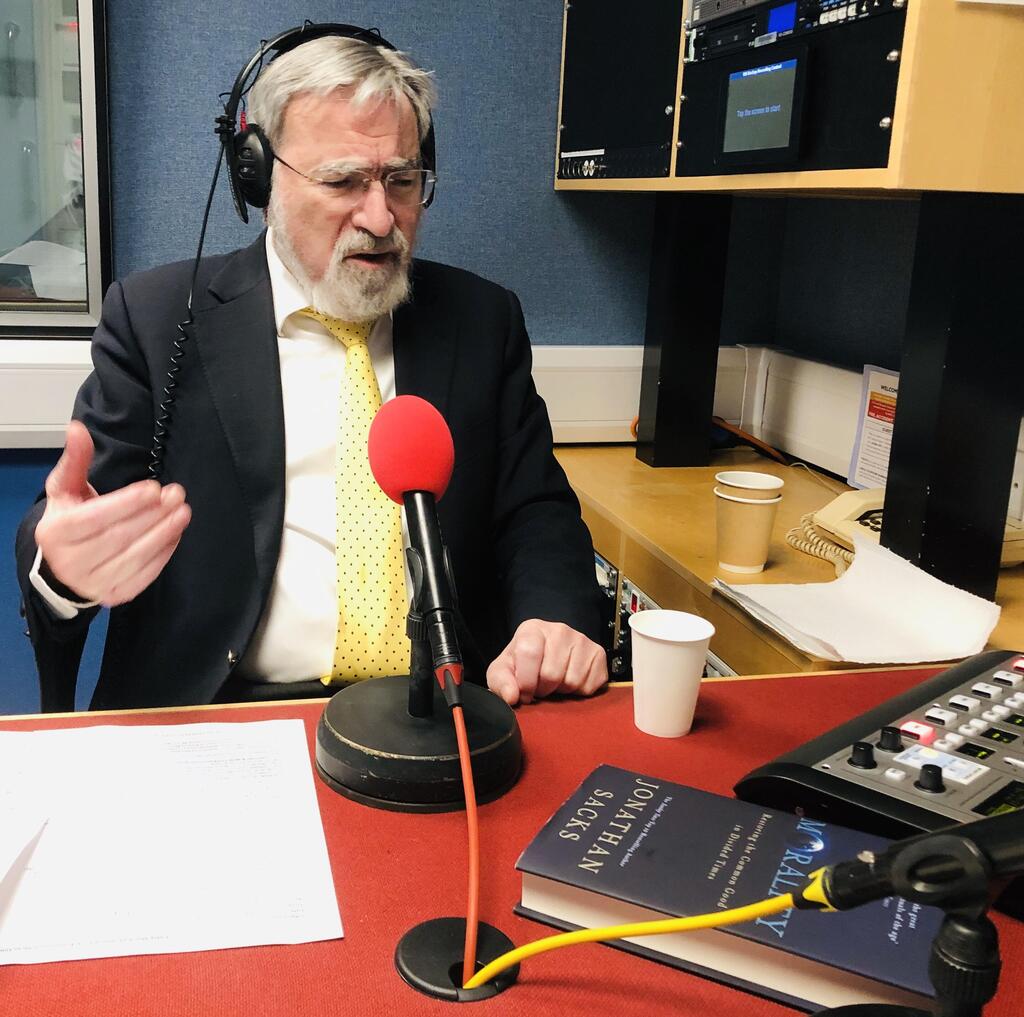
Rabbi Jonathan Sacks during one of the radio programs he hosted
(Photo: Rabbi Sacks Legacy Trust)
He frequently met with religious leaders and politicians and sought to foster dialogue and closer relations among faiths and world leaders. As part of this commitment to public dialogue, he wrote a regular column for The Sunday Times and hosted a segment called “Thought for the Day” on BBC radio. During his tenure as chief rabbi, he published a book of his thought each year. In 2009, he was granted the title Baron Sacks of Aldgate and took a seat in the House of Lords, which he held until his death.
Benarroch reiterated: “Launching the course on the fifth anniversary of Rabbi Sacks’ passing is a moving and meaningful way to commemorate his legacy. Making his thought accessible to the general public, in a spirit of education, dialogue and moral mission, reflects his vision exactly.”