


Fragments of oil lamps, unlit for some 1,700 years, may illuminate the existence of a small Jewish community in southern Spain during the late 4th or early 5th century CE.
Recent archaeological excavations in Castulo, near Linares in Andalusia, uncovered artifacts pointing to a Jewish presence in the region. Researchers are now investigating whether a structure from that period, previously thought to be a Christian church, might instead be a synagogue.
Among the finds are three oil lamp fragments decorated with a seven-branched menorah, a roof tile bearing an image of a five-branched menorah, and a conical jar lid with a blurred Hebrew inscription, possibly reading “Psalm of David” or a phrase linked to “Selichot.”
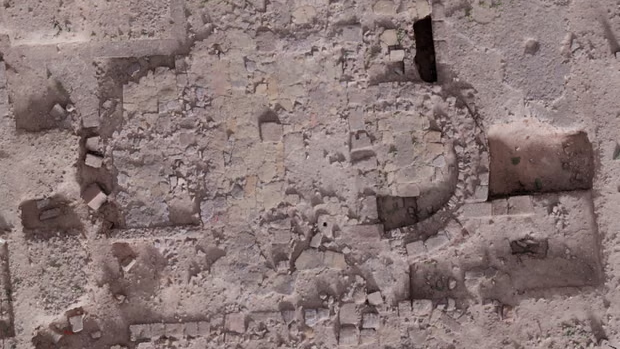
Archaeologists believe these artifacts provide the first evidence of an undocumented Jewish community in Castulo, a city abandoned roughly 1,000 years later. The discoveries have prompted a reexamination of a nearby structure, once identified as a 4th-century Christian church, now potentially an ancient synagogue.
Get the Ynetnews app on your smartphone: Google Play: https://bit.ly/4eJ37pE | Apple App Store: https://bit.ly/3ZL7iNv
“During the 2012–2013 excavations, we found the roof tile with the five-branched menorah,” said Bautista Ceprián, a senior archaeologist with the Andalusian government’s project. “But it was only now, with these additional finds, that it became clear that a small Jewish community likely lived here,” he added.
In a paper published in the journal of the Faculty of Geography and History at the University of Las Palmas, researchers noted the absence of Christian artifacts and burials—a hallmark of early churches—strengthening the synagogue hypothesis.
The structure’s location in an isolated part of the city, near a ruined Roman bath, aligns with the known pattern of early synagogues often built on urban outskirts. Ceprián suggested that, if confirmed as a synagogue, it could be among the oldest known in Spain, possibly the earliest.
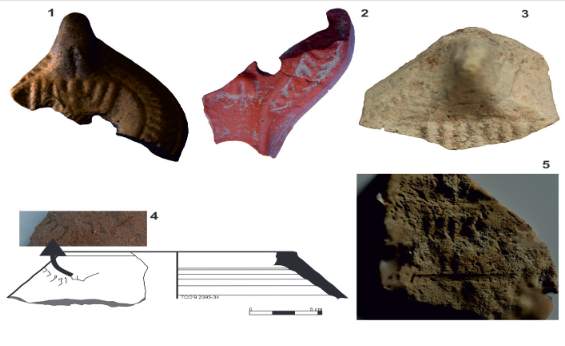
Remains found in the excavation in Spain
(Photo: Bautista Ceprián, מתוך המחקר)
Most surviving synagogues on the Iberian Peninsula date to the Middle Ages. Despite the excitement, researchers acknowledge the lack of written records definitively confirming a Jewish community in Castulo.
“I’m sure there will be criticism and that’s entirely legitimate—that’s how science works,” Ceprián said. “Still, we believe we’ve provided reliable data to support our conclusion.”
Professor Elisa Morera, an expert in ancient history at King Juan Carlos University in Madrid, underscored the discovery’s significance. “The findings unequivocally confirm the presence of Jewish communities on the Iberian Peninsula in the 4th century and even earlier,” she said.
Reflecting on the community’s disappearance, she noted: “The synagogue in Castulo likely vanished due to isolation, intolerance and violent hatred driven by the dominant Christian society of the time.”