

The encounter between Ethiopian Judaism and rabbinic Judaism is not merely an encounter between different customs, prayer texts, or approaches to Jewish law. To a large extent, it is an encounter between two forms of religious consciousness that emerged from the same Jewish story but which assigned different weight to God, the world, and the human being.
For centuries, the tradition of Bete Israel developed outside the world of the Mishnah and Talmud, the foundational works of rabbinic Judaism. This should not be regarded as a deficiency or a gap that the community needed to fill. Bete Israel maintained a Jewish tradition with its own religious, interpretive, and legal world, grounded largely in sacred scripture - foremost among its texts the Orit—the Bete Israel Torah, comprising the Five Books of Moses together with Joshua, Judges, and Ruth—as well as in its priestly tradition, prayer, and communal practice.
Gallery
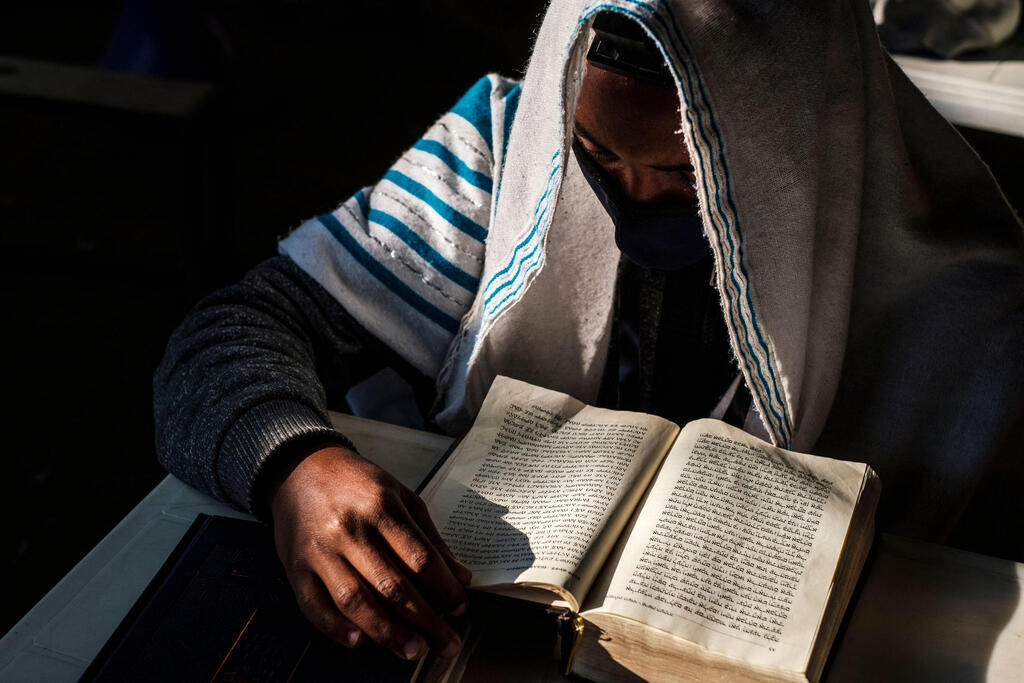
A member of the Ethiopian Jewish community attends a religious service at the synagogue of the community in the city of Gondar, Ethiopia
(Photo: AFP)
Nor should we assume that, had Bete Israel encountered rabbinic developments earlier, it necessarily would have adopted them. Some may even have been rejected because they did not accord with the religious logic that had developed within the community. It is therefore more accurate to see Bete Israel not as a tradition that "failed to reach" the Mishnah and Talmud, but as one that developed along a different Jewish path.
This does not mean that Bete Israel represents "the Bible as it once was" or that it perfectly preserved an ancient form of Judaism. It, too, underwent historical, interpretive, and religious development. Yet its deep affinity with biblical patterns allows us to recognize a theological center of gravity different from the one that emerged in rabbinic tradition.
Perhaps the best place to begin is with the Torah's opening verse: "In the beginning God created the heavens and the earth." The Torah does not begin with Abraham, Moses, Israel, or even humanity. It begins with the world. Before human beings appear, God creates light and darkness, heaven and earth, seas and dry land, vegetation, the celestial bodies, and animals. Again and again, God looks upon creation and declares it good. Goodness therefore exists before humanity does. Only at the end of this process, on the sixth day, is the human being created.
That literary sequence can also be read as a theological statement. We enter a world we did not create, a reality in which order, meaning and goodness already exist. The rabbinic sages themselves captured this idea in a striking teaching: If a person becomes arrogant, he should be reminded, "The mosquito preceded you in the order of creation."
It is more accurate to see Bete Israel not as a tradition that "failed to reach" the Mishnah and Talmud, but as one that developed along a different Jewish path.
Yet rabbinic literature also develops another trajectory. The human being is not merely a late arrival within creation, but an active partner in shaping the religious world. People interpret the Torah, decide disputes, sanctify time, repent, and stand in judgment. The sages could therefore teach both, "The mosquito preceded you," and, "For my sake was the world created." The tension between these two statements offers a key to the distinction I am proposing: In the Bible, humanity receives a world; in rabbinic teaching, the question of what humanity will do with that world becomes increasingly central.
Rosh Hashanah provides a revealing test case. In the Bete Israel tradition, the counting of the months begins with Nisan, known as Lisan, in accordance with the command given on the eve of the Exodus: "This month shall be for you the beginning of the months; it shall be the first of the months of the year for you" (Exodus 12:2). If children today were asked which month begins the year, many would probably answer Tishrei. The Torah, however, explicitly identifies Nisan as the first month.
The rabbinic sages did not revoke Nisan's special status. The Mishnah opens its tractate Rosh Hashanah by declaring, "There are four new years." It distinguishes the first of Nisan, "the new year for kings and festivals," from the first of Tishrei, "the new year for years, sabbatical years, and jubilees" (Mishnah Rosh Hashanah 1:1). This is not a simple transfer of the new year from one date to another, but the creation of a complex system with several starting points for time.
Rabbinic literature also preserves more than one view of when the world was created. Rabbi Eliezer teaches that the world was created in Tishrei, while Rabbi Joshua places creation in Nisan (Babylonian Talmud, Rosh Hashanah 10b-11a). This dispute raises a deeper question: Are Nisan and Tishrei merely competing dates for the same event, or do they embody two different understandings of beginnings and of time itself?
In a sense, the Bete Israel tradition holds both poles together. Nisan remains the first of the months, in keeping with the biblical command. At the same time, the community's tradition associates the beginning of creation with Tishrei. The world began to be created on the twenty-fifth of Elul, and the first of Tishrei - the sixth day of creation - marks the creation of the human being. In this respect, Bete Israel tradition resembles the view of Rabbi Eliezer.
But here a more profound difference emerges. Identifying the first of Tishrei with the creation of humanity does not necessarily make humanity the center of the day. The Torah itself neither calls the first of Tishrei "Rosh Hashanah" nor defines it as a day of judgment. It calls the day zikhron teru'ah, "a remembrance marked by the sounding of the horn" (Leviticus 23:24), and yom teru'ah, "a day of sounding the horn" (Numbers 29:1). These verses do not describe human beings standing trial, books of life and death, or repentance in anticipation of a verdict.
The explicit identification of Rosh Hashanah as a day of judgment appears in the Mishnah: "On Rosh Hashanah, all who enter the world pass before Him" one by one in judgment (Mishnah Rosh Hashanah 1:2). From there, rabbinic tradition increasingly shaped Rosh Hashanah as a day focused on human beings and their deeds. Each person is judged, examines his or her conduct, and is summoned to repentance. We can discern here a subtle but significant movement: from the world to the human being, from creation to human responsibility.
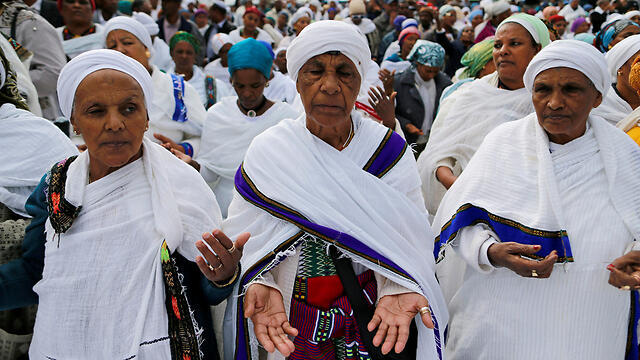
(Photo: Retuters)
The Bete Israel tradition allows us to hear the other voice more clearly. Rosh Hashanah is known within the community as Berhan Seraka, "the dawning of the light" - light heralding the beginning of a new year. My grandfather, Aba Dejen Gideon Mengesha, would say that this light recalls the dawning of the first light God created at the beginning of the world. The holiday's name therefore signifies more than the start of a new year. It returns us to the beginning of creation and to the first appearance of light in the world.
The holiday has another name in the community: Tizkar Abraham, "the remembrance of Abraham." According to Bete Israel tradition, the binding of Isaac took place on Rosh Hashanah, and so Abraham and the memory of the binding accompany the day. During the festival, the priests would read from a special work known as Gadla Abraham, which concerns the patriarch Abraham and his death. Creation, the memory of Abraham, and the covenant with God are thus joined within a single day.
Preparations began on Rosh Hashanah eve. Community members went down to the river to wash, immerse, and purify themselves. Afterward, they put on white clothing or clean new garments and walked to the mesgid, the synagogue, to welcome the festival. Their approach to the mesgid combined joy with trembling: the happiness of the holiday together with the awe of entering sacred time.
Early the next morning, the community gathered in the mesgid at the center of the village for festival prayers and a reading by the priests, the kessim, Bete Israel's traditional religious leaders. After the service, the worshippers moved into the synagogue courtyard. There the kessim conducted a ceremony over the masawait, a special bread baked for Rosh Hashanah. They broke the bread and distributed it to the community, after which everyone returned home for the festival meal.
Rosh Hashanah was devoted to prayer, festive meals, Torah study, and time with the kessim and the community. Work in the fields was forbidden, although tasks needed for the home and holiday - including preparing food and lighting a fire for cooking - were permitted. As the festival ended, preparations began for the Ten Days of Repentance, the period leading to Yom Kippur.
Taken together, these practices show that Berhan Seraka is more than another name for Rosh Hashanah. It expresses a religious consciousness of renewal, creation, purification, and memory. People do not begin the year by looking only inward. They immerse and purify themselves, then enter sacred time together with the community - a time that returns everyone to the first light, the creation of the world, and the covenant. The starting point is not the human being awaiting judgment, but the light being created; not first, "What will my judgment be?" but an encounter with a world renewed through God's act of creation. The world precedes the human being both in the order of creation and in religious consciousness.
According to Bete Israel tradition, the binding of Isaac took place on Rosh Hashanah, and so Abraham and the memory of the binding accompany the day.
The same sensibility can be heard in the language of prayer. Psalm 148 presents praise as the activity of all creation, both living and inanimate. The sun and moon, the shining stars, the heavens and the earth, fire and hail, mountains and hills, fruit trees and cedars, wild and domesticated animals, birds, and human beings are all summoned to praise God. The world is not merely created by God; all creation stands before and praises its Creator.
Psalm 150 brings this cosmic chorus to its culmination. The psalm unfolds through an ever-expanding catalogue of instruments, sounds, and forms of praise: shofar, harp and lyre, drum and dance, strings and flute, clashing cymbals and resounding cymbals. It then gathers this entire symphony into its final, all-embracing declaration. In Hebrew: “Let every neshamah praise the Lord” (Psalms 150:6). In Ge’ez:
ኵሉ ፡ ነፍስ ፡ ይሴብሖ ፡ ለእግዚአብሔር
“Let every soul praise the Lord.”
Read in light of Psalm 148 and as the culmination of Psalm 150, “every soul” becomes the summary of creation’s praise. The phrase does not necessarily mean that every element of nature possesses a soul. Rather, it expresses a biblical consciousness in which human beings do not stand alone before God. They stand before God within a creation whose many living and inanimate voices join together in praise.
We might imagine an orchestra. The human voice is important within it and carries a special responsibility, but it is not the entire orchestra. The heavens, the earth, and the living beings around us are not scenery created solely as a stage for human action. They are part of a world that exists in relationship with its Creator. Human beings discover their place not by pushing the rest of creation out of the picture, but by joining it.
Here the difference between the two forms of religious consciousness becomes sharper. Rabbinic tradition developed the idea of human responsibility with extraordinary power. The human being is commanded, interprets, decides, sins, repents, and stands in judgment. This is one of the great achievements of the Oral Torah, the body of rabbinic interpretation and teaching. People cannot hide behind the divine order. We are required to take responsibility for our actions and are capable of shaping reality.
The Ethiopian biblical tradition emphasizes a more primordial biblical principle: responsibility does not make the human being the owner of the world. We enter a world that preceded us and take our place within a creation that had already been declared “good” before we appeared. We do not stand alone before God, but as part of an entire world that stands before its Creator in submission, humility, and faith.
I am not suggesting that these two traditions should be set against one another, as if one were correct and the other mistaken, or as if one represented an "ancient" Judaism and the other an "advanced" Judaism. They offer two different centers of gravity. The Ethiopian biblical tradition reminds us: You are one voice in the orchestra of a creation that preceded you. Rabbinic tradition reminds us: From the moment you were created, you became responsible for what you would do in this world.
We are not the center or owners of creation, but we bear a distinctive responsibility for what takes place within it. The art of living lies in balancing these truths - and, above all, in recognizing the proper moment: when to hold on and when to let go, when to remain faithful to what we have received and when to make room for change and renewal. The challenge is not always to choose one pole, but to know how to move between them.
This is more than a claim about the sequence of creation; it is a profound moral statement. We are neither the world's starting point nor its sole purpose. The meaning of human existence therefore lies not in looking only inward, but in directing ourselves toward what lies beyond the self: the world, creation, and especially the people around us. Other people are not scenery in the story of my life. Their very presence places a responsibility upon me. Biblical morality begins by limiting the place of the self - by recognizing that not everything begins with me and not everything exists for my sake.
From this perspective, we can also reframe the question of Rosh Hashanah. Rabbinic tradition teaches us to ask: What will my judgment be? The tradition of creation - and especially the way it resounds in Bete Israel practice - adds an equally important question: What will be the fate of the world in human hands?
Rabbi Dr. Sharon Zeude Shalom is the founding director of Ono Academic College's International Center for the Study of Ethiopian Jewry. He is also the author of The Living Geniza (Open University, 2022), Dialogues of Love and Fear (Koren, 2021), and From Sinai to Ethiopia (Gefen, 2016).