


A historically significant treasure, previously hidden from public view and whose origins remain partly unclear, has been uncovered in the basements of the Warsaw District Court. Holocaust-era wall paintings were discovered on the walls of a secret passage inside the building that once connected the Warsaw Ghetto to the city’s so-called “Aryan” side. Children were smuggled out of the ghetto through this passage and saved. For decades, the site was closed to the public because it served as the court’s archive.
The paintings were revealed during extensive renovation work recently carried out on the entire floor, after the archive was temporarily removed. In the coming days, the renovations are set to be completed, including a dedicated conservation process for the paintings. Once the archive is returned to its permanent location, public access to the artwork will again be barred.
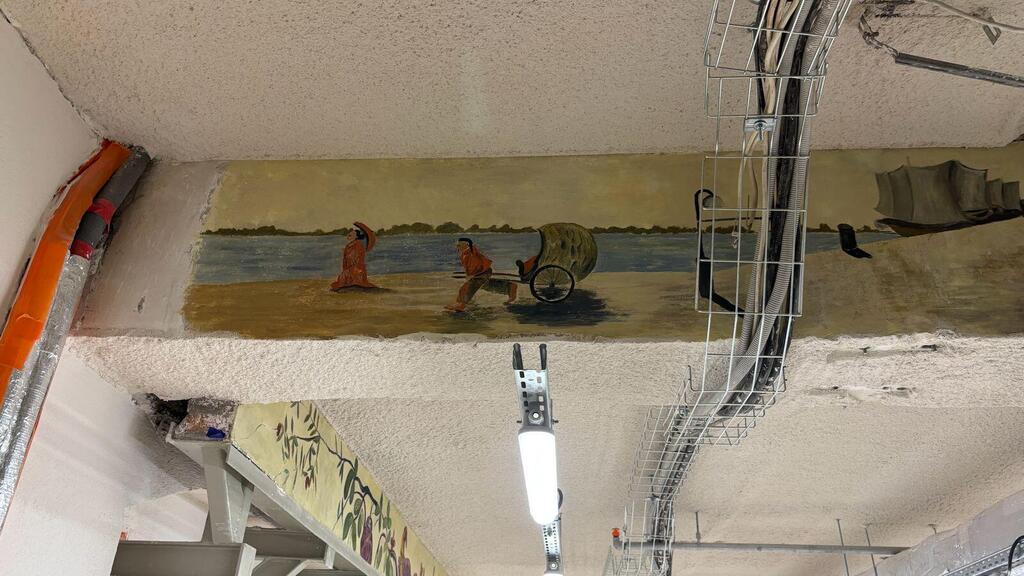
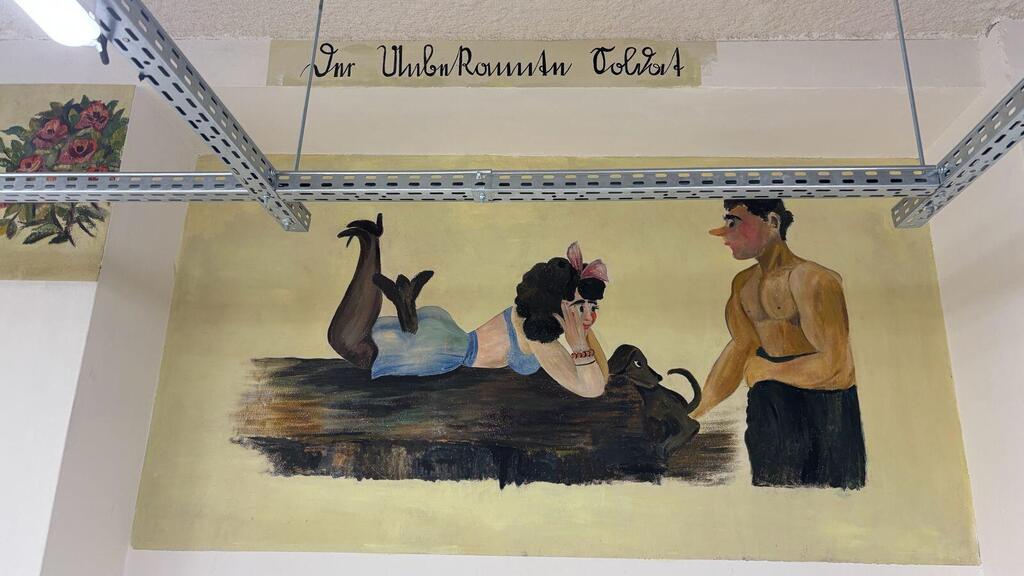
Some of the paintings were from the time when the place was used as a club for Nazi officers
(Photo: Meir Bulka)
Warsaw’s monument conservation officer was called in to examine the paintings, though their precise origin has yet to be determined. The prevailing assessment is that they were created during the Holocaust period, likely in several stages and at different times. The Warsaw District Court building, located at 127 Solidarności Avenue (formerly 127 Leszno Street), stood during the war at a junction between the small and large ghettos, in an area designated by the Germans as part of the “Aryan” side of the city.
During the war, the court building also served for a time as a hospital where Jewish children were treated, a fact that may explain the origin of some of the paintings. However, the Warsaw antiquities officer proposed another theory, suggesting the paintings were part of a decorative plan for a café intended for this floor when the building was constructed, though there is currently no evidence to support that claim.
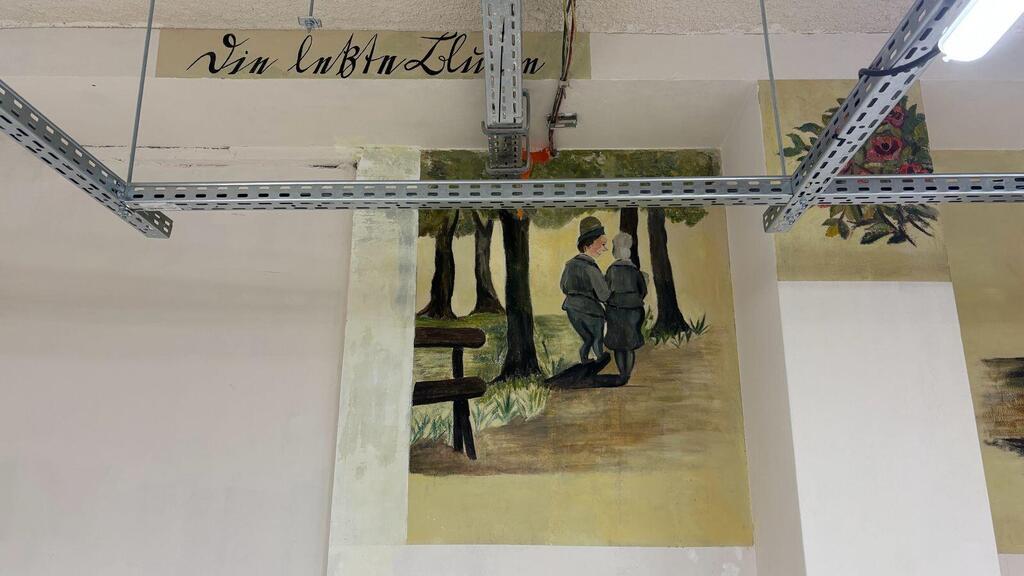
Painting discovered in the courthouse basement
(Photo: Meir Bulka)
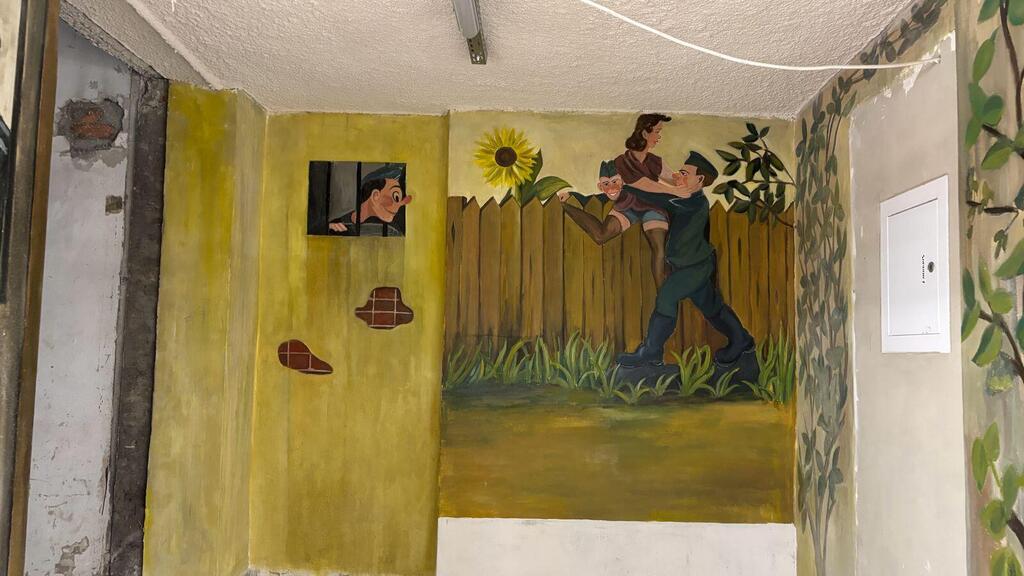
Another mural
(Photo: Meir Bulka)
Some of the paintings are provocative in nature and include German motifs, raising the possibility that the space later served as a rest room for German officers after the secret passage was discovered. By contrast, the prevailing view today is that the paintings functioned as navigational aids in the passage, intended to help guide children being evacuated from the ghetto.
Testimonies collected after the Holocaust indicate that the passage connecting the ghetto to the Aryan side was used to smuggle children, food, medicine and weapons. Meir Bulka, a scholar of Polish Jewry and chairman of J-nerations, an organization dedicated to preserving Jewish heritage in Europe, received rare, one-time permission from court officials to enter the basements days before the archive is returned, in order to document the findings.
“The entry into the basement is especially moving,” Bulka said. “To walk through the dark spaces where children were saved, where fate shifted from darkness to light, is a story that repeats itself throughout Jewish history. Even though the site has undergone renovation and preservation for the future, the public will not be able to see these findings, and I am deeply moved to have been given the chance to witness them.”
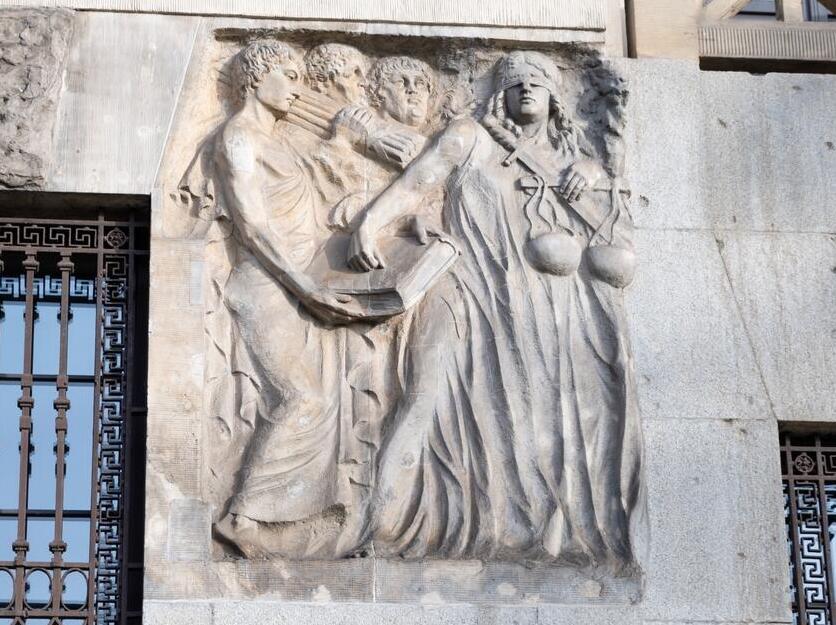
Warsaw District Court building
(Photo: bykot photo, Shutterstock)
Bulka said he first learned of the rare paintings from a Polish court official who contacted him to share the details. “This is actually one of the few buildings in Warsaw that was preserved and not bombed during the war,” he noted.
The identity of the artists remains unknown. Some of the paintings are provocative, including an image of a Nazi officer harassing a woman, raising the possibility that they were painted by Jewish prisoners for the Germans. Alongside these are decorations with a childlike character, appearing as though they were painted by children. Several of the paintings are known to have been created in an area that served for a time as a hospital, leading to the assessment that they were meant to cheer Jewish children hospitalized there.
“The most plausible explanation is that the paintings were likely created in three different periods,” Bulka added. “The first was when the space served as a hospital, to make the stay of the children there more pleasant. In some images you can see ambulances bringing patients to the other side of the city. The second period was when it became an officers’ club, which explains the more provocative paintings. The third was the idea of turning the place into a café, according to the building’s original plans. The character of the paintings supports this assumption: in one area they are decorative, and in another they resemble a kind of comic strip.”
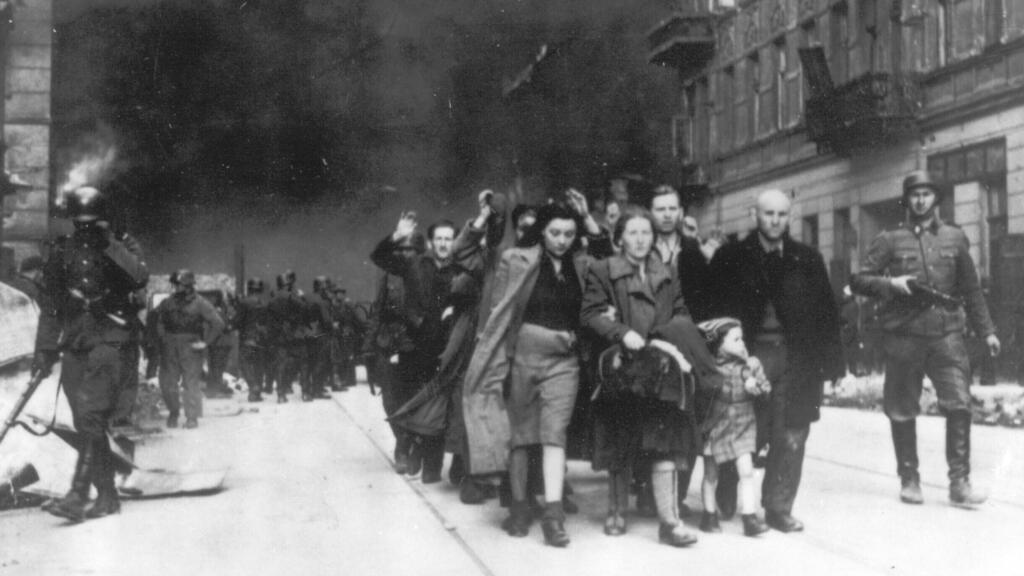
Jews in the Warsaw Ghetto
(Photo: AP)
There is extensive testimony from Holocaust survivors about the secret passage, including from people who were smuggled through it. Antek Zuckerman, one of the leaders of the Warsaw Ghetto Uprising, described the passage in his book “Seven Years”:
“How did we manage to get out of the ghetto? Lonka and I had a method: most of the time we would enter the courthouse building on Leszno Street… There was also access from the Aryan side. There was a clerk there who took bribes… We would go in with a note, as if we had been summoned to court, and exit on the Aryan side… Sometimes we slipped through with the help of our policemen, who arranged it in advance: I would hand the German my Jewish identification, with 500 zlotys or some agreed-upon sum tucked inside. After pocketing the money, he would return the document and allow me to pass to the Aryan side… I remember one day when Lonka and I went in, and since no one was there, we removed our armbands and looked for a way to reach that clerk who would take us through the corridor to the exit gate. Suddenly a Polish policeman grabbed us, because we were supposedly trying to sneak into the ghetto. It was a success, even without a bribe; he was sure we were Poles (a Jew with a Jewish appearance would not have managed this, but Lonka and I did). We began to say that we were owed money in the ghetto, but he threw us out onto the Aryan side.”