


At 98, Auschwitz survivor Nate Leipziger has a direct message for Jewish students confronting antisemitism on campuses around the world: do not hide who you are, do not allow antisemites to define you and do not believe that running away is the answer.
“They have to fight back,” Leipziger told Ynet in an interview alongside Revital Yakin Krakovsky, CEO of March of the Living Israel. “They can’t hide. They can’t run. Running is over.”
‘Don’t hide, don’t run’: Auschwitz survivor urges Jewish students to stand up to antisemitism
(Video: Lior Sharon)


Leipziger recently wrote an open letter to Jewish students, built around one central message: “Never permit those who hate you to define you.” For him, that principle is inseparable from the history he survived. “We have paid a very high price for our survival, and we survived,” he said. “Because we survived, now, we have to continue to fight for those who are not here, and we have to maintain our identity, and we have to be proud of who we are.”
Before the establishment of Israel, he said, Jews often had little choice but to flee persecution from one country to another. Today, he argued, Jewish students should understand that their circumstances are different. “Today, we don’t have to run because we have Israel, which is strong and it’s fighting for us and our survival and the survival of our young people,” he said.
Asked what he would tell students who are afraid to openly identify as Jewish, Leipziger urged them to organize and make use of the protections available to them in democratic societies. “Don’t be pushed around,” he said. “Organize, counterattack, or at least defend yourself as much as you have.” He stressed that he was referring to peaceful and lawful action, saying students should use “the peaceful means that are available to you in a free democratic country” and rely on police and state institutions to help protect them.
At the same time, Leipziger drew a clear distinction between antisemitism and criticism of the Israeli government. “They’re two different things,” he said. “Israel as a state has to account for their action, and they’re responsible for what they’re doing. Criticizing the state, either as a Jew or as a non-Jew, is legitimate.”
What crosses the line, he said, is directing hostility toward Jews themselves. “Attacking Jews as a nation, as a race, as a group, as a religion is not acceptable, and it is a crime and it’s hatred,” he said. He added that an Israeli government represents the country at a particular moment and does not permanently represent Jews everywhere. “The government represents us at this particular time,” he said. “It does not represent us forever.”
Leipziger also said today’s antisemitism is part of a broader ideological struggle extending beyond Jewish communities. “This hatred, by the way, it’s not only against the Jews,” he said. “It is against the Western way of life. It is against our democracies. It’s against our freedoms. It’s against our freedom of choice.”
That, he argued, makes confronting antisemitism a responsibility not only for Jews but also for others who share democratic values. “We have to engage other people of goodwill to help us fight this evil, because if we don’t hold hands together, we will go under together,” he said. “This message goes out not only to the Jewish students, but also to the non-Jewish students.”
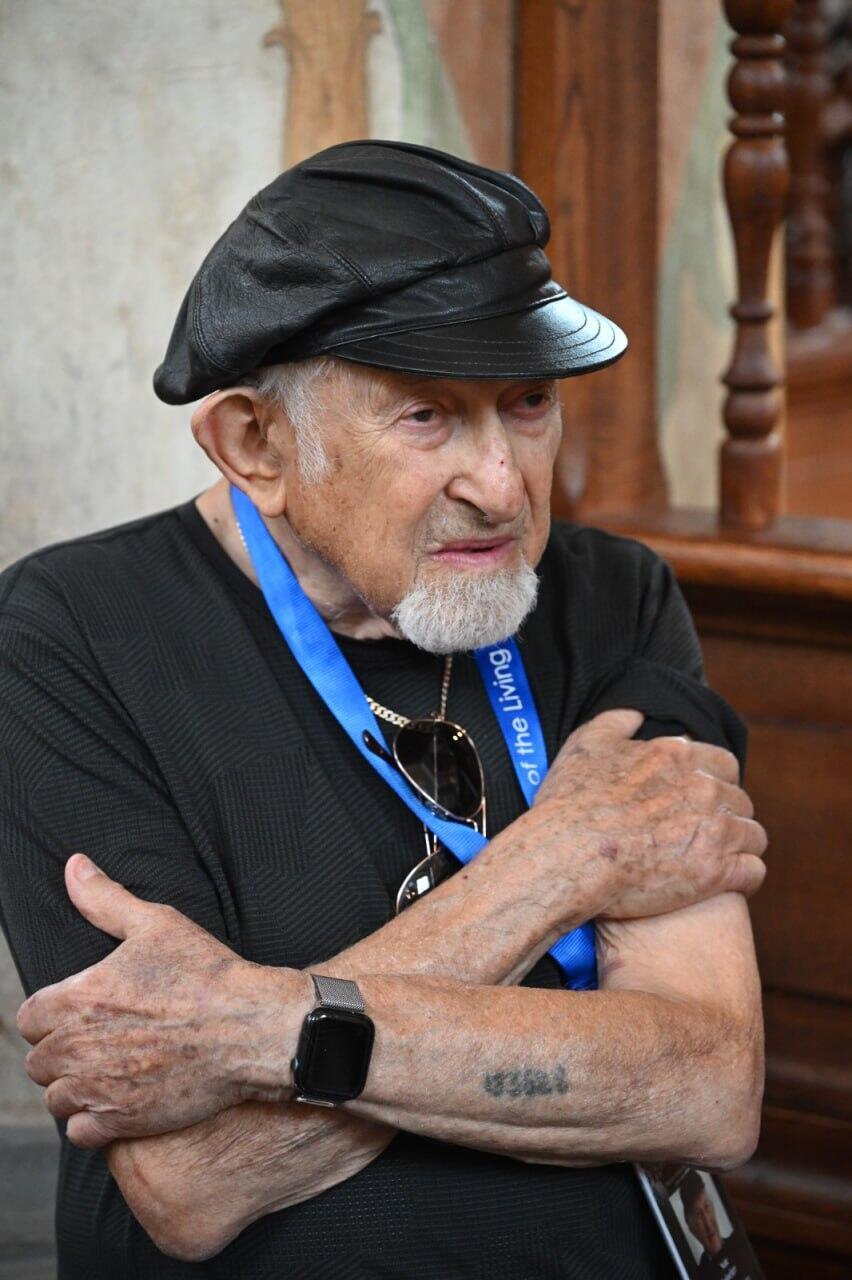
Nate Leipziger
(Photo: Yossi Zeliger)
Asked what gives him hope amid the rise in antisemitism, Leipziger pointed to Israel’s strength and its alliance with the United States. He said he hopes Israel and the United States will defeat Iran and that what he described as propaganda originating from Iran and terrorist groups will be confronted “at the source.”
Yakin Krakovsky said Leipziger was chosen to address Jewish students not simply because he survived the Holocaust, but because of the decades he has spent educating younger generations. She described him as a “champion survivor” who has participated in 22 March of the Living delegations and educated thousands of students in Poland and elsewhere.
“Nate, as an educator, not just as a survivor, was the best choice to write an open letter to every Jewish student across the globe,” she said. The aim, she added, was to offer “words of encouragement and strength” and remind students “that they’re not alone, that they have support, and we have each other.”
Asked whether parallels could be drawn between antisemitism on North American campuses today and the period leading up to the Holocaust, Yakin Krakovsky cautioned against equating the two. “The Holocaust was unique,” she said. “Nothing can be compared to it in its scale, in its length, in its magnitude.”
Still, she said, some imagery and stereotypes used by antisemites today evoke memories of earlier periods of anti-Jewish hatred. “The imagery that the anti-Semites are using, the stereotype, can remind us of those dark days,” she said. “But as Nate said, Jews are not defenseless anymore. They have Israel, they have each other, and we have learned from the past and we’re standing stronger.”
Leipziger agreed, saying that after surviving the Shoah and experiencing decades in which antisemitism appeared to diminish, Jews should not surrender the freedoms they have gained. “We realize that life is good,” he said, “and that the only thing that we have to do is to defeat the antisemitism and the hatred.”