

At a “Zikaron BaSalon" event, a grassroots Israeli initiative in which people host Holocaust remembrance discussions in homes and public venues, marking Holocaust Remembrance Day, former Supreme Court President Aharon Barak spoke not as a jurist but as a 5-year-old child from Kovne (Kaunas), Lithuania.
Addressing a hall filled with lawyers at the Yitzhak Rabin Center, against the backdrop of ongoing war and security threats, he connected his personal Holocaust memories to broader questions of law, democracy and Israeli identity. “Do not assume this cannot happen here,” he warned.
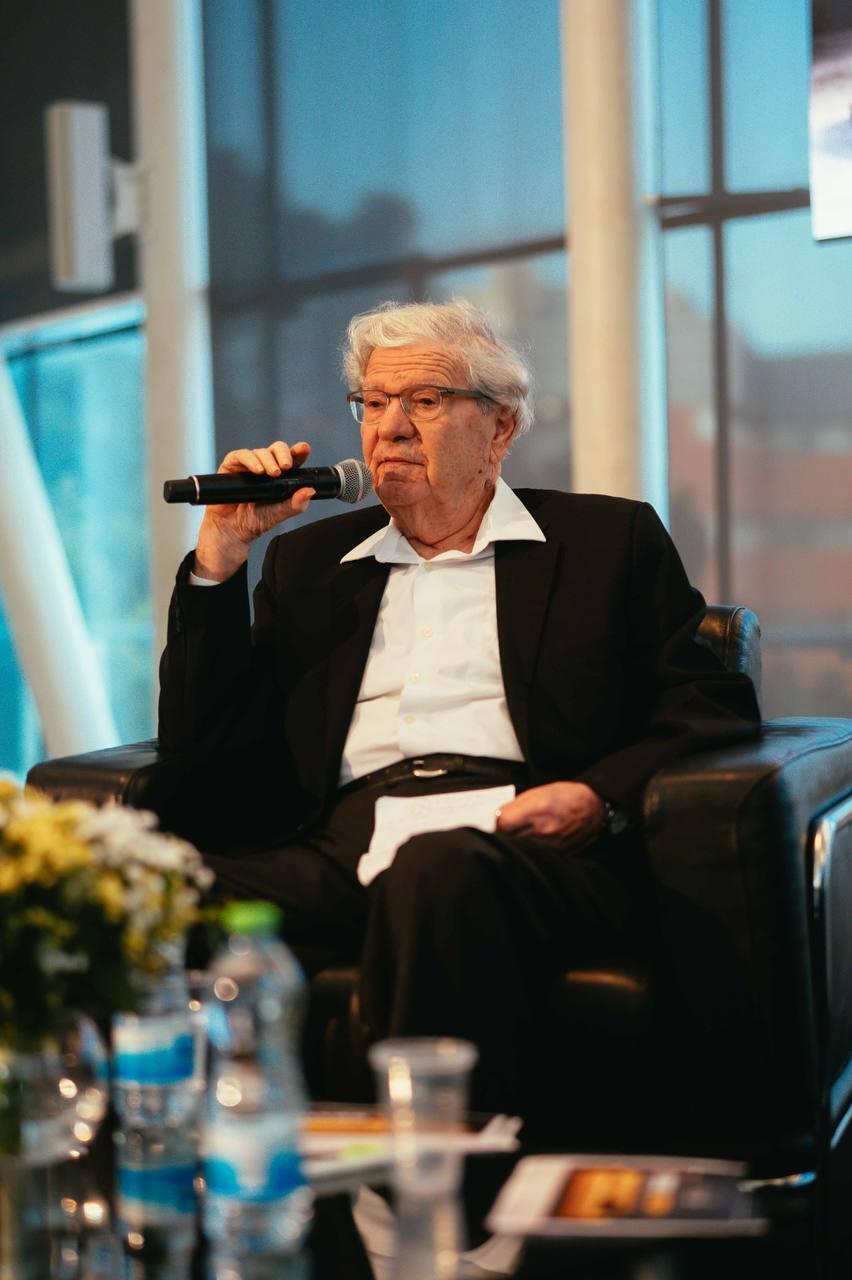
The event, held on the eve of Holocaust Remembrance Day, was led by Israel Bar Association head Amit Becher and Barak himself. They discussed how Barak’s childhood trauma in the ghetto shaped his legal philosophy. “This evening involves first and foremost your personal story, but it is also the story of national revival,” Becher said at the start of the discussion.
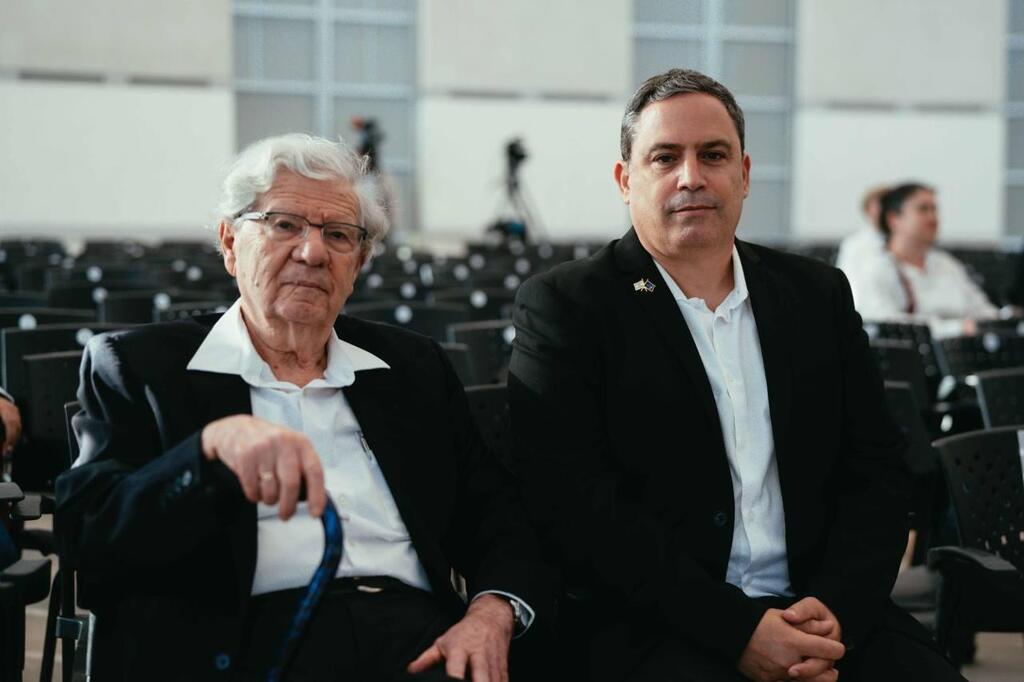
Barak with Amit Becher
(Photo: Eyal Efrati)
Barak started recalling: Kaunas (Kovne), 1941. He was 5, sitting in a cart with his parents on the way to the ghetto. “The image I carry from that time is of a prison,” he said. “People lived under a death sentence, never knowing when it would be carried out.”
He described hunger, daily deaths and strict prohibitions. “It was forbidden to study or teach, and forbidden to have children. A child who was born would be murdered, and so would the mother.”
His breaking point came during the 1944 “children’s action,” when German soldiers entered homes and took all children under age 12. “They were all murdered,” he said. Barak survived extraordinarily. He was smuggled out of the ghetto in a sack from the factory where his father worked.
“They put me inside a sack with soldiers' uniforms. A German soldier sat on top of me. If I had moved, it would have been the end of me,” he recalled. When the sack was opened in a Lithuanian farmer’s barn, it was the first time he had seen a cow. “That was my first moment of fear,” he said.
Barak and his mother were hidden by two Lithuanian farmers later recognized as Righteous Among the Nations, a title given by Israel to non-Jews who risked their lives to save Jews during the Holocaust. Years later, Barak asked their children why their parents had taken such risks. “The answer was simple,” he said. “We are devout Catholics. If someone needs help, you help them."
Barak said he has asked himself ever since what he would have done in their place. “I don’t have an answer,” he said.
Alongside the horror, he emphasized the humanity that endured in the ghetto. “There was solidarity. We helped each other. The Germans took our lives, but not our spirit, and not our humanity,” he said.
After the war, the family reunited, fled Europe and immigrated to Israel. Barak described arriving as a child who did not know Hebrew and struggled in school, before eventually becoming one of Israel’s most prominent jurists.
That journey, he said, shaped his legal outlook. “The first lesson is the importance of Israel as the nation-state of the Jewish people,” he said. “If such a state had existed during the Holocaust, things would have looked completely different.”

Aharon Barak: “Human dignity is a Jewish concept”
(Photo: Eyal Efrati)
At the same time, he stressed a universal moral lesson. “We must treat Arabs as we would have wanted to be treated as Jews in Lithuania,” he said. “Human dignity is a Jewish concept.” He said the role of the law is to maintain a balance “between the survival of the state and human rights, not to veer toward extremes but to seek balanced solutions.”
When asked whether legal systems themselves can descend into injustice, as happened in Nazi Germany, Barak answered unequivocally: “Yes. If it happened in the country of Beethoven and Bach, it can happen here. Do not assume it cannot happen here. Anything can happen.”
He added a direct warning: “If democracy does not protect judges, judges will not be able to protect democracy.”
As the evening concluded, Becher asked a final question: What gives Barak hope for the future of Israel’s legal system and the state?
His answer was brief: “Elections.”