


Outrage erupted in Israel, the Jewish community in Dublin, and among senior American Jewish organizations following Ireland’s move to advance a bill that would criminalize the import of goods from Israeli settlements in the West Bank, East Jerusalem and the Golan Heights. The proposed legislation has been criticized as discriminatory and politically motivated.
Foreign Minister Gideon Sa’ar slammed the legislation as “antisemitic,” saying it targets Jews based on where they live and blocks normal trade. “You can’t keep turning the other cheek,” Sa’ar said. “If this legislation passes, Ireland will pay a price.”

According to a senior Israeli official, Ireland recently reached out to Jerusalem in an attempt to open a dialogue, but Sa’ar refused until Dublin withdraws its legal claim at the International Court of Justice in The Hague, which accuses Israel of committing genocide in Gaza. “You don’t hold dialogue with a country accusing you of genocide,” the official said.
Ireland is widely seen as one of the most anti-Israel voices in the EU. A recent attempt by Ireland and Spain to pass joint anti-Israel measures in Brussels failed to gain the necessary support.
Ireland’s Chief Rabbi Yoni Wieder also condemned the bill, calling it one-sided and hypocritical: “Like most things to come out of Ireland’s parliament since the Gaza war began, this targets Israel alone, ignoring Hamas and Iran’s war crimes. How do they think this helps a two-state solution?”

Ireland’s Chief Rabbi Yoni Wieder
(Photo: The Jewish community in Ireland)
Wieder added that if Irish politicians truly cared about humanitarian concerns, they would pressure Hamas to release hostages and disarm. “Instead of demonizing Israel again, why isn’t Ireland speaking out against Iran or Hamas’ genocidal intentions?” he asked.
He warned that support for the bill appears to span all major Irish political parties and suggested the only thing that might stop it is fear of the economic damage it could bring to Ireland’s economy. “Most politicians seem willing to overlook that, just to score points against Israel,” he said.
Get the Ynetnews app on your smartphone: Google Play: https://bit.ly/4eJ37pE | Apple App Store: https://bit.ly/3ZL7iNv
Wieder clarified that criticism of Israel is not inherently antisemitic, “but it becomes so when it relies on antisemitic tropes, double standards, or baseless accusations.” He argued those lines have been repeatedly crossed in Irish public discourse over the past year and a half.
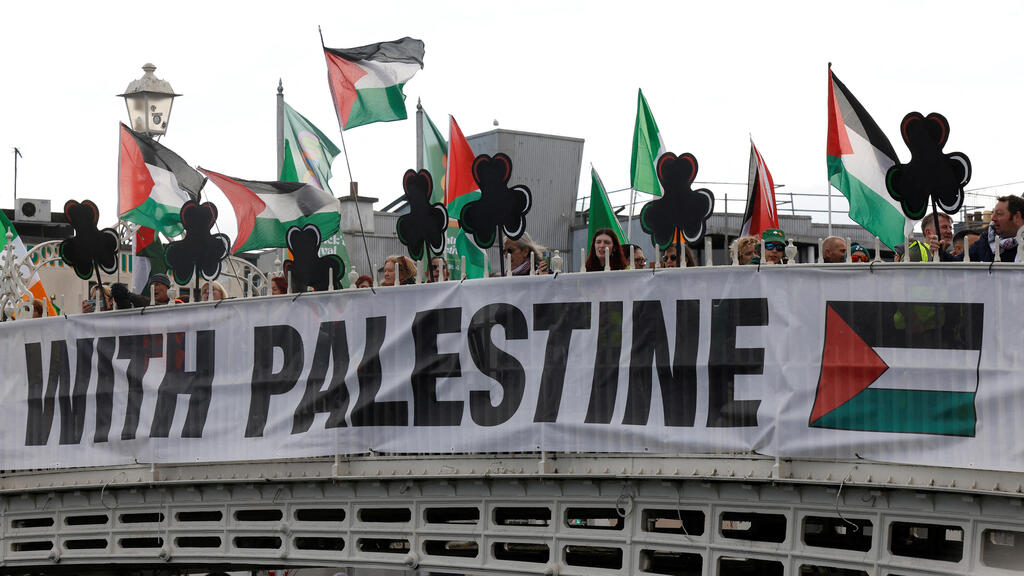
Pro-Palestinian demonstration in Ireland
(Photo: Reuters/Clodagh Kilcoyne)
Several leading U.S. Jewish organizations—including the American Jewish Committee, Anti-Defamation League and Conference of Presidents of Major American Jewish Organizations—issued a joint statement warning that the bill could endanger American businesses operating in Israel and fuel rising antisemitism in Ireland and beyond.
They also argued that the bill undermines the possibility of a negotiated two-state solution by unilaterally determining the final status of disputed territories.
The debate comes amid worsening tensions between Dublin and Jerusalem. In December 2024, Israel closed its embassy in the Irish capital after the Irish government announced it would unilaterally recognize a Palestinian state and passed a nonbinding resolution accusing Israel of genocide in Gaza.