


"After one child came out, I thought that was it. I never even considered the possibility that another one would come out," says Tzafira Walker, a resident of the religious Zionist community of Moreshet in northern Israel. "My prejudices went so far that I thought it simply couldn't happen. When it did, I couldn't believe it was happening to me. Three out of six seemed inconceivable."
She and her husband, Aharon, have six children: Drora, Yekutiel, Hodiya, Ben-Nun, Avinoam and Tzefania. Their three youngest sons came out as gay; the youngest is now 26. Walker, 63, has traveled a long road from denial to acceptance.
Gallery
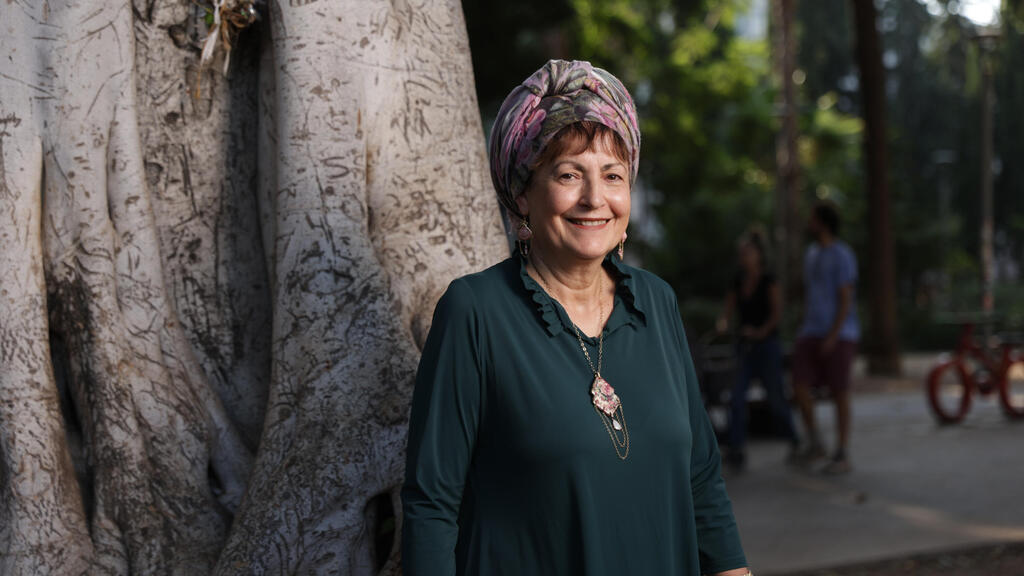
Tzafira Walker: 'People are understanding it better and responding with humanity, just as the Torah asks us to respect every person'
(Photo: Orel Cohen)
"Someone once approached me and said, 'Don't you find it strange?' It was a religious figure I had turned to because I wanted him to help. But with his question, he was essentially throwing it back at me: 'How do you explain this?' But I don't need to explain it. Let Him explain it," she says, pointing upward. "Let the Almighty explain it. Especially after we studied the subject and understood that it certainly has nothing to do with one person influencing another."
On the eve of Shabbat when the Torah portion of Bereshit, or Genesis, was read, the Walker family had cause for great celebration. A baby was born to one of their sons, Ben-Nun, and his partner, Aviel, following a surrogacy process.
"We're very excited," says Walker, the new father's mother. "We're also seeing a positive change. Friends of ours wrote about it on WhatsApp, acknowledged it and congratulated us. People are beginning to understand that this isn't an agenda; these are human beings. Yes, there are difficulties. We encounter awkwardness, and people in religious communities don't always know how to process it. But we're seeing that, gradually, people are understanding it better and responding with humanity, heart to heart, just as the Torah asks us to respect every person."
A complete turnaround
Walker teaches music education at colleges and also performs as a musician in playback theater. Today, she facilitates support groups for religious parents of LGBTQ children, having once participated in such a group herself. She brings insights from her family's experience and her own personal journey to the meetings. She leads two parent support groups, in Modi'in and Kiryat Bialik, which meet once a month through a partnership between Tehila, an organization supporting parents of LGBTQ people, and Havruta, an organization for religious LGBTQ people.
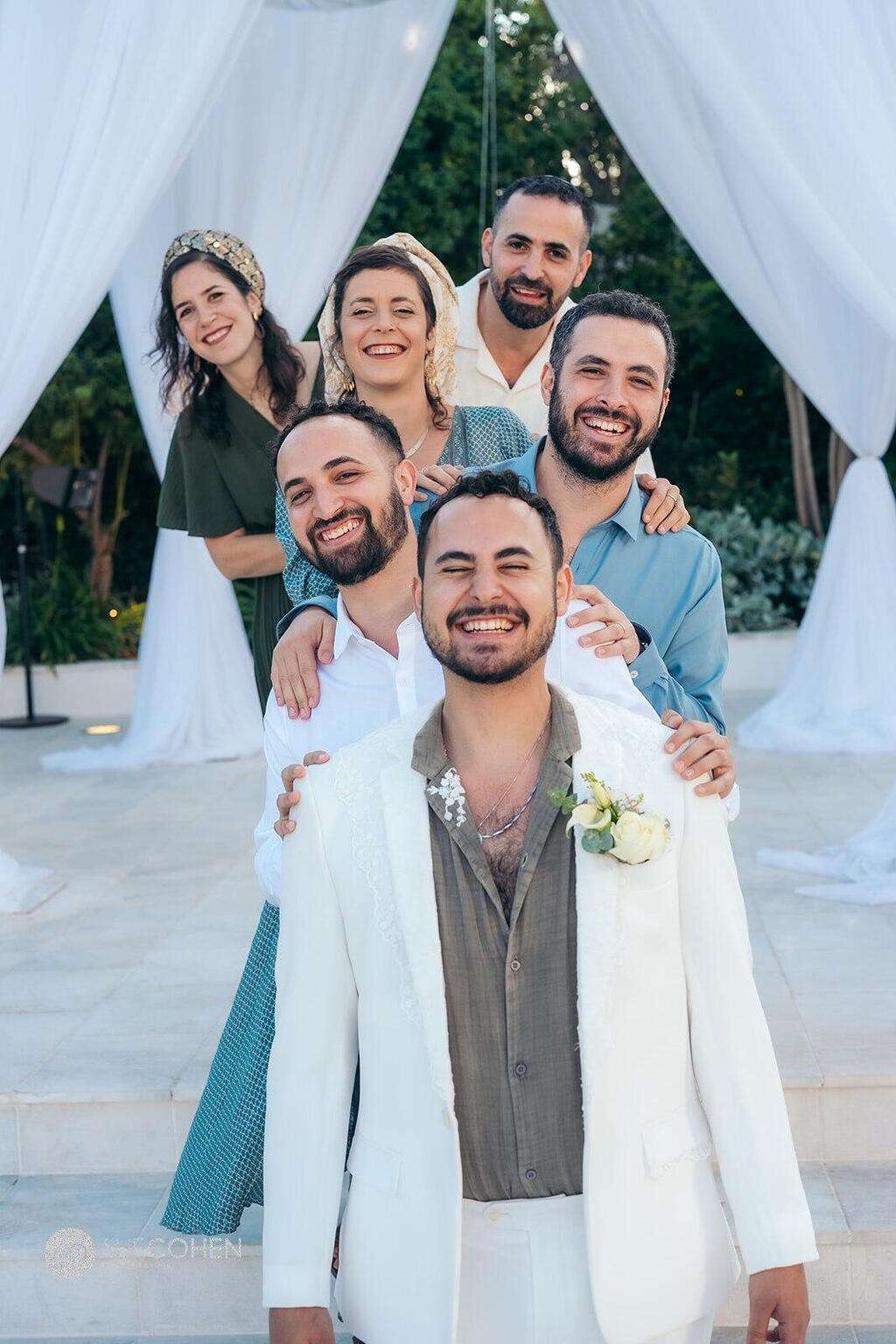
The siblings, from front to back: Tzefania, Avinoam, and Ben Nun, who came out of the closet; and behind them, Hodiah, Yekutiel, and Drora
(Photo: Suf Cohen)
Walker, who wears a full head covering, could be described as part of mainstream religious Zionism. She belongs to a generation that struggled to accept LGBTQ identities and relationships.
"Young men and women, teenagers who come from religious families and discover during their lives that they are LGBTQ, face major questions of faith and questions about their place in the community and their relationships with their parents," she says. "Unfortunately, this causes many of them to wonder whether they have a place in the religious community. It also raises questions of faith for their parents. Along the way, I took this challenge from a place of initial shock, a feeling that my world was collapsing, and turned it into a mission. I get tremendous satisfaction from working with parents."
What were your views about LGBTQ people before your children began coming out?
"I can say that, in this respect, I was a fairly typical person in religious society. When our fifth child, Avinoam, was 14, he sat us down for a conversation and told us. He was the first to come out. At that first moment, I felt I was receiving the worst news a mother could possibly receive. When people face other difficulties, the community can still help them. But this was something you couldn't even tell anyone about or share. Suddenly, I was carrying a secret. There's a saying that when a child comes out of the closet, the parents go into the closet. That was exactly what happened.
"My initial feeling was that everything had been shaken to its foundations, and I was terribly afraid for him. We're very fortunate, and I call it siyata dishmaya, divine assistance, that both my husband, Aharon, and I grew up in families where love is unconditional. So there was never any question, not even for a second, that I loved my child, that he was mine, that he was my life and that I cared about him more than anything.
"But I was worried about what would happen to him and what his life would look like. He was such a wonderful child, with such character, someone who cared about other people. I would go to parent-teacher meetings, and they would tell me that during recess he would sit and help children who had immigrated from Ethiopia with their homework. His teacher would tell me this with tears in her eyes and say, 'What an incredible child you have.'
"Then suddenly it hit me, and I thought: What will happen when people find out? Will his life be over? Will there be no place for him in society at all? At first, the fear was overwhelming."
At the end of a long process, when it was clear beyond a shadow of a doubt that their son's sexual orientation could not change, the parents moved to acceptance and inclusion.
"If someone is at a point on the spectrum where he is genuinely incapable of falling in love with a woman, there's nothing you can do about it. You can't change it. Once we understood that, we realized that clearly the Holy One, blessed be He, expected something different from us than what we had originally thought," Walker says. "It was a complete 180-degree turnaround. We understood that we were simply going to accept things as they were and learn to live with them joyfully and lovingly."
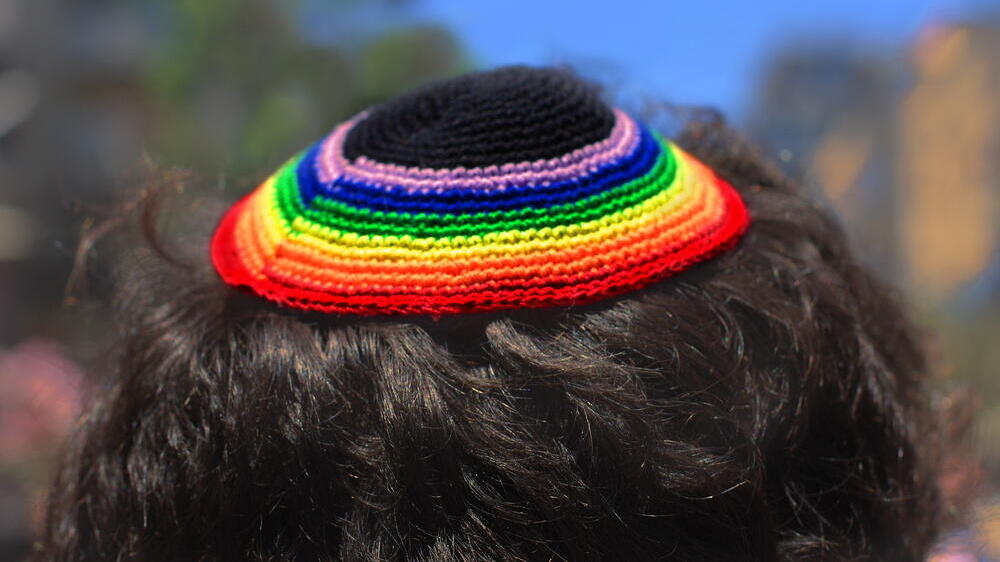
The inability to tolerate LGBTQ people is not a matter of Jewish law but a purely social one. It is age-old homophobia,'
(Photo: Konstantnin / Shutterstock)
When Avinoam attended Yeshivat Machanaim, a liberal religious Zionist hesder yeshiva at Kibbutz Migdal Oz in the Gush Etzion region, he finally felt that he belonged. Rabbi Shlomo Wilk, who headed the yeshiva at the time, published an article in the newspaper Makor Rishon in 2016 criticizing negative attitudes toward LGBTQ people in religious society.
"Halachic authorities have already accepted people who violate Shabbat and eat pork, and they are inclusive and tolerant toward them, call them up to the Torah and accept synagogue membership dues from them. This shows that the inability to tolerate LGBTQ people is not a matter of Jewish law but a purely social one. It is age-old homophobia," he wrote.
"Rabbi Wilk posted a message to the students on the yeshiva noticeboard: 'Young men who are attracted to other men, I want you to know that I love you deeply. I find it much harder with those who decide not to observe Shabbat, because that is their choice. I know you didn't choose this,'" Walker recalls. "My son sent me a photograph of it, and we were both incredibly moved. I actually cried. There was a feeling that we were no longer completely alone, that someone was helping us rather than only making things more difficult."
Was everything easier when your other sons came out?
"Not necessarily. Because you still understand that their lives are going to be less easy, more challenging. Everything is much more complicated. It's something you have to deal with, but you accept it with love."
A secret revealed during a vow of silence
The next son to come out to his parents was Tzefania, the youngest.
"A friend of Avinoam's was seriously injured in a tank accident, and the women in our community organized a ta'anit dibbur, a fast from speaking, for his recovery. We only prayed and recited Psalms. We didn't speak beyond that, out of the belief that working on our character and improving the way we speak could bring about something good. It's not an easy challenge," Walker recalls.
"I started reciting Psalms, and my youngest son came over and said, 'Mom, now that you're not allowed to talk, I have something to tell you.' Anyone who knows him knows that's exactly the sort of thing he would do, with that sense of humor. Of course, I couldn't keep silent at that moment. I immediately asked him, 'But are you also attracted to girls? Is there a chance you might discover that you can be?' He answered, 'I don't know.' This was a boy who had been a youth counselor in Bnei Akiva, the kind of boy all the girls adored."
One day, Tzefania invited his parents to a special event led by Rabbi Binyamin Lau at the Ramban Synagogue in Jerusalem.
"It was two days before Sukkot. We traveled all the way to Jerusalem and sat there. We saw lots of rabbis and people who looked just like our friends," Walker recalls. "Within a few minutes, we realized that everyone there was actually like us, parents with an LGBTQ child. Suddenly, I realized how surprised I was that they looked just like us."
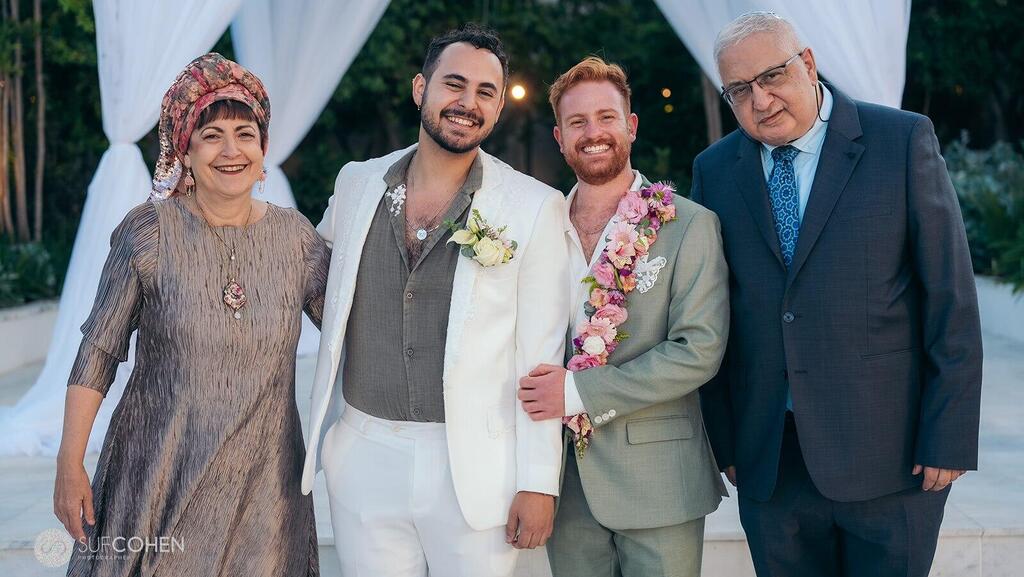
Aaron and Tzafira Walker with their son Tzefania (in white suit) and his partner Itai
(Photo: Suf Cohen)
The event was organized in cooperation with Tehila. "When I got there, I couldn't speak. I just cried all evening. But I felt I had arrived at a spiritual home. The facilitator of the parents' group in Ra'anana, Bracha, came over to me. She handed me a note with her phone number and said, 'I can see you're having a hard time. You should know there's a group.'
"Later, my husband and I attended that group's meetings, for four years. It changed our lives," she says. "When something like this happens, you blame yourself. What did I do wrong? What's wrong with our marriage? What's wrong with the way I've been a mother? Or you blame each other. There's so much self-blame, this feeling that surely we, as parents, must have done something wrong that caused it."
In conversion therapy, there are sometimes claims that sexual orientation is supposedly connected to relationships with one's parents or to the relationship between the parents themselves.
"Yes. When we sought help, one of the places we ended up was parental counseling with a moderately Haredi therapist. He presented us with a theory that we later realized belonged to the world of conversion therapy. According to this theory, attraction to men develops because the mother is dominant and the father is more passive. He explained to us how to change the family dynamics.
"You know, parents tell me, 'If something can help my child, I'll do anything! I'll even fly to the moon and back, anything that could help him.' We said the same thing. We would do anything.
"For an entire year, we traveled to a very distant place for these sessions. He asked me to distance myself a little from our son and for my husband to become closer to him, all kinds of attempts to engineer the family relationships. We went along with it to give it a chance. Every few months, we checked whether anything was changing, and we saw that nothing was changing.
"It took us time to study the issue in depth and understand that these were theories that had never been proven. They're very convenient to use when someone doesn't want to acknowledge the reality because it contradicts their understanding of the Torah, so they look for ways to prove that it's actually a choice.
"As I understand it, this way of thinking is really an attempt to cover up the fact that people have major questions of faith, so they turn to these explanations. I learned from Rabbi Yehuda Amital that it's better to live with big questions than to offer unsatisfactory answers.
"I still haven't heard of anyone these treatments have helped. In our case, we got through it relatively easily, until we realized we were a pair of fools for believing it. We told ourselves: Come on, let it go. You're wonderful parents. Accept your children, love them. This is what the Holy One, blessed be He, has given you. Accept it with love. This comes from the Creator. Forget everything else; it doesn't matter. But I've met young men who went through terrible things in conversion therapy."
What kinds of things did they tell you?
"There were cases where therapists actually drove wedges between young people and their parents because of these kinds of theories. Conversion therapy is an extremely dangerous form of manipulation. I've met young men and women who went down that path, and it brought them into very dangerous situations.

Sign of the homophobic Noam Party
(Photo: Ahmad Gharabli/ AFP)
"Young men told me that rabbis and therapists had said to them, 'Absolutely, there's a 90% chance you'll get out of this.' Then, after some time, when nothing had changed, they went back to the therapist, who told them, 'You don't want it badly enough.' When he says that, the young man realizes he's alone, because he knows how badly he wants it.
"Religious society is going through a process, thank God, and there has been progress, but the starting point was very low."
Speaking about rabbis who referred, or still refer, young people to conversion therapy, Walker says: "I believe that for most of them, it comes from ignorance. I don't believe there are that many cruel people in the world. I think that, for most, it comes from a lack of serious study and understanding. At first, I didn't know what it was either.
"I want to believe that recently, because of greater awareness, fewer institutions are directing people there. There are more rabbis who are aware of the issue, and I meet them myself. But on the other side, there are still things happening that put people's lives at risk.
"There's an enormous difference between professionally exploring one's sexual orientation and where it falls on the spectrum, without judgment, and conversion therapy. It's important to know that there is very troubling data about the damage these treatments cause: harm to self-esteem, worsening distress and an increased risk of depression and suicide.
"Our Torah says, 'Choose life.' It cannot be that because of Judaism, young people come to hate themselves and reach a point of depression and suicidal thoughts, or make female partners miserable."
Choosing to be a happy mother
The third son to come out was Ben-Nun, who received his unusual name in honor of his late grandfather, Yehoshua.
"With him, it was even more surprising, because it wasn't long after Tzefania, our youngest, had come out," Walker recalls. "He had been dating a young woman for an entire year, and you could see that they were very compatible intellectually, in terms of appearance and in their interests. But I can't tell you that we didn't feel something was missing.
"We sensed something, but sometimes there are things you don't want to see, and we made a real effort not to see it, because we had planned an easier, more conventional life for him. There was even a stage when he said to me, 'Mom, I think we're going to go ahead with it.'
"I asked him, 'Are you really in love with her?' I was looking for the butterflies in his stomach. I know what people look like when they're in love. He gave me a strange answer: 'This is the most I can feel, so I think I'll get married.'
"In the end, through divine providence, the relationship fell apart. It could have been much worse. When they started dating, he thought he was bisexual and told her that, but they eventually saw that it simply wasn't working."
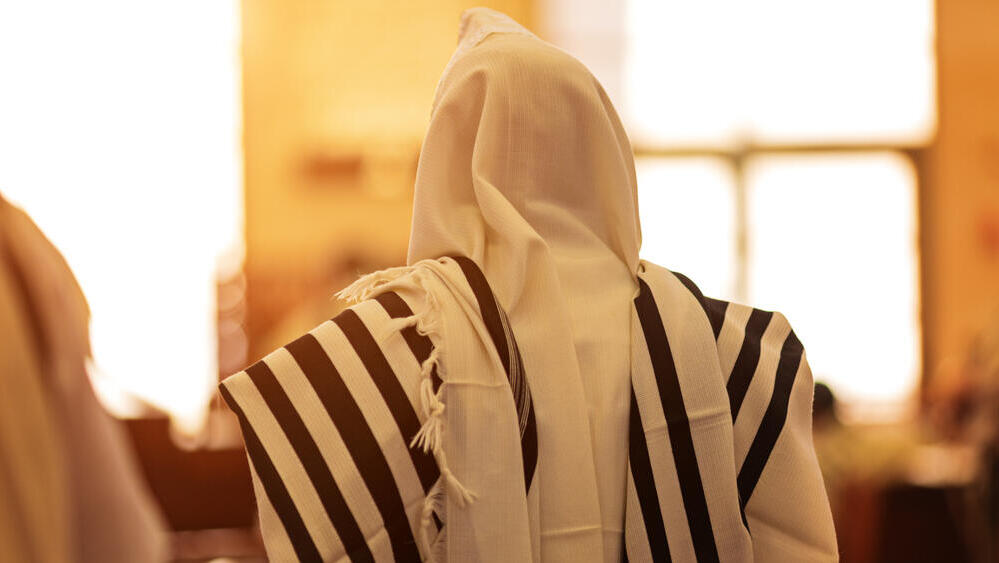
'It's terribly difficult to go to a synagogue that doesn't accept you as you are'
(Photo: Evgeniy Pavlovski / Shutterstock)
Ben-Nun's coming out was also accompanied by fears on his parents' part. "He's wonderful with children, and it was clear that he would be an amazing father. But with the understanding I had at the time, I simply couldn't imagine what his future might look like," Walker says.
"One day, his eldest sister, Drora, who's the kind of child who educates her parents, called me. She said: 'Mom, listen. Ben-Nun was at my house and told me he doesn't see a future for his life. I know you, and I know that you don't see a future for him either. And it's very, very dangerous for a child when his mother can't see a future for him.'
"When she said that, I was horrified. I felt chills throughout my entire body. I felt that I was undergoing a real transformation.
"At that moment, I decided: I don't care whether it makes sense or doesn't make sense, whether it's what I was once taught, whether it's something I've known or not. This young man is going to have a future, and it's going to be a good future."
Ben-Nun's wedding to his partner, Aviel, four years ago was featured in an episode of the Kan Digital web series "Aron HaKodesh" ("The Holy Closet"). Since then, Tzefania has also married his partner, Itai.
"There are so many moments of pride and joy with these children. We're happy with them and happy because of who they are," their mother says. "There's a certain humility before the Holy One, blessed be He: This is what You have given me. You trust me to know how to handle it, and I'm going to be a happy mother."
When your sons got married, were there people who were invited but didn't attend the ceremonies?
"We didn't really take chances. We invited only those who were completely with us, 100%, because you don't want to keep taking one blow after another.
"I have a brother who is very observant, and emotionally, he and his wife are completely with us. But the ceremony itself is difficult for them. So they found a way to come at the beginning, dress festively, hug the couple and bring a generous gift. They didn't even mind being photographed with us, but they weren't there for the ceremony itself.
"I think that's beautiful, when a person expands the boundaries of what they're capable of because they understand that there's a human being involved. This is someone's life. It's not just politics."
Where do your children stand in relation to religion today?
"You could say they're on a spectrum of religious observance. Recently, Avinoam decided to stop wearing a kippah, and that is also connected to his relationship with religious society. But he would definitely describe himself as traditional-religious.
"The other two, Ben-Nun and Tzefania, are religious in their own way. They've found synagogues they can attend and truly feel at home, rather than feeling like fourth-class citizens. It's terribly difficult to go to a synagogue that doesn't accept you as you are."
There are various prejudices about LGBTQ people, including the idea that being gay is somehow 'contagious.' Was there a point when you began to wonder whether one brother had influenced another?
"Science itself is still investigating the subject. We don't necessarily know exactly what determines sexual orientation, and there are various theories. But it's clear that hereditary factors are involved, and it's clear that it isn't contagious. This is something very deep and internal, something that comes from within the person."
Alongside the growing acceptance and inclusion in liberal religious circles and the mainstream religious Zionist community, there is also an opposing trend in parts of religious Zionism, particularly among the more conservative, Haredi-nationalist public. Some voices seem to feel a need to become defensive, and that defensiveness often turns aggressive.
"That's true. I can say that our community, Moreshet, is fairly conservative, and it includes all kinds of people, some more moderate and some less so. On a human level, I see that even people connected to the Noam party have never done anything hurtful toward us.
"On the other hand, I think a thousand times before sharing news of a wedding or a birth in a group of friends. There are people who might experience it as though we're deliberately rubbing it in their faces. But for us, it's simply living our lives."
People who are uncomfortable with the LGBTQ community often say they don't oppose the people themselves, but rather progressive ideology.
"As for that argument that it's all about 'progressivism, progressivism,' there really is extreme progressivism in the world, and there really are people who have lost their way. But when we're talking about LGBTQ young people in religious society, you'll hardly ever find someone who wanted this.
"A religious gay man understands that he's been handed a difficult challenge, something he has to deal with. It's the furthest thing from progressivism. It's simply being a human being.
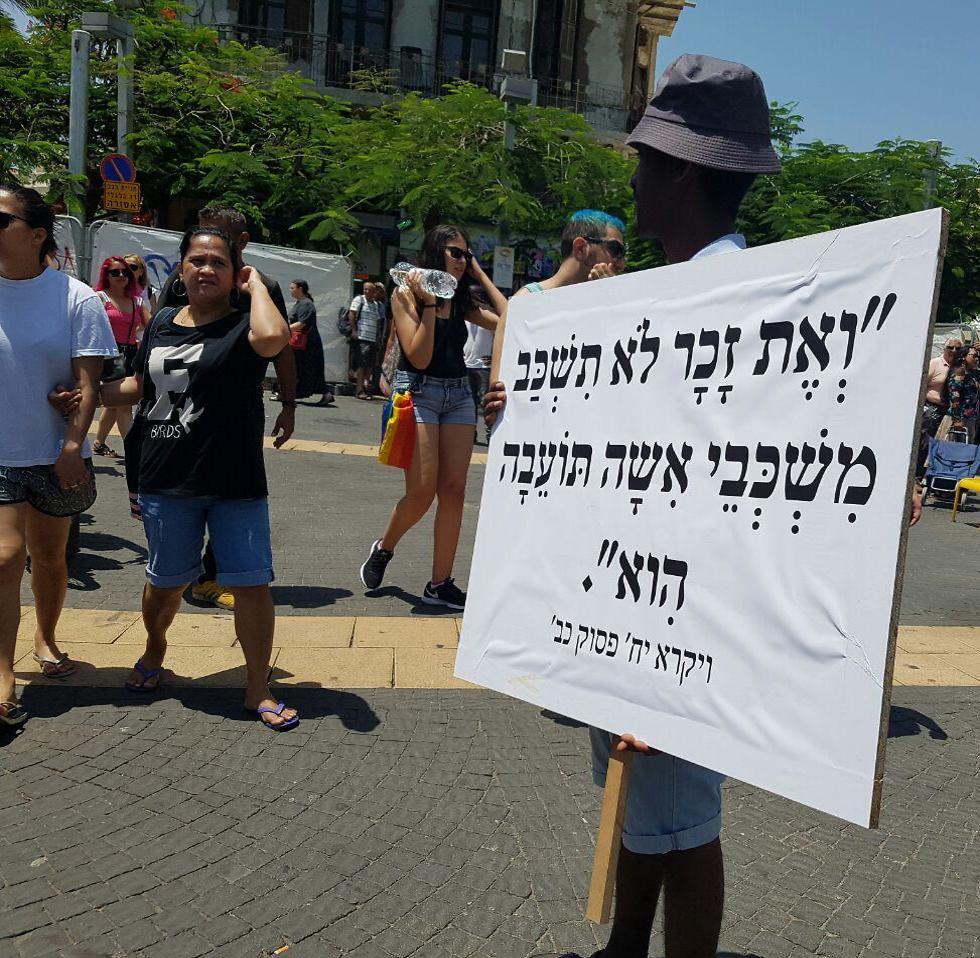
Protester against Pride parade in Jerusalem
(Photo: Merav Kristal)
"There's a blind spot in religious society, a real blind spot. One of the ways even good people can cause harm is through passive-aggressive behavior. They don't say anything insulting, but on the other hand, they ignore it, as if it's something shameful, something that mustn't be discussed. That hurts terribly, both our children and us.
"How many people can live as celibates or spend their lives alone? Very few. So what other option do LGBTQ people have? Live on the streets? Live with people who don't know who they really are?"
The opposite of progressivism
Walker finds the conservative campaign against LGBTQ people in the name of "family values" particularly misguided in the Israeli context.
"Children from religious families grow up with the value of family. For them, family life is the way to find happiness. They grew up in large families, and they're the very opposite of progressivism," she emphasizes.
"People talk about 'family values.' I also know completely secular LGBTQ people for whom the most important thing in the world is to have children, all the more so for children from religious families. Think about how much money they invest in it, how much time, how many years it takes until they achieve it. They don't give up, and that only shows how much they want a family."
What is your message to religious parents who have LGBTQ children?
"First of all, we trust that the Holy One, blessed be He, does not make mistakes. If He gives us a challenge, we need to meet that challenge in the best possible way.
"The most important thing I want to tell parents is that there's absolutely no reason for you to go through this alone. It causes so much pain and suffering. Just meeting other parents who know exactly what you're going through and understand you makes a difference.
"Everyone makes their own choices, and we have an enormous range of approaches among us: what parents do with the situation, how far they're willing to open up and where they set boundaries. It's important to us in these groups to allow people to find their own way."
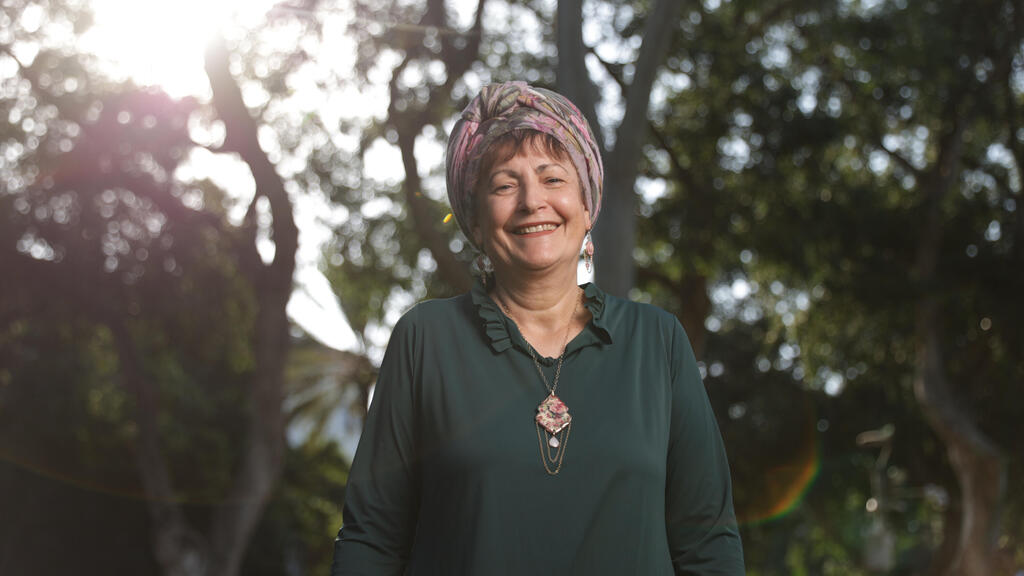
' When a person lets go of the struggle instead of fighting against the reality, they can find happiness and joy in life'
(Photo: Orel Cohen)
According to Walker, at the parent support group meetings she facilitates, "you're also allowed to cry and talk about what hurts. After people cry and bring those painful feelings to the surface, the laughter and relief come too. When a person lets go of the struggle instead of fighting against the reality, they can find happiness and joy in life."
The support and discussion groups for parents of LGBTQ people from religious backgrounds, organized in partnership with Tehila, are just one part of Havruta's activities. The groups are intended to provide a space for coping, discussion, information and guidance as parents navigate their children's coming out and their lives as members of both the LGBTQ and religious communities.
Havruta, which works to promote a more inclusive and accepting religious society, has a community of more than 2,500 LGBTQ people from religious, Haredi and traditional backgrounds, including those who have become religious and those who have left religious life. Alongside its community activities, the organization's assistance and support services respond to more than 800 inquiries each year.
"We don't lose a single child. Love is unconditional," Walker says, summing up the principle that guides her. "We find a way to keep our children and our families together. Everyone has different relatives, different siblings and different parents. There's no magic formula here.
"But the sense of fellowship, the very ability to share and think things through together, helps people become the best version of themselves in this situation and preserve their family relationships, their children, and also their beliefs and their moral backbone.
"Yes, we live with conflict. But within that conflict, we find a way to choose life."