

The first day of Sukkot 5787, which falls on the 15th of Tishrei, begins this year on Friday evening, September 25, 2026, with the onset of Shabbat, and ends on Saturday night, September 26. The first day of Sukkot is Yom Tov, during which Jewish law prohibits melacha, or categories of work forbidden on festivals.
In Israel, Chol Hamoed Sukkot begins afterward and continues through the end of Hoshana Rabbah on October 2. Sukkot is then followed by Shemini Atzeret and Simchat Torah, which are celebrated in Israel on the same day, the 22nd of Tishrei, from October 2 to 3.

Holiday times: First day of Sukkot
Sukkot and Shabbat begin on September 25: Jerusalem 5:56 p.m.; Tel Aviv 6:13 p.m.; Haifa 6:05 p.m.; Be'er Sheva 6:14 p.m.; Petah Tikva 5:53 p.m.; Modi'in 6:13 p.m.; Netanya 6:12 p.m.; Ashdod 6:12 p.m.; Ashkelon 6:04 p.m.; Safed 6:06 p.m.; Tiberias 6:03 p.m.; Eilat 6:03 p.m.; Kiryat Shmona 6:00 p.m.
Sukkot and Shabbat end on September 26: Jerusalem 7:07 p.m.; Tel Aviv 7:09 p.m.; Haifa 7:09 p.m.; Be'er Sheva 7:09 p.m.; Petah Tikva 7:09 p.m.; Modi'in 7:08 p.m.; Netanya 7:09 p.m.; Ashdod 7:10 p.m.; Ashkelon 7:10 p.m.; Safed 7:07 p.m.; Tiberias 7:06 p.m.; Eilat 7:08 p.m.; Kiryat Shmona 7:06 p.m.
The first day of Sukkot falls on Shabbat
This year, the first day of Sukkot falls on Shabbat. Therefore, the four species are not taken on the first day of the holiday, but only on the remaining days.
As a result, the mitzvah of taking the four species this year is rabbinic rather than biblical, and some rules may therefore be treated more leniently than they would be on a first day that does not fall on Shabbat.
The Mishnah in tractate Sukkah states: “Originally, the lulav was taken in the Temple for seven days and elsewhere for one day. After the destruction of the Temple, Rabban Yohanan ben Zakkai instituted that the lulav be taken elsewhere for seven days, in remembrance of the Temple.”
According to the Mishnah, the Torah obligation to take the lulav applies in the Temple throughout all seven days of Sukkot, while outside the Temple it applies biblically only on the first day.
After the destruction of the Temple, Rabban Yohanan ben Zakkai instituted that the lulav be taken all seven days everywhere as a remembrance of the Temple.
Thus, Jews take the four species on every day of Sukkot, but only the first day carries a biblical obligation. On the remaining days, the obligation is rabbinic.
The Talmud explains that although the Torah requires the four species even when the first day falls on Shabbat, the sages prohibited doing so because a person might carry them four cubits in the public domain. Rava explained the concern as a decree lest someone take the species in hand and carry them to an expert in order to learn how to perform the mitzvah.
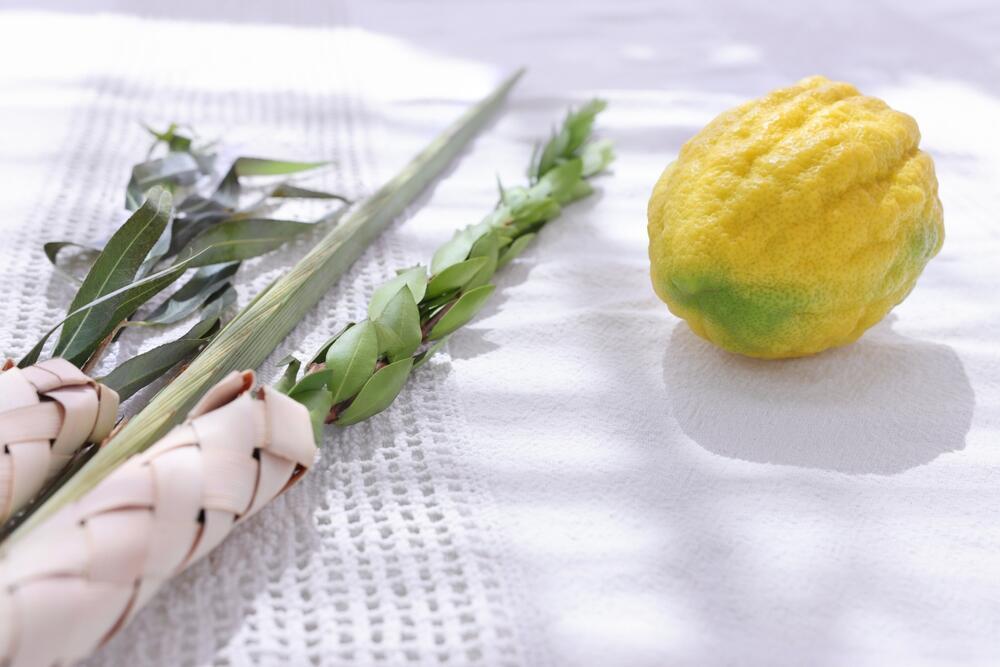
The four species. This year they are taken only during Chol Hamoed
(Photo: Tomertu / Shutterstock)
The basic requirements defining each of the four species, the etrog, lulav, hadassim and aravot, apply throughout the holiday.
Other rules, however, are more lenient after the first day. On the first day, the four species must belong to the person performing the mitzvah and may not merely be borrowed, unless given as a gift on condition that they be returned. On subsequent days, borrowed species may be used.
On the first day, an etrog that is deficient, such as one with a hole, is invalid. On the remaining days, it may be valid.
Authorities disagree over other defects, including an etrog whose pitom has fallen off or one with certain blemishes, and in many such cases the species may be accepted on the later days.
The mitzvah of dwelling in the sukkah
The fundamental obligation to dwell in the sukkah is derived from the verse, “You shall dwell in sukkot for seven days; every citizen in Israel shall dwell in sukkot” (Leviticus 23:42).
The sages interpreted the word “dwell” to mean living in the sukkah as one normally lives at home.
The Sifra teaches: “‘You shall dwell’ means in the manner in which you normally reside. From here they said: one eats in the sukkah, drinks in the sukkah, spends time in the sukkah and brings one’s belongings into the sukkah.”
The sages therefore understood the sukkah as a person’s home during Sukkot. Jewish law allows people to leave the sukkah at times, but the straightforward meaning of the biblical verses and rabbinic teachings is that a person should make an effort to treat the sukkah as home, spend as much time there as possible and take full advantage of the mitzvah.
The blessing ‘leishev basukkah’
The Talmud, in tractate Sukkah, states that when a person enters the sukkah to dwell there, the blessing recited is: “Blessed are You, Lord our God, King of the universe, who sanctified us with His commandments and commanded us to dwell in the sukkah.”
Early halachic authorities disagreed about when the blessing should be said. The Shulchan Aruch, Rema and Mishnah Berurah rule that the blessing is recited specifically when eating in the sukkah. Accordingly, it should be said before eating.
What type of eating requires the blessing? A person eating bread in an amount greater than a kebeitzah, or grain-based foods in an amount considered a fixed meal, certainly recites the blessing because those foods require a sukkah by strict law.
According to the Mishnah Berurah, the widespread custom is also to recite the blessing over a kebeitzah of mezonot, about 56 cubic centimeters. To avoid any concern over a blessing recited in vain, it recommends remaining in the sukkah for a short time afterward and intending that the blessing apply both to the eating and to the stay in the sukkah.
A person who recited “leishev basukkah,” ate and then remained in the sukkah until the next meal does not recite the blessing again. Likewise, someone who leaves briefly with the intention of returning immediately and does so need not repeat it.
However, someone who leaves to attend to business, go to synagogue or run other errands should recite “leishev basukkah” again upon returning and eating in the sukkah.
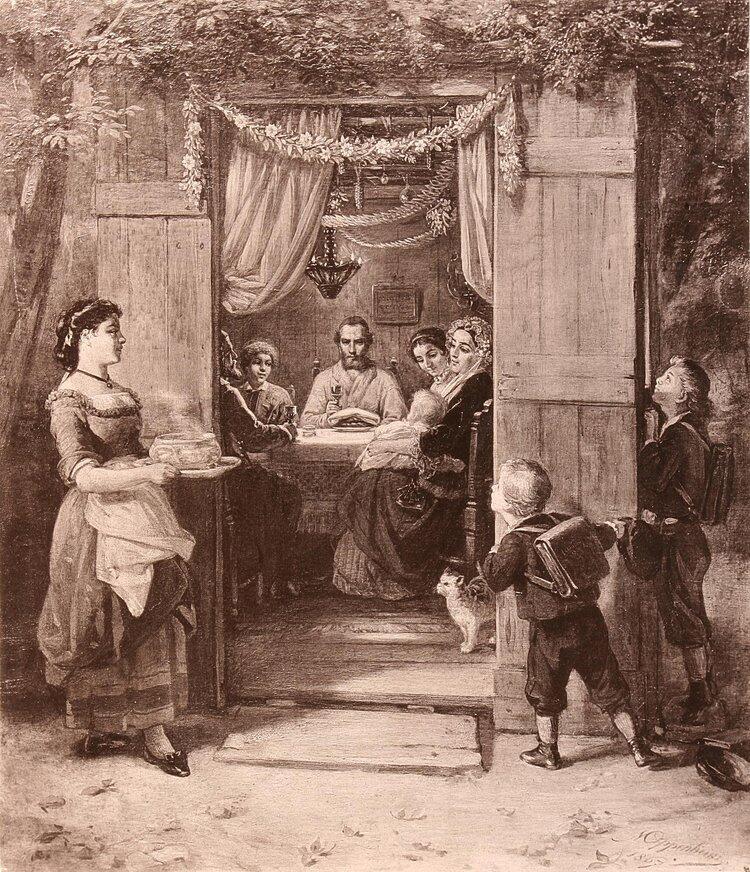
Sukkot, an 1867 painting by Moritz Daniel Oppenheim
Eating in the sukkah
The Mishnah states that casual eating and drinking are permitted outside the sukkah. The basic rules are:
- Bread or grain-based foods, including dishes such as pasta or ptitim, in an amount greater than a kebeitzah, about 56 cubic centimeters or roughly the volume of two matchboxes, must be eaten in the sukkah according to Jewish law.
- Meat, fish and similar foods may be eaten casually outside the sukkah, although it is proper to be stringent and not eat them as part of a regular meal, such as lunch, outside the sukkah.
- Fruits and vegetables may be eaten outside the sukkah even in large quantities.
- Drinks may be consumed outside the sukkah in any quantity, though one should be stringent about not drinking wine as part of a fixed drinking session outside the sukkah.
These rules define the halachic boundary between fixed and casual eating. A person who wishes to be stringent and consume even casual food inside the sukkah is praiseworthy and is not considered ostentatious. At the same time, someone who does not follow this stringency is not considered lax in observance.
That stringency can also apply to drinking water, though there is room to be stringent regarding other foods and drinks while remaining lenient about water.
Sleeping in the sukkah
The Talmud states that one may not sleep outside the sukkah. Casual eating is permitted outside it, but even a brief nap is prohibited.
The Talmud explains that “there is no fixed measure for sleep.” Rashi explains that a person may sometimes doze briefly and find that sufficient. In this sense, even temporary sleep is considered more significant than casual eating and is therefore prohibited outside the sukkah.
 Rabbi Yosef Zvi Rimon Photo: Yehoshua Halevi
Over the generations, however, many people have been lenient about sleeping in the sukkah. That requires explanation because the Talmud treats sleep more strictly than casual eating. Early and later halachic authorities offered various justifications for those who are lenient.
The Mordechai wrote that people fear the cold in the sukkah and are therefore considered ill or distressed, categories that can exempt a person from the mitzvah. This ruling was cited by the Rema.
The Shulchan Aruch Harav wrote that the exemption applies only when the discomfort and difficulty are such that a person would also avoid sleeping in his own home under similar conditions.
The Rema offered another defense of those who are lenient. In his view, the mitzvah is for a man to sleep with his wife as he would at home. Since his wife generally cannot sleep in the sukkah, the husband may also be exempt.
These arguments are essentially defenses of lenient practice. In the Diaspora, many have traditionally avoided sleeping in the sukkah because of weather conditions. In Israel, however, one should make an effort to have a sukkah suitable and comfortable for sleeping and to sleep there as much as possible.
Rabbi Yosef Zvi Rimon is rabbi of the Gush Etzion Regional Council, rabbi of the Jerusalem College of Technology and chairman of the Sulamot organization