


“Since coming to this land, I have been shaped above all by the Bible, which only here, in the land itself, I began to understand in its full depth. It influenced me more than any other book or literature, Jewish or non-Jewish alike.” Those words were spoken by David Ben-Gurion, Israel’s first prime minister and the author of the book ‘Reflections on the Bible,’ which has been reprinted in recent days by the Ben-Gurion Heritage Institute.
“Ben-Gurion saw the Bible, on the one hand, as our mandate to the land and, on the other, as our moral compass, the force that urges us to build a model society inspired by the vision of Israel’s prophets,” said Eitan Donitz, head of the institute, which by law is tasked with preserving the legacy of Israel’s first prime minister for future generations. “We felt that now, more than ever, it is right to return to these ideas and to look ahead toward a shared vision around which we can all unite.”
Gallery

David Ben-Gurion said the Bible influenced him more than any other book
(Photo: Ben-Gurion Archive)
“In recent years, we realized it had become very difficult to find his writings in print,” Donitz added. “We are republishing his books in new editions, and in the coming months we will reissue seven of them. They will also be available for free download on the institute’s website.”
Seeing himself through the Bible
The new edition of ‘Reflections on the Bible’ also includes rare texts, among them a lecture on the Exodus from Egypt that Ben-Gurion delivered to the Journalists Association on May 12, 1960. Rabbi Dr. Benny Lau, founder of the ‘929: Bible Together’ initiative, notes that just one day earlier, on May 11, 1960, Nazi war criminal Adolf Eichmann was abducted in Argentina following a direct order from Ben-Gurion, who was prime minister at the time.
Despite the immense tension and effort surrounding the covert operation, “the Old Man,” as Ben-Gurion was known, did not forgo the opportunity to bring the Bible to the public.
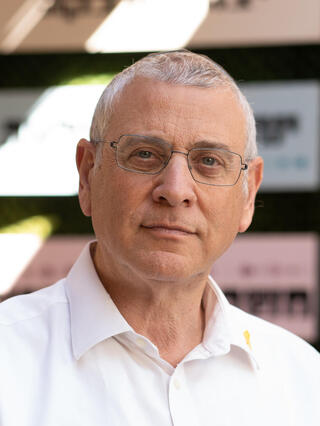 Rabbi Dr. Benny LauPhoto: Shalom Shalev
What do you think was the source of his attachment to the Bible?
“I do not think it is accurate to describe it as affection. It was a bond of the soul,” Lau said. “In 1960, he said, ‘The Bible is hard to define. I would say it is the soul of the Jewish people from its beginning until the end of all generations.’ He identified himself as a Jewish man connected at his core and in his soul, through the Bible, to the great story that constitutes a people.”
“His conception of the Jewish people as bound together by a historical journey did not pass through Jewish law. In his personal experience, he was far removed from the world of halacha and the Shulchan Aruch. For him, the root of his existence as a Jew was nourished through the Bible.”
As someone who researches and teaches the Bible, how deep was his biblical knowledge?
“He was an interpreter, and as such he debated rabbis and academic professors. He sketched the biblical figures he wrote about according to his own beliefs.”
Which biblical figure did he admire most?
“He wrote with admiration about King Uzziah, king of Judah in the eighth century BCE. The Bible describes him as someone who built the land, invested in the military, developed water projects and made the Negev flourish. Ben-Gurion read the Bible reflectively. He looked at its heroes and, through them, at himself.”
In a 1955 lecture titled ‘The Meaning of the Negev,’ delivered at Sde Boker, Ben-Gurion said, among other things, “Of all the political figures in the Bible, none is closer to the spirit of our time than Uzziah, king of Judah. He understood that he must strengthen his army, improve its training and armament, but he did not suffice with conquest by the sword. He understood that he must develop the land, expand settlement and make its wastelands bloom. Alongside military strengthening, settlement expansion and the conquest of the southern seas came a spiritual and cultural flowering unprecedented in earlier times. In the days of Uzziah arose the great literary prophets, Amos, Hosea and Isaiah, who bequeathed to the Jewish people and to all humanity the doctrine of justice, compassion and human brotherhood.”
Were there figures toward whom his attitude changed?
“In 1970, three years before his death at age 87, plans were made to celebrate his birthday at Sde Boker. He asked that the celebration be a seminar on the prophet Jeremiah. There he said, among other things, ‘There is no doubt that the greatest prophet to arise in the days of the monarchy before the destruction of Jerusalem, and also the most wretched, despised and resolute in spirit, was Jeremiah. He did not fear prison, beatings or even death itself and chose to tell his people the bitter truth to the very end. Jeremiah loved his people and also believed in their future, and that faith has endured to this very day.’”
It is important to note, Lau said, that as a young man Ben-Gurion had deep opposition to Jeremiah, whom he saw as insufficiently nationalist.

The Bible. ‘In recent centuries, it was the Talmud that served as the central Jewish text
(Photo: joshimerbin/Shutterstock)
What changed?
“In old age, as he looked back and judged him, one of the central questions Ben-Gurion asked himself was whether Jeremiah loved his people. That was the threshold condition. That is the great story in his contemporary reading of the Bible.”
‘Zionism returned to the Bible’
“Ben-Gurion’s connection to the Bible was very deep and meaningful,” said historian Dr. Gili Gofer of the Ben-Gurion Heritage Institute. “Without having asked him,” she added with a smile, “it is clear that he took pleasure in the Bible and engaged with it as one enjoys research or study.”
 Dr. Gili GoferPhoto: Camilla Butchins
“He took pleasure in the text itself, in trying to understand it, analyze it and place it in context. He said that studying the Bible gave him the strength to do other things.”
She emphasized that “for centuries, the Talmud was the central Jewish text, studied in yeshivas and relied upon for legal rulings, and that remains the case in the ultra-Orthodox world today. Zionism returned to the Bible, a text whose center is the Land of Israel and whose language is Hebrew. Ben-Gurion argued that the return to the Land of Israel was also a return to the Bible. He was not alone in this view. It characterized the Zionist movement as a whole.”
After the establishment of the state, she said, Ben-Gurion continued to argue that young people’s connection not only to the Jewish people but also to Zionism itself passed through the Bible.
Was he right?
“To a large extent, yes. The younger generation was deeply connected to the Bible, more so than to Zionist writings. The Bible predates Herzl by millennia, but it is more vital, more alive, than classical Zionist texts like those of Herzl or Ahad Ha’am.”
“Young people can connect to the drama of its stories and to the literary beauty of its language. In the 1940s, 1950s and 1960s, young Israelis connected to the Bible through hikes across the Land of Israel. To some extent, that remains true today. It is a text full of vitality, and young people can still connect to it.”
“Beyond that,” she said, “Ben-Gurion saw the Bible as a universal text. The Jewish people created it, but it has global influence. He believed that modern morality rests on the ethics of the prophets. In his view, the moral teachings of Jeremiah, Amos and Isaiah form the foundation of modern Western morality. The principles of liberty, equality and fraternity are rooted in prophetic ethics.”
Did he believe in God?
“That question is disputed among scholars,” Gofer said. “But he believed there is order in the world, perhaps even a higher power. He certainly was not an observant Jew. He did not see a contradiction. The Bible is a Jewish cultural asset, not the property of the observant alone but of the entire people.”
“And as noted,” she added, “for him, the morality of the prophets is something the Jewish people gave to the entire world.”
Is that still relevant today?
“The Jewish people have always been a small nation and have had to prove their legitimacy,” she said. “The way to do that was through striving to be as moral as possible. Ben-Gurion believed the prophets preached a morality that was far ahead of its time because that was the Jewish people’s path to survival.”
“That is also what the state needs today. To strive to be as moral as possible. That is the only thing that can grant legitimacy to the existence of the State of Israel. We know we need a state, but the world has no reason to accept it unless we have a mission, act morally and set an example for the world of how a society should conduct itself.”