

On his T-shirt is a picture of a black belt bodybuilder with a big Jewish star on his chest. His muscles are rounded and defined, and he looks every bit like the professional athlete he once was.
Perhaps because of his size and stature, Gul Pohatu, best known as the Hebrew Hammer, can walk openly as a Jew. But he admits that Australia has become dangerous for most Jewish people, and if he were not who he is, he probably would not be able to do so. He said he would be too afraid of the consequences. "I've had a few altercations with people knowing that I'm Jewish," Pohatu said.
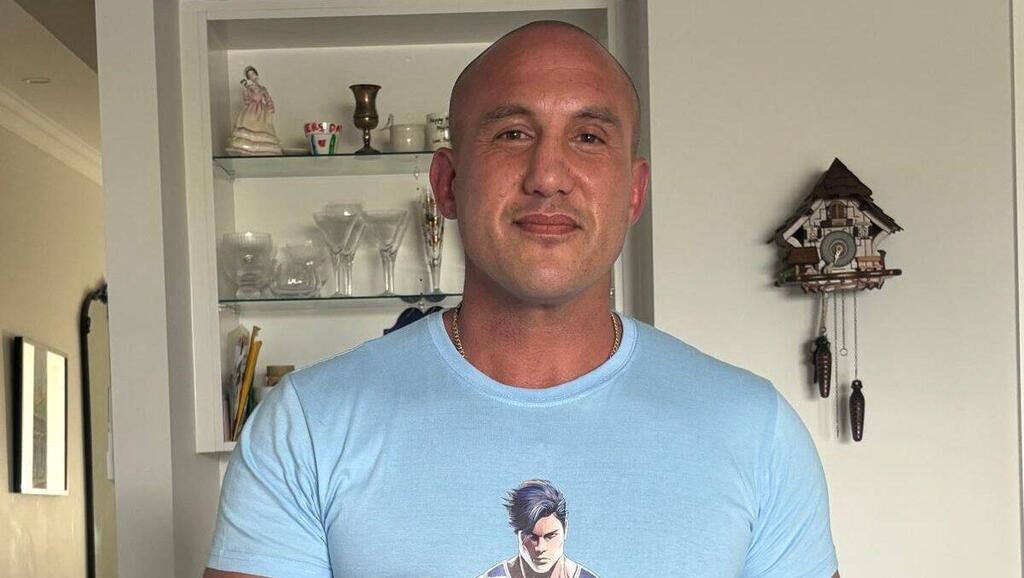
Gul Pohatu
(Photo: Maayan Hoffman/The Media Line)
Pohatu is not the only fighter known as the Hebrew Hammer, but he is the only one in Australia. He was active in the field until around 2015 and continues to train others across the country.
He was born to a Māori father and a Russian Jewish immigrant mother. Māori are the Indigenous Polynesian people of mainland New Zealand. His parents met in the 1960s, a time when intermarriage for Jews was far less common. Pohatu's mother was disowned by her family when they decided to marry, but the couple went ahead anyway.
The family moved to Israel in 1973, and Pohatu was born in 1977 in Afula. They later moved back to New Zealand in the 1980s, and he eventually moved to Australia when he was 19.
Pohatu remembers attending Hebrew school as a young boy. He learned Hebrew to celebrate his bar mitzvah at their liberal shul. Although the house was not kosher by Orthodox standards, they maintained a kosher style and never brought bacon or shellfish into their home. Pohatu's father even converted while the family was in Israel and served briefly in the Israel Defense Forces.
Pohatu revisited Israel in 2001 and spent a month volunteering on a kibbutz, which helped him reconnect to his Israeli roots. "That was an amazing experience," he recalled.
It was his coach who gave him the nickname "Hebrew Hammer," a name he had seen used for other Jewish fighters. Pohatu said he did not mind it. However, during the Second Lebanon War, he was asked not to wave an Israeli flag at mixed martial arts matches, particularly when he competed against a Palestinian. He also received credible death threats at that time and had to turn to the police.
"Someone came up to me just the other day and asked me where I am from. When I answered Israel, he just looked at me, shook his head, and walked off"
For a while, things quieted down. Then came Oct. 7. "I live in a suburb where there are a lot of Muslims," Pohatu said. "Wherever I go, if I wear this T-shirt or a Magen David Adom, I get a lot of comments and pushback. I've had a few altercations with people knowing that I am Jewish."
He recalls one time when a group of five Afghan men cornered him and threatened him, but another Muslim who respected him from the fighting world stepped in. Thanks to that intervention, Pohatu was able to walk away without a fight.
"Someone came up to me just the other day and asked me where I am from. When I answered Israel, he just looked at me, shook his head, and walked off," Pohatu said.
Pohatu is married to a non-Jewish woman, and he said he knows many fellow Jews married to non-Jews today who face similar challenges. "They just can't understand. It's very tough for them," he said.
He described his wife as supportive but said they do not talk much about antisemitism or about Israel. "Obviously, they love you as the father of their kids and stuff, but you don't feel 100% as a team," Pohatu admitted. "I would say a lot of my other Jewish friends with similar wives, around Judaism, they feel the same way. I've discussed it with them."
At the same time, Pohatu does not feel that the entire country is against Israel. He believes the majority is silent and prefers not to get involved. "The loudest voices are sort of the crazy ones," Pohatu said. "I think they make the most noise."
"I think it’s the fact they don’t know Jews, and all they see is the ones that are being demonized in the media, that has a lot to do with it"
A report published Dec. 2 by the Executive Council of Australian Jewry recorded 1,654 antisemitic incidents between October 2024 and September 2025, about three times higher than before Oct. 7.
Overall numbers are slightly down from last year's record. Still, severe attacks like arson and vandalism have risen, including the firebombing of the Adass Israel Synagogue in Melbourne and multiple attacks on Jewish businesses and synagogues in Sydney.
Pohatu said he believes social media and misinformation are driving the rise in antisemitism. "There's a lot of left-wing media in Melbourne; Australia's very left-wing," Pohatu said. "They are pushing one side of things."
He added that most Australians do not know Jews personally because the community is so small. Recent Australian census data shows more than 800,000 Muslims on the continent compared with around 100,000 Jews.
"I think it's the fact they don't know Jews, and all they see is the ones that are being demonized in the media, that has a lot to do with it," Pohatu stressed. He said he tries to be a good person and show people that he is as normal as they are.
"Most Jews don't want war," Pohatu said. "We just want to live in peace. We're not trying to take over the world. There's no ‘Greater Israel’ and all that propaganda." He believes actions speak louder than words.
Pohatu said he has considered moving to Israel because "it would be nice to walk down the street and just know that everyone's my race and I can just be who I am." Yet he does not see it as realistic, as his wife and children live in Australia. "They're not going to move with me, but it would be nice," he said.
Instead, he says he will simply keep living as he always has. That includes flexing his muscles at the gym, wearing his Magen David with pride, and letting people see exactly who he is.