

As air raid sirens sounded across Israel and reports of antisemitic incidents rose worldwide, nearly 200 Jewish leaders from around the globe gathered online for an hourlong initiative aimed at strengthening ties and building a shared future.
The event, known as “The Great Mifgash: Global Jewish Leadership Speed Date,” brought together 195 professionals, educators and community leaders from Israel, North America, Latin America and Europe earlier this month. Organized by the Tisch Center for Jewish Dialogue at ANU Museum of the Jewish People, in partnership with Global Jewry and DateNight.AI, the virtual gathering paired participants in a series of rapid one-on-one conversations.
Gallery
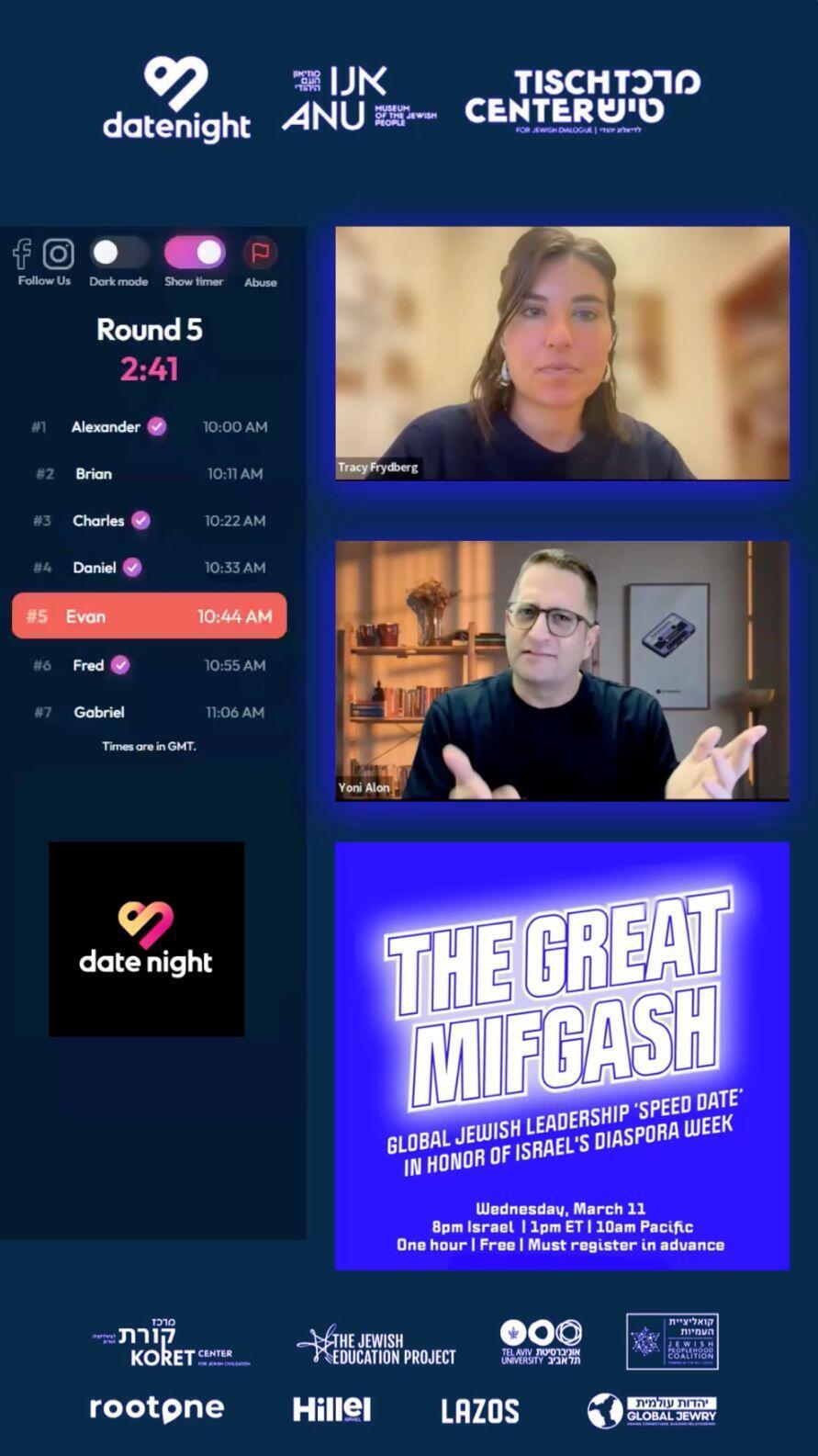
Yoni Alon, founder of David Cards and a member of the Israeli Jewish Peoplehood Coalition, with Tracy Frydberg, director of the Tisch Center for Jewish Dialogue at ANU Museum of the Jewish People
Despite disruptions caused by ongoing security alerts in Israel, participants completed 390 of 582 scheduled meetings, a 67% completion rate. Organizers said 161 of those conversations, or 41%, were identified by participants as meaningful new connections. For many participants, the event’s impact was immediate, even amid uncertainty.
The initiative was originally planned to coincide with Israel’s Diaspora Week but took on added urgency as the war with Iran intensified and antisemitism surged globally. Organizers said the event addressed a growing need for connection between Israeli and Diaspora communities that are often physically and culturally divided.
“The reality of recent years — war in Israel alongside growing antisemitism around the world — reminds us that the Jewish people share a common destiny,” said Oded Revivi, CEO of ANU Museum of the Jewish People. “Strengthening the relationship between Israel and Jewish communities in the Diaspora is not only a value, it is essential for the future of the Jewish people.”
Tracy Frydberg, director of the musuem's Tisch Center, said the initiative reflects a broader effort to shape postwar Jewish life. “The ‘day after’ demands a new vision, which we have the opportunity to make global and shared,” she said.
The event also served as a pilot for a potential long-term international coalition, connecting ANU’s Israeli Jewish Peoplehood Coalition — a network of about 700 Israelis focused on strengthening Jewish identity in civic life — with global Jewish leadership.
Survey data from 136 respondents indicated strong engagement. Eighty-two percent said the event was a valuable use of their time, while 80% reported gaining personal or professional value from conversations. Eighty-two percent said the gathering was relevant to the current moment in Jewish life, and 77% said they intended to follow up with at least one match. Notably, 85% expressed interest in joining a permanent global coalition.

ANU Museum of the Jewish People
(Photo: Roni Cnaani)
Participants reflected a wide cross-section of the Jewish world. Forty-five percent were based in Israel and 36% in North America, with the remainder from Latin America, Europe and other regions. The group included educators, nonprofit leaders, managers, advocates and students, and represented a range of religious identities from secular to Orthodox.
The conversations were facilitated by DateNight.AI, a platform typically used for social matchmaking. Founder and CEO Ian Mark said the technology proved adaptable to a leadership context, pairing participants across geographic and ideological lines.
“Until now we’ve exclusively hosted dating events, but we couldn’t resist this opportunity to connect Jewish leaders across the globe,” Mark said.
Participants received contact information after the event to continue discussions. Organizers reported a Net Promoter Score of 32, indicating strong satisfaction and interest in future programming.
Sandy Cardin, founder of Global Jewry, said the initiative represents a broader strategy for addressing challenges facing Jewish communities.
“We believe this is the best way to respond to the Jewish people’s internal and external challenges and to bring about a better future,” he said.
Organizers said feedback pointed to plans for expanding future sessions, including longer conversation times and broader outreach. Additional partner organizations included Hillel Israel, the Zionist Rabbinic Coalition, LAZOS, RootOne, The Jewish Education Project, the Koret Center for Jewish Civilization, ConnectEd and Jewish National Fund-USA.
First published: 19:27, 03.19.26