

When employees of the Culture Department at the Jerusalem Municipality head down to the protected space during sirens, they step into a kind of time tunnel that leads them into a historic vault inside the city’s iconic municipal building at Safra Square.
The structure, inaugurated during the British Mandate in 1934 as Jerusalem’s City Hall, was designed by architect Clifford Holliday in the International Style with Art Deco elements. It was built in partnership with the British Barclays Bank, which financed the construction in exchange for leasing the ground floor as its central branch for about 30 years. As part of the arrangement, large fortified vaults were constructed on the ground floor for the bank’s use.
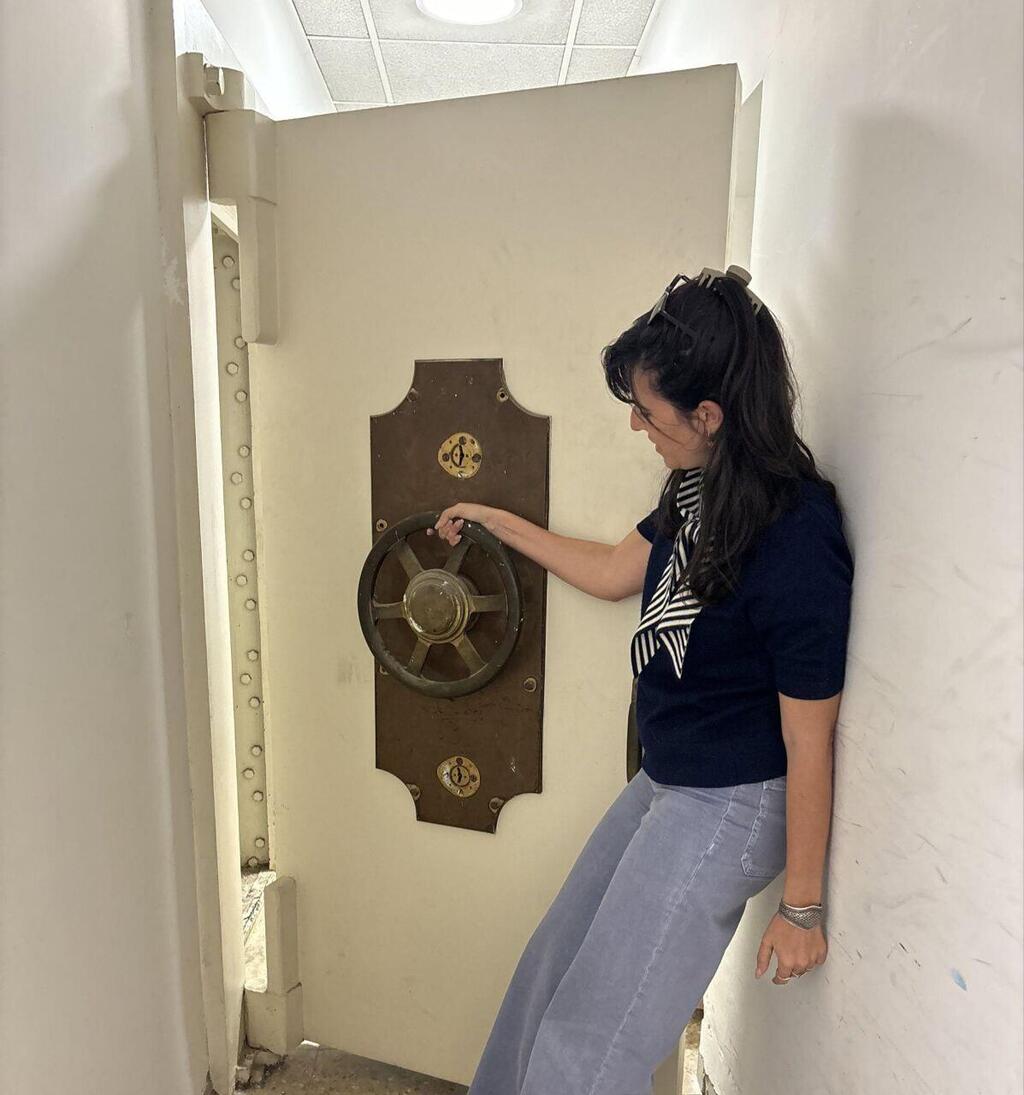
The story becomes even more intriguing in 1936, when Ethiopian Emperor Haile Selassie arrived in Jerusalem as a political exile following the Italian invasion of Ethiopia. He came with his family and considerable property that reportedly included 117 chests filled with gold.
While the emperor initially stayed at the King David Hotel and later lived with his family at Villa Leah in Jerusalem’s Rehavia neighborhood, the vast treasure was entrusted for safekeeping in the Barclays Bank vaults inside the municipal building. The gold remained there securely, and the massive door with its classic locking wheel, a clear relic of the Mandate era, still survives today.
“The bank was essentially the sponsor of the construction in exchange for the space it received for its use for 30 years,” explained architect Sharon Dinur, who is responsible for preservation at the Jerusalem Municipality.
The complex was renovated in the 1990s as part of the development of Safra Square. Today, the historic building houses several municipal departments, including the Culture Department. It also contains the old City Council hall, decorated with stained glass windows, as well as the rounded balcony, shaped like a ship’s bow, overlooking the walls of the Old City.
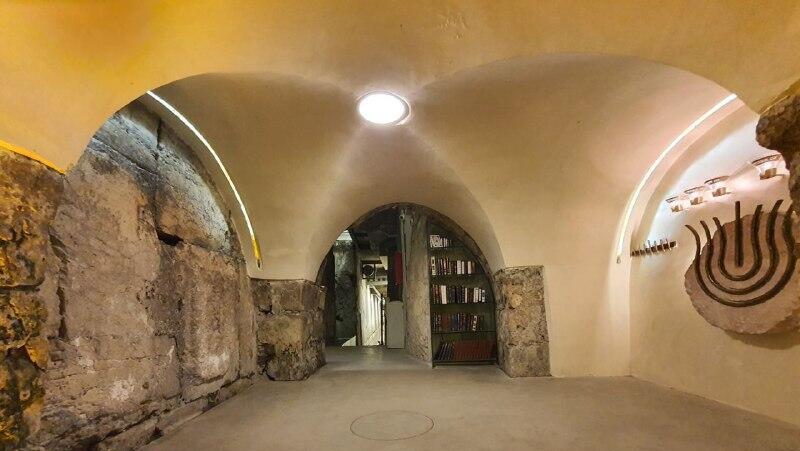
The ancient cave near the Western Wall
(Photo: Western Wall Heritage Foundation)
Jerusalem, often described as a city bound together through layers of history, contains many such fragments of the past. One lies beside the Western Wall prayer plaza, where an entrance leads into an ancient cave that forms a hidden continuation of the prayer area. Prayers and Torah study are held there as well.
Because the cave is ancient and built of massive, heavy stones, with layers of structures above it, many consider it relatively protected during emergencies. During the most recent war, worshippers who ventured deeper into the cave discovered that behind a wall at the far end of the known area lies a unique synagogue called Shaarei Teshuva.
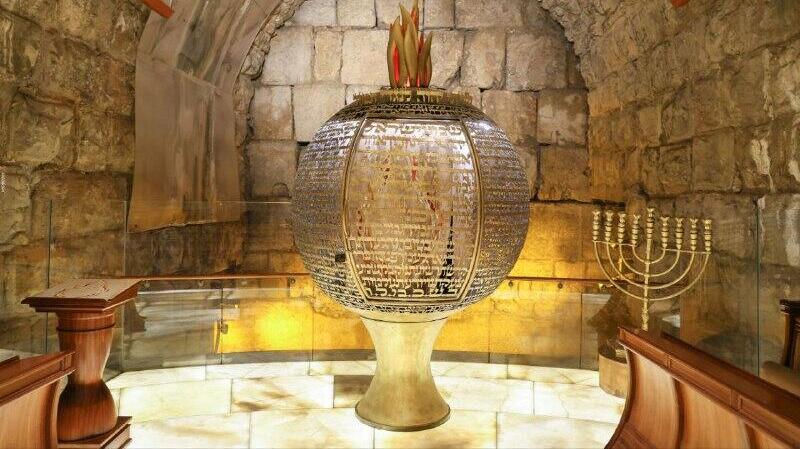
Items inside the ancient cave
(Photo: Western Wall Heritage Foundation)
The synagogue, carefully furnished and maintained, was built at the closest possible point to the site of the Holy of Holies. As such, it is considered one of the physically closest locations to the holiest place of the ancient Temple.
However, Israel’s Home Front Command has instructed the public to enter standard protected spaces during sirens and not rely on the cave. Still, early in the war, some worshippers who entered it discovered the synagogue by surprise. It is not usually open to the general public and is typically reserved for special tours.
Even without historic sites, Jerusalem has no shortage of unusual shelter stories.
In a small shelter on Rabbi Hisda Street in the Katamonim neighborhood, residents have found an unexpected use for their protected space: a neighborhood boxing club. Ironically, converting the shelter into a boxing gym helped keep it active and well maintained.
During normal times, young people from the area train there. When sirens sound, residents of the building and nearby neighbors head down into the same space.
The stairs leading to the shelter are decorated with photographs of legendary boxers such as Muhammad Ali alongside pictures of local fighters from the club who have won medals and achievements over the years. At the center of the room stands a professional boxing ring, giving the shelter the appearance of a small sports hall.
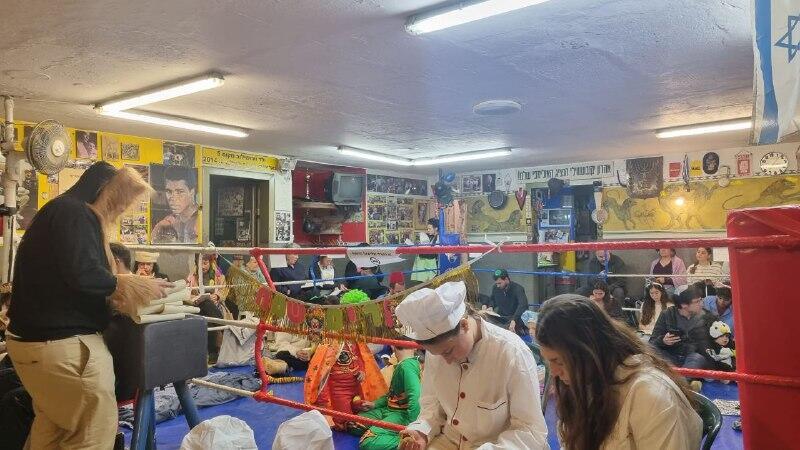
Shelter inside a neighborhood boxing club
(Photo: Gilad Cohen)
Above the entrance flies an Israeli flag, a reminder that even in the shadow of war, life and community continue to pulse beneath the ground. One particularly memorable moment took place last week during the reading of the Book of Esther on Purim, when residents sat on boxing mats and listened to the story of Mordechai and Esther in ancient Persia.
For residents of Kleinman Street in the Kiryat Yovel neighborhood, descending into their shelter means stepping backstage at the Meshu-Meshu Theater, which operates in the protected space during normal times.
The theater was founded in 2009 by Mirit Yanai and Yael Gidoni, both graduates of the directing program at Kibbutzim College. Their goal was to establish a group of artists who would work together over time and remain rooted in a local community.
Later that year, the group was invited by the “New Spirit” nonprofit organization to work in the Kiryat Yovel neighborhood in western Jerusalem.
During the early years, members of the group moved from central Israel to Jerusalem, and additional artists joined from the city’s higher arts institutions, including Nissan Nativ Acting Studio, the Hebrew University and the Bezalel Academy of Arts and Design.
These days, when residents enter the theater space during sirens, the show quite literally goes on. Actors continue staging performances that offer children a brief theatrical break from the tension outside.
“The community is thirsty for culture,” Gidoni said. “It eases the heaviness, connects people, lifts their spirits and brings joy.”
Jerusalem Mayor Moshe Lion said the city’s bomb shelters reflect its unique character, serving not only as places of safety but also as spaces where the story of Jerusalem continues to be told. “The bomb shelters in Jerusalem tell the story of the city — one that creates culture and tells its unique story both in routine times and in emergencies,” he said, adding that he was proud of residents for their solidarity, care for neighbors and “optimism that has no equal in the world.”
First published: 07:22, 03.09.26