


The divisions that have emerged between parts of the Jewish and Black communities in the United States since the October 7 Hamas attack on Israel make it easy to forget that the two minorities not only share histories of discrimination but were once close allies in the struggle for civil rights. In 1964, Jewish activists Michael "Mickey" Schwerner and Andrew Goodman were murdered in Mississippi while fighting racial segregation, alongside Black civil rights worker James Chaney. Martin Luther King Jr. and Rosa Parks repeatedly spoke out against antisemitism and expressed support for Israel.
Against this historical backdrop, it is perhaps not surprising that Ashley Jackson, daughter of the Rev. Jesse Jackson, one of the most prominent figures in the American civil rights movement, found her way to Judaism and completed a formal conversion. Her father supported the establishment of a Palestinian state, met with Yasser Arafat on several occasions, called former Israeli Prime Minister Menachem Begin a "terrorist" and faced accusations of antisemitism.
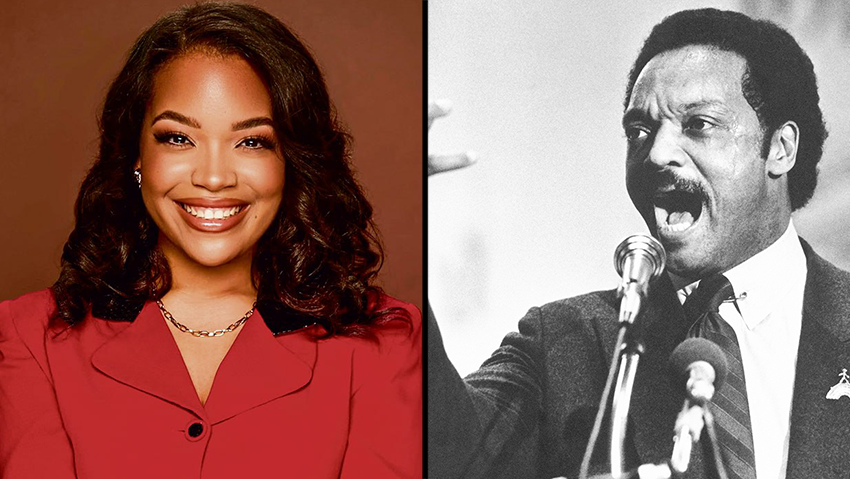
"Two years before he died, my father came to my synagogue," Ashley Jackson, a writer, actress, producer and founder of PUSH The Next Generation, wrote in an essay published in The Washington Post. "For many members of my congregation, that was the day they discovered my father was Jesse Jackson, a towering figure in the civil rights movement, an African American Baptist minister and one of the architects of multiracial coalition politics. To me, he was simply Dad. My father sat in the front row, holding my hand, dancing to prayers in a language he did not speak and eating the candy thrown during a bar mitzvah celebration at the synagogue."
Jackson, who has adopted the Hebrew name Miriam Yiskah, wrote: "I was raised to believe that faith must lead to action. In Judaism, I found a lasting expression of that belief. Ancient rituals and rigorous study of sacred texts went hand in hand with the call to 'tikkun olam,' repairing the world. During my first Rosh Hashanah, the sound of the shofar touched a part of my soul I had never reached before, and tears streamed down my face. Being both Black and Jewish means carrying a dual inheritance filled with sorrow and wonder."
The elder Jackson died in February at the age of 84, leaving behind an extraordinary legacy that included two unexpectedly successful presidential campaigns in the 1980s, driven by his ability to bring together a diverse coalition of voters. "The bond between African Americans and Jewish Americans was forged in the struggle for civil rights," his daughter wrote. "That shared history is now under attack. In some communities, speaking out against antisemitism is seen as diverting attention from the fight against anti-Black racism. In others, confronting anti-Black racism is perceived as a threat to Jewish identity and belonging. About 1% of American Jews identify as Black. Their experience, and my own, show that this alienation can be overcome. I feel that bridging this divide has now become my mission."
A complicated relationship with Israel
Over the years, Jesse Jackson became involved in international affairs, including the Israeli-Palestinian conflict. He supported the establishment of a Palestinian state and met with Yasser Arafat on several occasions. In 1979, during a visit to the Middle East, he referred to then-Israeli Prime Minister Menachem Begin as a "terrorist." In 2024, Jackson attended a Chicago City Council meeting and called for a ceasefire between Israel and Hamas.
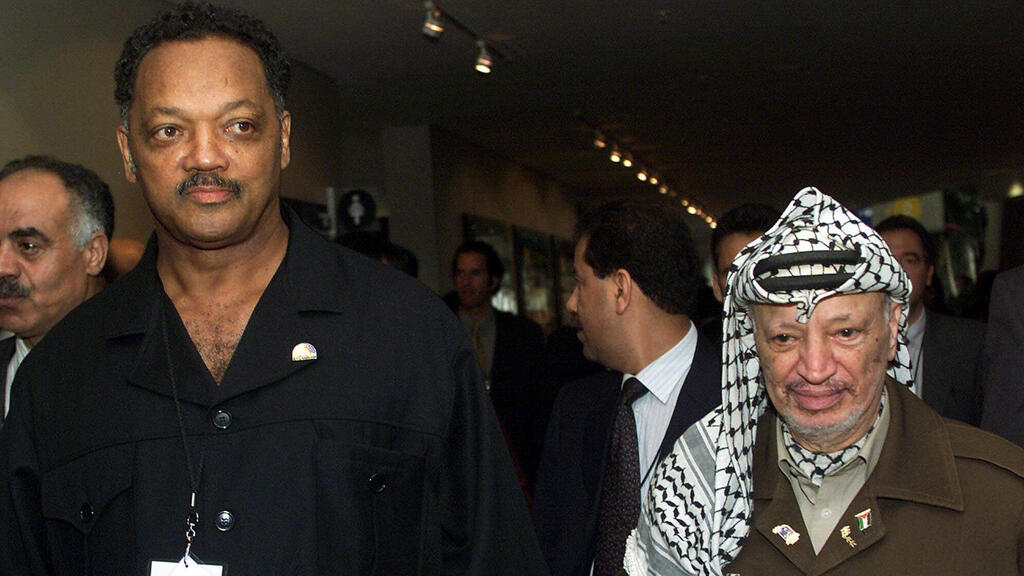
Jesse Jackson with Yasser Arafat
(Photo: AP/ Jose Goitia)
Known for his charisma and powerful oratory, Jackson twice sought the Democratic presidential nomination, running in the party's primaries in 1984 and 1988. Although neither campaign secured him the nomination, his candidacies helped reshape American politics and broaden the coalition of voters participating in Democratic primaries. In 2008, Jackson was seen weeping during celebrations of Barack Obama's historic election as the first Black president of the United States.
In 1984, Jackson received 3.3 million votes in the Democratic primaries, representing 18% of the total, and finished third. His campaign lost momentum after he faced accusations of antisemitism over a private conversation in which he referred to Jews using the derogatory term "Hymies" and called New York City "Hymietown." He later apologized for the remarks. Four years later, he ran a more successful campaign, finishing second in the Democratic primaries with 6.8 million votes, or 29% of the total.