

This week marked three years since the worst massacre in the history of the State of Israel. As the anniversary is commemorated, a familiar demand has returned to the public debate: that someone among those who bear political responsibility for what happened stand up and say, "I have sinned, I have done wrong, I have transgressed."
Is that a reasonable expectation? Or is the demand for an admission of responsibility merely an unnecessary obsession?
Gallery

Adam's response: ‘I ate, but it wasn't my fault; I'm not responsible or to blame’
(Photo: Valentyn Volkov / Shutterstock)
This week's Torah portion, Bereshit (Genesis), which will be read in synagogues on Shabbat, addresses precisely this question.
The biblical account of creation reaches its climax with the creation of humanity, the crowning achievement of God's work. According to the Torah, God tells Adam that the world has been placed at his disposal. He may eat from and make use of everything, with one exception: the Tree of Knowledge, whose fruit he is forbidden to eat.
Then the serpent appears, tempting Eve, Adam's partner, to eat the forbidden fruit. She does so and gives some to Adam, who also eats it.
God asks Adam: "Have you eaten from the tree that I commanded you not to eat from?"
Adam's first response was to blame someone else
There are only two possible answers to that question: yes or no. But Adam chooses neither.
Instead, he replies: "The woman whom You gave to be with me, she gave me fruit from the tree, and I ate."
Was Adam lying? Absolutely not. Was his account factually accurate? Yes. But something essential was missing from his answer: accepting responsibility.
He acknowledges that he ate the fruit, but in the original Hebrew, nine words pass before he finally admits it.
In effect, Adam is saying: Yes, I ate, but it wasn't really me. I'm not responsible, and I'm not to blame. It was the woman You, God, gave me who handed me the fruit.
Our sages made a striking observation about this episode, describing Adam as someone who denied a fundamental principle of faith.
Later commentators questioned how they could reach such a conclusion, since the biblical account contains no explicit evidence that Adam rejected belief in God. One medieval scholar, Rabbeinu Hananel, went so far as to argue that anyone who believed Adam was a heretic would ultimately have to answer for making such an accusation.
Nevertheless, something about Adam's behavior clearly troubled the sages enough to provoke such forceful criticism.
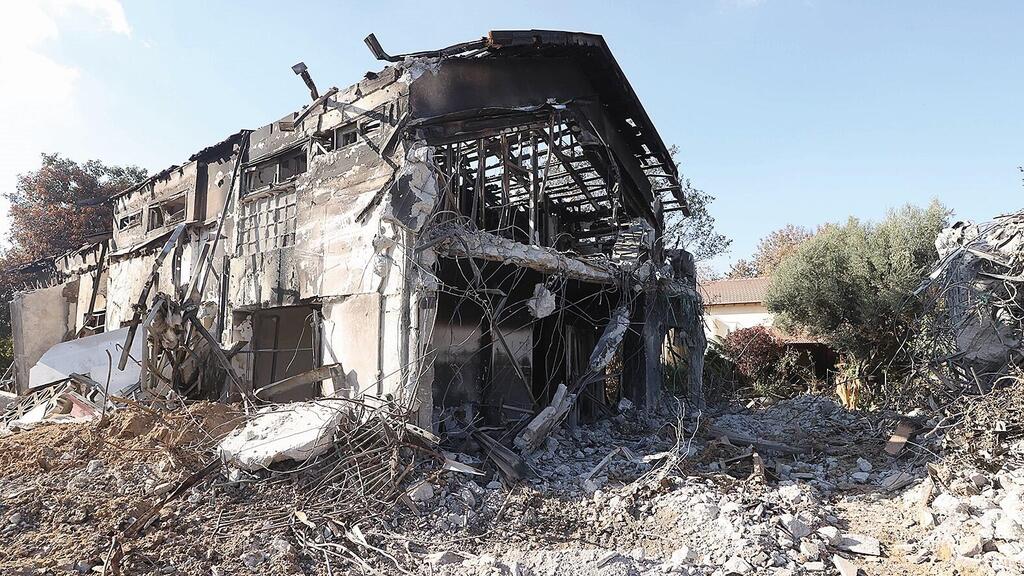
Destruction in Nir Oz following the October 7 massacre
(Photo: Gadi Kabalo)
Perhaps what disturbed them was his ingratitude toward God. Rather than expressing gratitude for the woman he had been given, Adam complained about her.
But I believe the central problem with Adam's response is far more serious: he simply refuses to take responsibility for his actions.
This is not a minor moral failing. It strikes at the very essence of human existence and at what distinguishes human beings from animals.
Adam was asked whether he had eaten the forbidden fruit. His answer should have been simple: Yes, I ate it. I am responsible for disobeying Your command.
How did it happen? Why did he do it? Those explanations might have served as mitigating circumstances. But before anything else, he needed to acknowledge that he had failed.
Recognizing wrongdoing and confessing it are fundamental elements of teshuvah, the Jewish process of repentance.
The entire observance of Yom Kippur begins with our willingness to say, "We are guilty."
That principle applies to every individual. When it comes to leadership, however, it becomes even more important.
Why Saul lost his throne and David kept his
Two great leaders emerged during the early years of the Israelite monarchy: King Saul and King David.
Saul was removed from his position after failing to complete the campaign against Amalek as he had been commanded.
David, by contrast, retained his kingship, and his descendants continued to rule, despite the Bible attributing more transgressions to him than to Saul.
Our sages recognized this apparent contradiction and expressed it in a famous teaching: "Saul sinned once, and it cost him; David sinned twice, but it did not cost him."
In other words, one transgression led to Saul's removal, while David committed two and was not deposed.
Why?
The difference between the two leaders is evident in the way they responded to their failures.
Saul explained his disobedience by saying that "the people spared the best of the sheep and cattle."
It wasn't me, he was effectively saying. It was the people.
David responded differently.
When the prophet Nathan confronted him with the parable of the poor man's lamb, David's answer was immediate and unequivocal: "I have sinned against the Lord."
The transgression itself is not necessarily grounds for removing a leader from office. On the contrary, almost every prominent leader in Jewish history, from Moses to David, experienced failures and made mistakes.
What matters is how a leader responds to those failures.
Our sages went even further, arguing that Judah's willingness to acknowledge his wrongdoing in the episode involving Tamar helped establish his descendants' claim to kingship.
The Talmud recounts a question posed by students to Rabbi Tarfon in Yavneh: "Why did Judah merit kingship?"
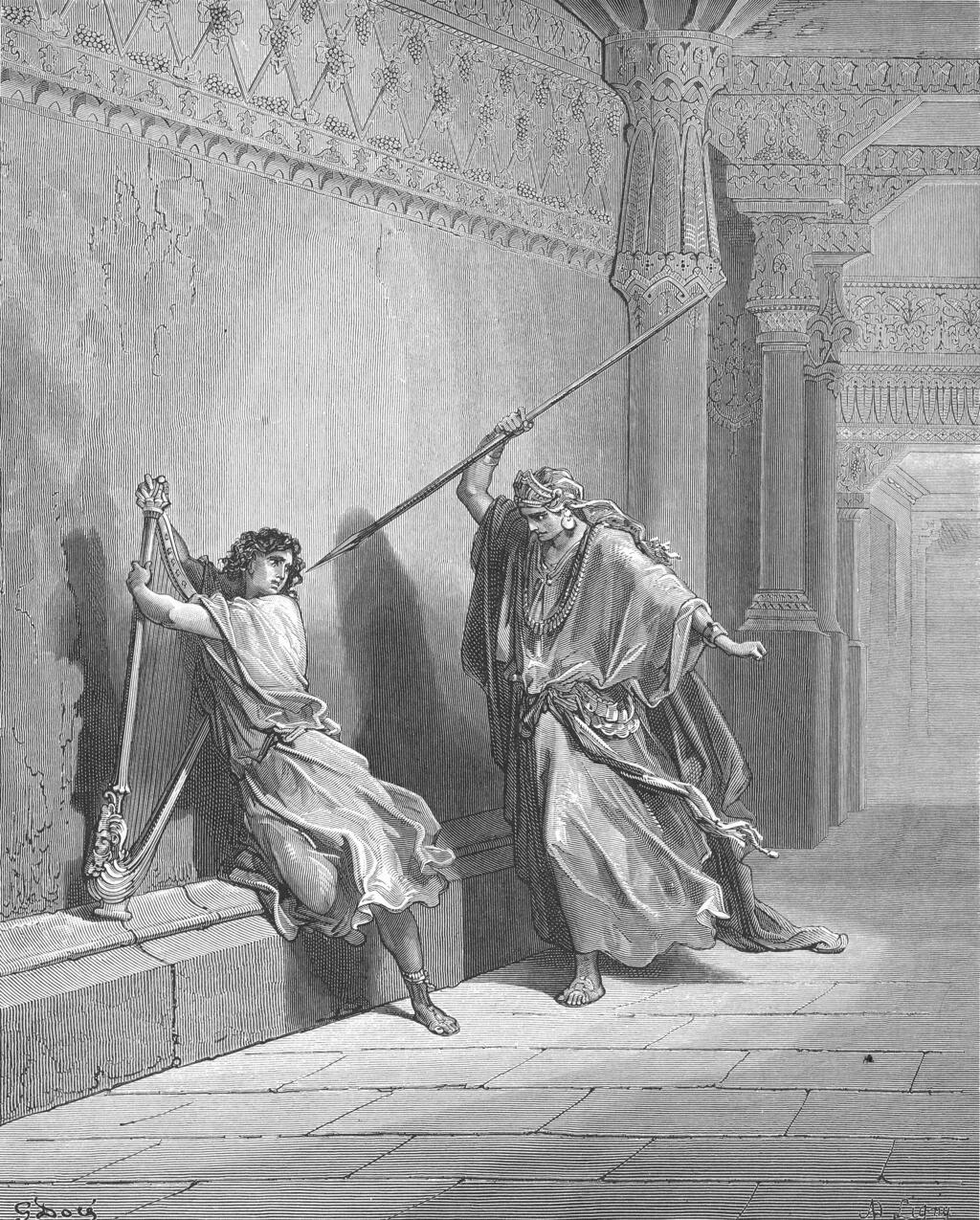
Saul attempts to kill David, an engraving by Gustave Doré
His answer was simple: "Because he acknowledged his actions in the matter of Tamar."
The reasoning behind this principle is straightforward.
Someone who refuses to acknowledge a mistake cannot learn from it.
As far as that person is concerned, nothing went wrong because of anything they did. The responsibility lies elsewhere, with other people. And if there was no personal mistake, there is nothing to correct.
The king who lost his throne was the one who could not bring himself to say, "I have sinned."
Instead of accepting responsibility, he shifted the blame in every possible direction, toward others around him, the people and his military commanders. Anyone, it seemed, could be held responsible except the person who actually bore responsibility.
Jewish tradition begins with accepting responsibility
The story of Adam is not some obscure detail buried in the Bible.
It expresses one of the central principles around which Jewish religious and moral tradition has revolved from the creation of humanity to the present day.
That principle is personal responsibility.
It demands that we recognize our actions, acknowledge our failures, experience genuine remorse and commit ourselves to behaving differently in the future.
These are not optional stages of repentance. They are its very foundation.
This is why the expectation that Israel's political leaders acknowledge their responsibility for the failures surrounding October 7 is neither excessive nor obsessive.
It reflects something deeply rooted in our religious and moral heritage.
A person who cannot admit wrongdoing cannot truly repent. And a leader who refuses to recognize failure cannot learn from it or ensure that it will not happen again.
Accepting responsibility, expressing remorse and committing to change are inseparable.
There is no way to skip any of these steps.