


In Jewish tradition, the holiday of Sukkot is closely associated with the commandment of hospitality, known in Hebrew as hachnasat orchim. This connection stems from an ancient passage in the Zohar, a foundational Kabbalistic text, which teaches that on each day of the holiday, seven ushpizin—Aramaic for "guests"—visit every sukkah. In most Jewish communities around the world, there is a liturgical tradition of inviting a specific guest each day—Abraham, Isaac, Jacob, Moses, Aaron, Joseph and David.
“What’s fascinating,” says Jewish studies scholar Elyasaf Tel-Or, “is that the same Zoharic passage that speaks about inviting the ushpizin also says the poor must be invited to the sukkah. It warns that if someone does not invite the poor, the ushpizin themselves will not enter his sukkah.”

Tel-Or is deputy director of the Meitarim educational network and a lecturer in Herzog College’s teacher training program for inclusive religious education. He explains that “the essence of hospitality, not only on Sukkot but year-round, is not just about hosting. It’s about surrendering the basic human instinct to claim something as one’s own.”
He elaborates: “In some ways, hospitality is tied to commandments that may seem unrelated—like shmita, the sabbatical year, when every seventh year a person is forbidden to work their land, and whatever grows is considered ownerless, free for the poor to take. The common thread is the surrender of ownership. The Torah is saying: You are not the master of your possessions. These commandments are meant to open us up to the existence of the other, and that is what makes hospitality possible.”
Hospitality as a manifestation of the divine
The commandment of hospitality appears twice early in the Book of Genesis. The first instance is Abraham welcoming three angels to his tent—messengers who will later tell him of Isaac’s impending birth. The second is Lot, Abraham’s nephew, who hosts the angels in his home in Sodom, risking his life in the process.
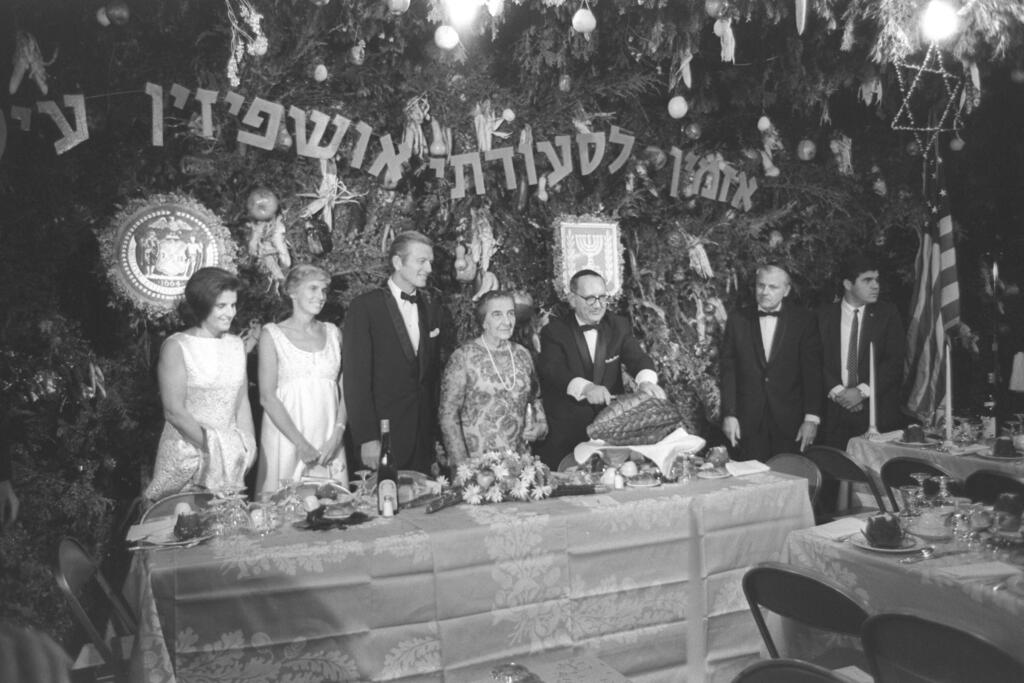
Prime Minister Golda Meir and other dignitaries attend a Sukkot celebration in Brooklyn, 1969
(Photo: Moshe Milner/GPO)
“What stands out to me,” says Tel-Or, “is what Abraham says when he sees the guests: ‘My lord, if now I have found favor in your sight, please do not pass by your servant’ (Genesis 18:3). This can be read as a greeting to the guests, but it can also be understood as a moment of divine encounter—Abraham saying to God, ‘Stay with me while I tend to others.’ But I have a more radical interpretation: that the deeper idea behind hospitality is the revelation of the Divine Presence.”
Belief in God, Tel-Or says, is not about pointing to something and declaring it divine. “It’s the recognition that I am not the owner. When I experience that kind of humility in the face of the world and reality, I become available to truly encounter and host the other under my roof.”
This is significant, he notes, because according to rabbinic interpretation, Abraham did not know the guests were angels. To him, they were strangers—neither kin nor members of his tribe, and certainly not Jews. “A person who is ‘full of himself’ may host others out of goodwill. But on a basic level, people tend to prioritize family, then tribe. That’s not the Torah’s idea of hospitality. The Torah wants us to break down that self-centeredness. When you let go of those labels, you can extend that hospitality to every human being you meet. That, to me, is the core message of the Abraham story.”

President Yitzhak Ben-Zvi raises a glass during a Sukkot reception, joined by Prime Minister Levi Eshkol and Chief Rabbi Yitzhak Nissim, 1967
(Photo: Fritz Cohen/GPO)
Lot’s act of hospitality, Tel-Or adds, came with real danger to himself and his daughters. “True, and the Torah is not recommending that behavior as a model. But Lot’s actions continue Abraham’s message: that hospitality is so powerful and important it can override the natural hierarchy where protecting your home, your children, your tribe comes before hosting others. Here, the order is reversed.”
When non-Jews peer inside
To illustrate just how central hospitality is in Jewish tradition, Tel-Or cites a passage from the Mishnah in Tractate Bava Metzia (7:1):
"There was an incident involving Rabbi Yochanan ben Matya, who said to his son: 'Go out and hire laborers for us.' His son went, hired them and pledged to provide sustenance for them as a term of their employment, without specifying the details. And when he came back to his father and reported what he had done, Rabbi Yochanan ben Matya said to him: 'My son, even if you were to prepare a feast for them like that of King Solomon in his time, you would not have fulfilled your obligation to them, as they are the descendants of Abraham, Isaac and Jacob. Rather, before they begin engaging in their labor, go out and say to them: 'The stipulation that food will be provided is on the condition that you have the right to claim from me only a meal of bread and legumes, which is the typical meal given to laborers.''"
“At first glance, this halachah seems very odd,” Tel-Or observes. “Why should someone hiring day laborers need to clarify that they’ll only be getting a basic meal, not a lavish one? Why would the workers assume otherwise? The answer lies in a deep-rooted Jewish mindset: when someone is hosted in your home, the expectation is to treat them with such dignity that you offer them a king’s feast. If that’s not what you’re offering, you must say so explicitly.”

A sukkah
(Photo: Tomertu / Shutterstock)
Tel-Or adds another element often overlooked: “Hospitality isn’t only about feeding and providing drink. Jewish law also requires accompanying the guest when they leave. Even if you hosted them generously, the obligation doesn’t end at the door. You don’t just shut the door and think, ‘I’ve done my part.’ The halachah says you must walk them out, just as one might escort a family member to the bus or train station. The guest—who may not be family, tribe or even Jewish—is treated as a relative, someone you do not part from at the threshold, but accompany on their way.”
Sukkot, Tel-Or notes, commemorates the Israelites’ time dwelling in booths after the Exodus from Egypt. The Book of Deuteronomy instructs that the sukkah should also be open to those on the margins of society, similar to the ethos of the Passover Seder: “You shall rejoice in your festival, with your son and daughter, your male and female slave, the [family of the] Levite, the stranger, the fatherless and the widow in your communities.” (Deuteronomy 16:14).
“In other words,” he says, “the Torah obligates us to care for the vulnerable during the holidays—including the non-Jew who lives among us. A powerful example of this appears in art. In my book Reading Between the Images, which explores Jewish tradition through visual art, I highlight many paintings that shed light on Jewish life. One painting, though not in the book, is by Moritz Daniel Oppenheim, one of the great Jewish painters of the modern era. Painted in 1867, it shows non-Jewish neighbors peering into a sukkah, curious to glimpse Jewish life.”
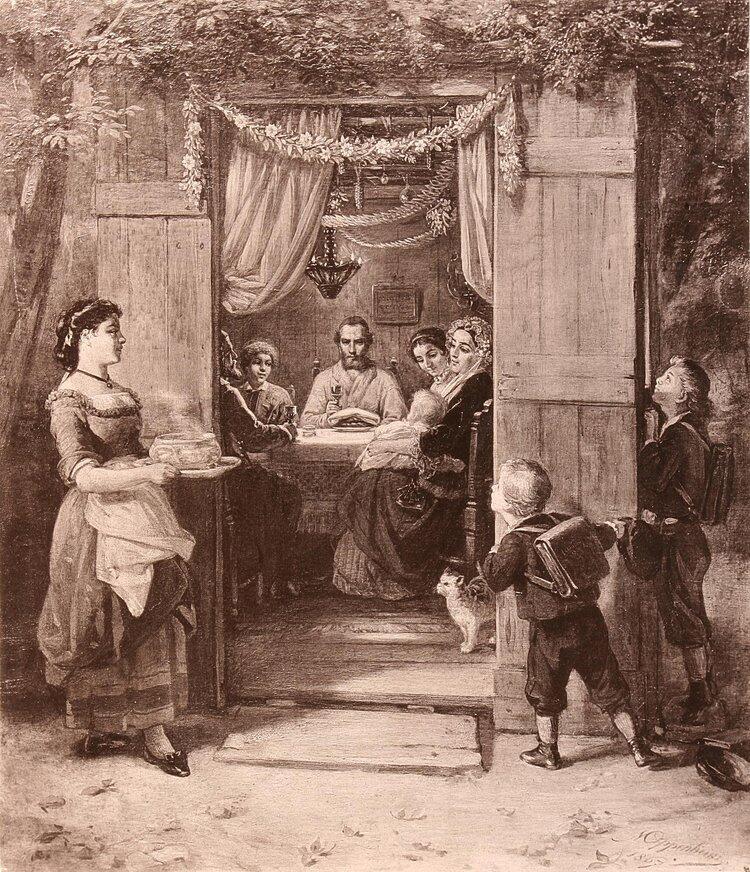
Sukkot - a painting by Moritz Daniel Oppenheim, 1867
What’s so unusual about that?
“A Midrash says Abraham hosted the angels in his sukkah. But halachic literature later wrestles with the question of whether non-Jews may even enter a sukkah. Oppenheim’s painting highlights a tension between traditional halachic rulings—primarily in the Talmud and early legal codes—and the Zohar and later halachic rulings, especially among Sephardic authorities influenced by Kabbalah. The image of non-Jews peering into the sukkah points to a reality of interaction between Jews and their non-Jewish neighbors, in contrast to certain mystical or legal interpretations that discouraged it. Often, art reveals more about Jewish life than intended, and helps fill in the gaps left by rabbinic literature.”
Tel-Or continues: “We’ve mentioned hospitality in both Sukkot and Passover. In the Sarajevo Haggadah, created in 14th-century Barcelona, there’s an illustration of a Passover Seder showing a dark-skinned non-Jewish woman at the table. Maybe she converted—but it’s also possible she was a servant in the Jewish household, and they invited her to join them. Another 17th-century painting by Emanuel de Witte shows the Portuguese Synagogue in Amsterdam. At the edge of the synagogue, men and women stand together, even with dogs at their feet.”

Interior of the Portuguese Synagogue in Amsterdam - a 17th-century painting by Emanuel de Witte
Who were these people?
“Academic research shows that in those days, it was common for Christians to visit Jewish synagogues in the Netherlands to observe the services. They didn’t participate, nor did they intend to convert. They simply wanted to catch a glimpse of Jewish life.”
So what’s the takeaway from all this in relation to Sukkot?
“The very act of going outside to dwell in a sukkah—and the tradition of hospitality and inviting ushpizin—sends a message. On one hand, we are called to step beyond our boundaries and be open to encounters with those different from ourselves. Hosting and being hosted by one another—all tribes, all communities—including those not of the Jewish people. On the other hand, halachah insists the sukkah have sturdy walls, able to withstand an ordinary wind. This symbolizes the need to preserve our own identity even as we meet others, maintaining distinctions without erasing them.”